5.3 TRANSITION METALS
No description yet. This curated deck is ready for daily study.
Card preview (24)
State the two types of precipitation reactions transition metals can undergo
1) Sodium hydroxide + transition metal 2) Ammonia + transition metal
State the colour of Cu2+ / Copper solution
• Blue
State the colour of Fe2+ / Iron(II) solution
• Green
State the colour of Fe3+ / Iron(III) solution
• Yellow
State the colour of Mn2+ / Manganese solution
• Pink
State the colour of Co2+ / Cobalt solution
• Pink
State the colour of Cr3+ / Chronium solution
• Green
State the observation of Cu2+ with dropwise then excess aqueous NaOH/ Sodium hydroxide
• Blue precipitate forms • no change with excess NaOH
State the observation of Fe2+ with dropwise then excess aqueous NaOH/ Sodium hydroxide
• Green precipitate forms • No change with excess NaOH
State the observation of Fe3+ with dropwise then excess aqueous NaOH/ Sodium hydroxide
• Brown precipitate forms • No change with excess NaOH
State the observation of Mn2+ with dropwise then excess aqueous NaOH/ Sodium hydroxide
• Brown precipitate forms • No change with excess NaOH
State the observation of Co2+ with dropwise then excess aqueous NaOH/ Sodium hydroxide
• Blue precipitate forms • No change with excess NaOH
State the observation of Cr3+ with dropwise then excess aqueous NaOH/ Sodium hydroxide
• Green precipitate forms • Precipitate dissolves in excess NaOH
State the observation of Cu2+ with dropwise then excess aqueous NH3/Ammonia
• Blue precipitate forms • Deep blue solution forms with excess NH3
State the observation of Fe2+ with dropwise then excess aqueous NH3/Ammonia
• Green precipitate forms • No change with excess NH3
State the observation of Fe3+ with dropwise then excess aqueous NH3/Ammonia
• Brown precipitate forms • No change with excess NH3
State the observation of Mn2+ with dropwise then excess aqueous NH3/Ammonia
• Brown precipitate forms • No change with excess NH3
State the observation of Co2+ with dropwise then excess aqueous NH3/Ammonia
• Blue precipitate forms • No change with excess NH3
State the observation of Cr3+ with dropwise then excess aqueous NH3/Ammonia
• Green precipitate forms • Purple solution forms with excess NH3
Define transition element
• A d-block element that has an incomplete d-sub-shell when a stable ion
State the two elements are not classed as a transition element/metal
• Zinc Zn2+ • Scandium Sc3+
State the electron configuration to explain why scandium 3+ is not a transition element/metal
• Scandium’s d-orbital is empty

State the electron configuration to explain why zinc 2+ is not a transition element/metal
• Zinc’s d-orbital is full/complete

Give two examples of transition metals as catalysts
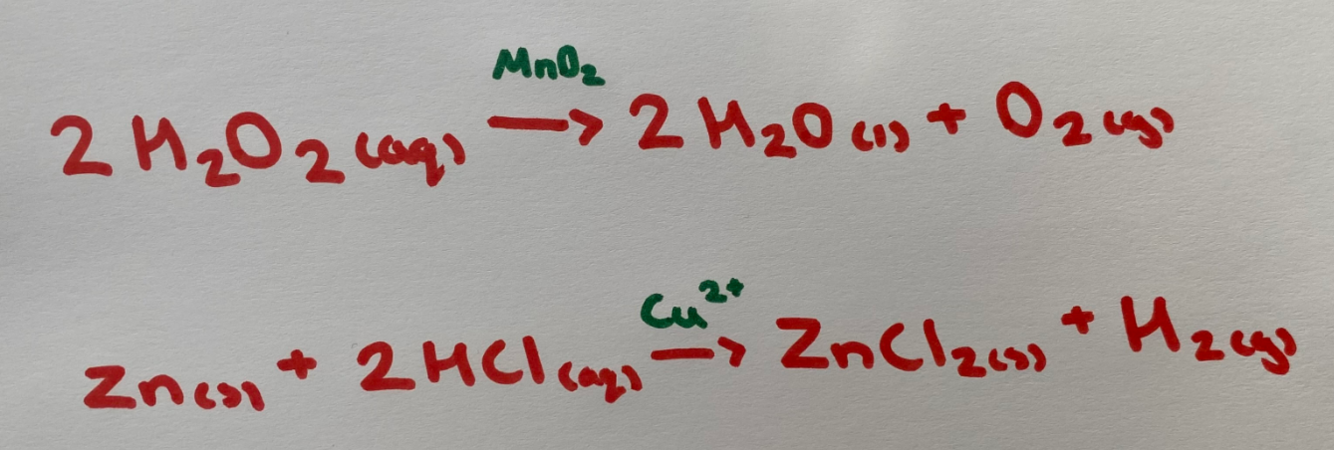
1) MnO2 catalyses the decompostion of H202 2) Cu2+ catalyses the reaction of Zn with acids