6.5 Neuron Synapse
No description yet. This curated deck is ready for daily study.
Card preview (7)
Nervous System
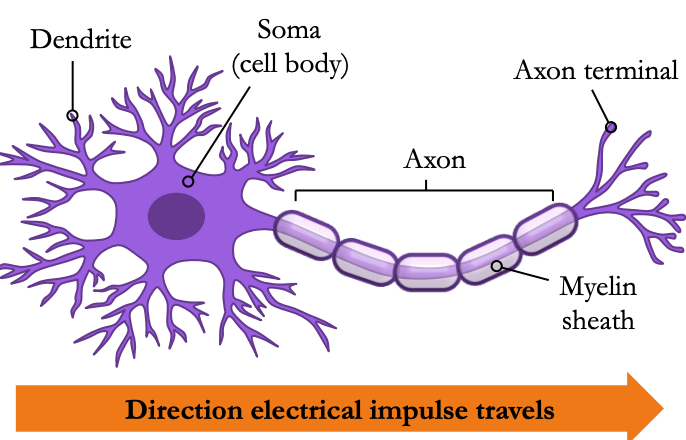
The nervous system consists of two main divisions: * Central nervous system (CNS) = brain and spinal cord * Peripheral nervous system (PNS) = peripheral nerves The nervous system is composed of specialised cells called neurons that function to transmit electrical signals The CNS coordinates sensory & motor signals from the PNS * Sensory neurons send signals to the CNS (afferent pathway) * Motor neurons send signals from the CNS (efferent pathway) * Relay neurons (interneurons) send signals within the CNS
Structure of Motor Neuron
Dendrite Soma (cell body) Myelin sheath Axon Axon terminal
Membrane Potentials
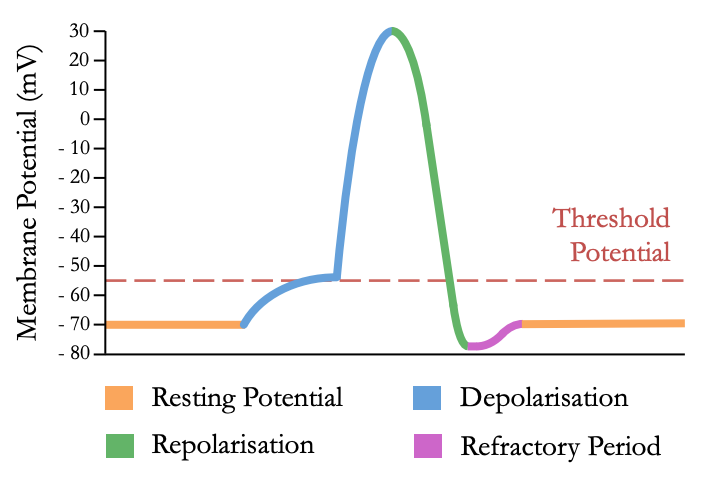
Neurons have a difference in charge across their membranes due to the distribution of positively-charged ions (Na+ / K+) Electrical signals are created by changing membrane polarity * Polarity of a neuron at rest is the resting potential (-70mV) * Polarity of a firing neuron is the action potential (+30mV)
Nerve Impulses
The resting potential is maintained by a Na+/K+ pump * It exchange sodium ions (3 out) and potassium ions (2 in) so that the membrane potential becomes slightly negative An action potential changes the resting membrane potential * The opening of sodium channels causes a sodium influx * This creates a positive membrane potential (depolarisation) * Opening potassium channels causes a potassium efflux * This restores a negative membrane potential (repolarisation) The ion distribution must be restored to original conditions before a neuron can fire again (this is the refractory period)
Myelination
Nerve impulses are action potentials propagated via axons * Action potentials are ‘all or none’ and are only propagated if a certain threshold potential is reached (~ -55mV) In certain neurons, the axon is covered by a myelin sheath * This enables saltatory conduction (⇧ transmission speed) * The action potential ‘hops’ between gaps in the myelin sheath (called nodes of Ranvier) for faster transmission
Synaptic Transfer
Synapses are the physical junctions between two neurons * Electrical impulses cannot cross these physical gaps Neurons release neurotransmitters into the synapse cleft * Depolarisation in axon terminals opens Ca2+ channels * Ca2+ influx causes vesicles containing neurotransmitters to release their contents into the synapse (via exocytosis) * Neurotransmitters bind receptors on post-synaptic cells and generate graded potentials (excitatory or inhibitory) * The summation of these graded potentials determines if the post-synaptic neuron (or effector cell) is activated
Neonicotinoid Pesticides
Acetylcholine is a neurotransmitter used in CNS and PNS * It is broken down in synapses by acetylcholinesterase * This prevents the overstimulation of the receptors Neonicotinoid pesticides irreversibly bind to acetylcholine receptors and cannot be digested by acetylcholinesterase * Insects have higher levels of these types of receptors * This makes neonicotinoids highly effective pesticides