M3 Rates of Reaction Q&A
No description yet. This curated deck is ready for daily study.
Card preview (8)
Explain the effect of increasing concentration (of solution) on the rate of reaction
• More particles / molecules per unit volume • More frequent successful collisions • Rate increases
Explain the effect of increasing pressure (of gas) on the rate of reaction
• More particles / molecules per unit volume • More frequent successful collisions • Rate increases
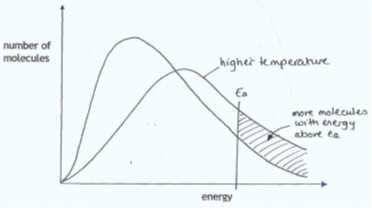
Using Boltzmann distribution diagrams, explain the effect of an increase in temperature on the rate of reaction
• (As temperature increases) there is a greater proportion of molecules with energy greater than or equal to the activation energy (as shown by the increased shaded area on the graph) • More frequent successful collisions • Rate of reaction increases
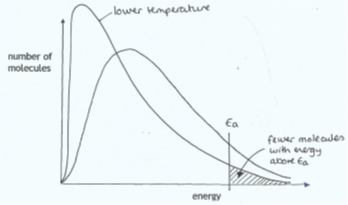
Using Boltzmann distribution diagrams, explain the effect of a decrease in temperature on the rate of reaction
• (As temperature decreases) there is a smaller proportion of molecules with energy greater than or equal to the activation energy (as shown by the decreased shaded area on the graph) • Less frequent successful collisions • Rate of reaction decreases
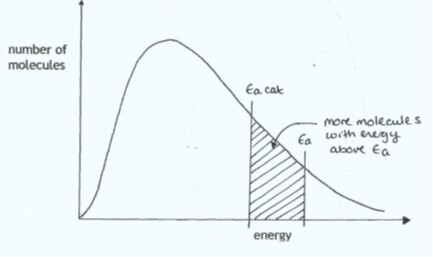
Using a Boltzmann distribution diagram, explain the effect of adding a catalyst on the rate of reaction
• (With a catalyst) the activation energy is lower • There is a greater proportion of molecules with energy greater than or equal to the activation energy (as shown by the increased shaded area on the graph) • More frequent successful collisions • Rate of reaction increases
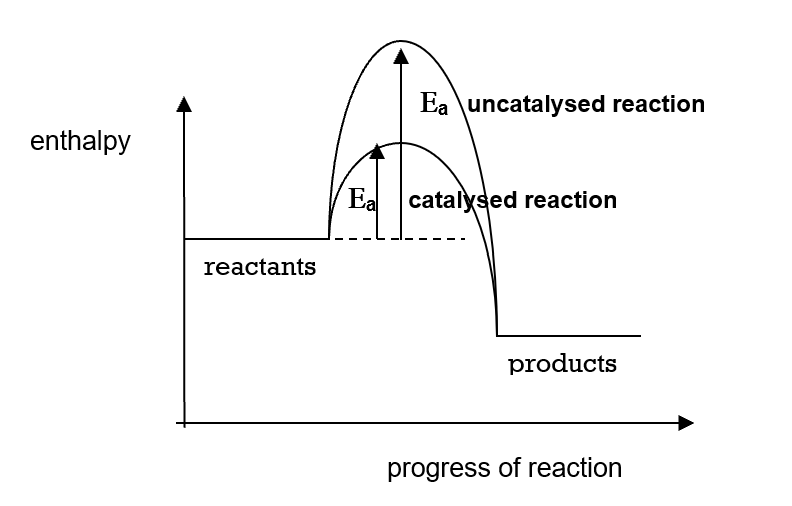
Using an enthalpy profile diagram, explain the effect of adding a catalyst to the rate of reaction
• (With a catalyst) the activation energy is lower • There is a greater proportion of molecules with energy greater than or equal to the activation energy • More frequent successful collisions • Rate of reaction increases
State the benefits of using catalysts in industry
• Lower energy demand: lower temperature can be used, which reduces CO2 emissions / burning fossil fuels • (Different reactions could be used with) higher atom economy
State the benefits of using enzymes to catalyse reactions
• Lower energy demand: lower temperature can be used, which reduces CO2 emissions • Enzymes are very specific • Higher atom economy • Less use of toxic reactants / solvents