3 - Physical chemistry (a) Energetics
No description yet. This curated deck is ready for daily study.
Card preview (10)
What is a chemical reaction where heat energy is given out described as?
An exothermic reaction
What is a chemical reaction where heat energy is taken in describes as?
An endothermic reaction
EXPERIMENT: How would you calculate the temperature rise of the reaction between Magnesium and Copper (II) Sulphate? (Method)
• 50 cm3 of copper(II) sulfate is measured and transferred into a polystyrene cup. • The initial temperature of the copper sulfate solution is measured and recorded. • Magnesium is added and the maximum temperature is measured and recorded. • The temperature rise is then calculated.
EXPERIMENT: What are the products of the reaction between Magnesium and Copper (II) Sulphate?
Magnesium Sulphate and Copper (Displacement Reaction)
What is the equation to work out the amount of energy transferred in a reaction?
Q = mc△T Q = Amount of energy transferred (J) m = Mass of solution being heated (g) c = Specific heat capacity (J/g/°C) △T = Temperature change (°C)
What is the specific heat capacity of water?
4.18 J/g/°C
Why do experiments use polystyrene cups?
Polystyrene is an insulator and so heat is lost slower to the environment and the result is more accurate.
How can this experiment be improved to give a more accurate reading?
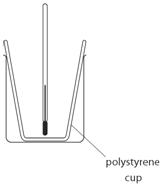
If a lid is put on the polystyrene cup/beaker because it will reduce heat loss.
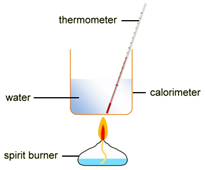
EXPERIMENT: How would you measure the amount of energy produced when a fuel is burnt.
• The initial mass of the ethanol and spirit burner is measured and recorded. • 100cm3 of water is transferred into a copper container and the initial temperature is measured and recorded. • The burner is placed under of copper container and then lit. • The water is stirred constantly with the thermometer until the temperature rises by, say, 30 oC • The flame is extinguished and the maximum temperature of the water is measured and recorded. • The burner and the remaining ethanol is reweighed.
What is the equation to calculate molar enthalpy change?
ΔH = Q / n ΔH = Enthalpy change (J/mol) Q = Heat energy (J) n = Moles (mol)