Chapter 11: Addition Reactions
No description yet. This curated deck is ready for daily study.
Card preview (24)
What is the outcome of this reaction?
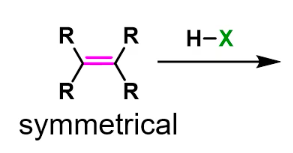
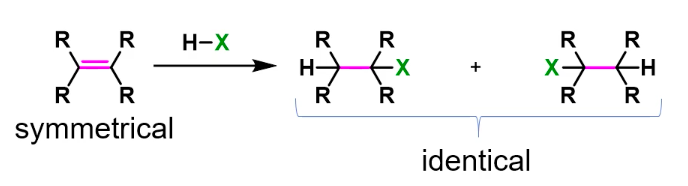
What is the regiochemistry of this molecule?
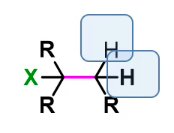
Markovnikov product/addition
What is the regiochemistry of this molecule?
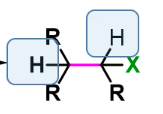
Anti-markovnikov product/addition
What is the stereochemistry of this molecule?
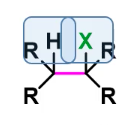
Syn
What is the stereochemistry of this molecule?
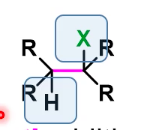
Anti
What are the products of this reaction if they are Markovnikov and syn
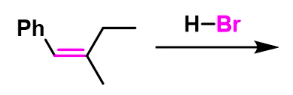
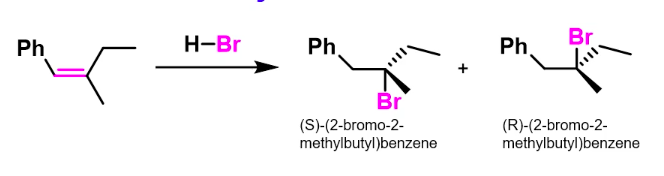
What are the products of this reaction if they are anti-markovnikov and syn?
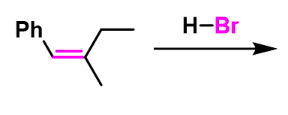
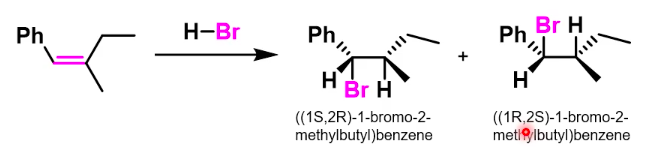
What are the products of this reaction if they are anti-markovnikov and anti?
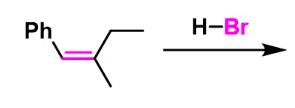
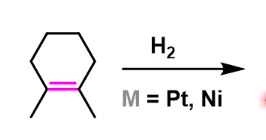
What is the regiochemistry and stereochemistry of a H2 (H-H) addition reaction?

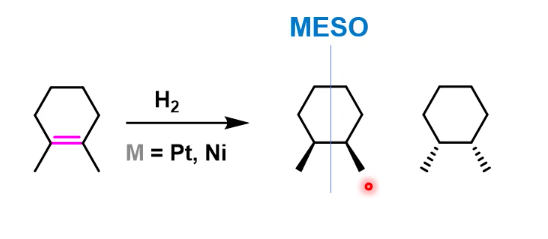
What is the outcome of this reaction?
Meso because there is a plane of symmetry
What is the outcome of this reaction?
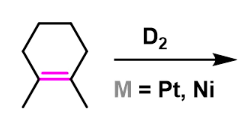
Have to show D atoms
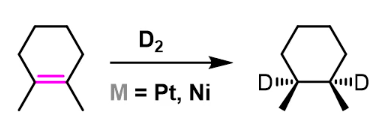
What is the outcome of this reaction?
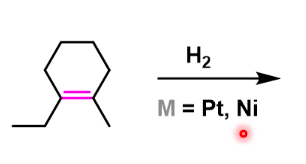
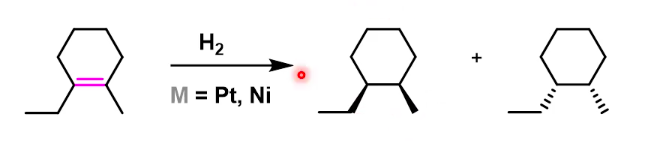
results in enantiomers
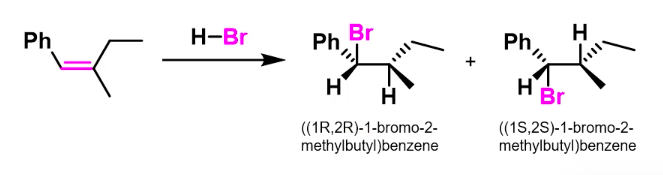
What is the regiochemistry and stereochemistry of H-Halogen addition reactions?

What is the mechanism of H-Halogen addition reactions?
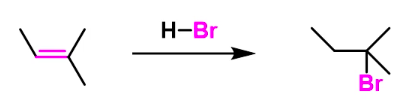
Carbocation forms on the more substituted carbon because it is more stable. The halogen then acts as a nucleophile to attack the carbocation forming a Markovnikov addition.
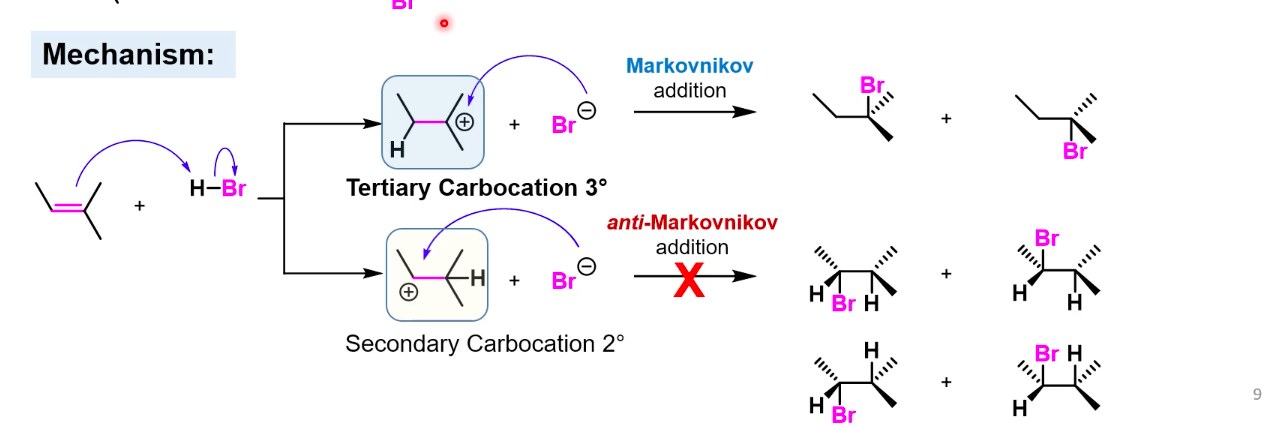
What is the mechanism of this H-Br addition reaction?
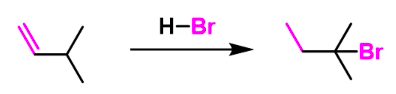
There is a carbocation rearrangement to stabilize the secondary carbocation, creating a tertiary carbocation. Br then acts as a nucleophile and attacks the tertiary carbocation, forming a markovnikov addition.
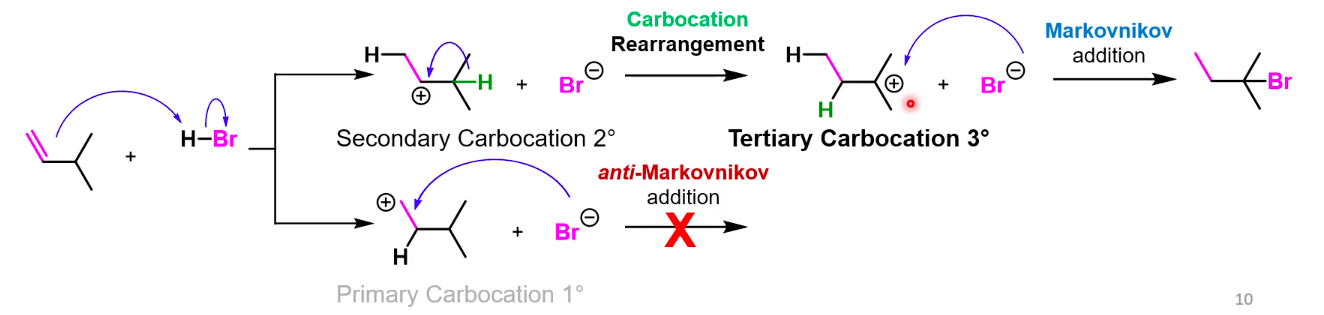
What is the mechanism of this H-Br addition reaction?
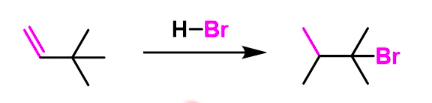
Alkyl migration occurs to make the secondary carbocation a tertiary carbocation so it is more stable.
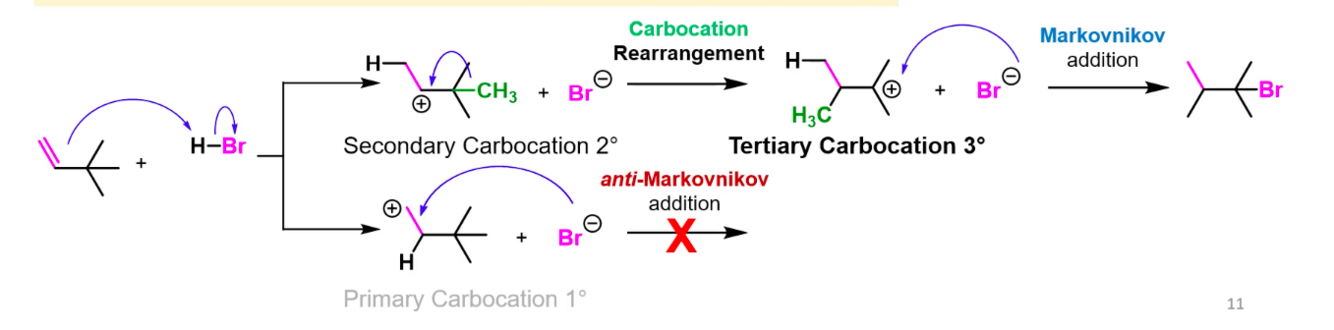
What will cause a H-Halogen addition reaction to be anti-Markovnikov?
Adding peroxide (ROOR) as a reagent in the reaction

What is the mechanism when H-Halogen, ROOR are used in an addition reaction?
RO OR are broken homolytically (each oxygen keeps their shared electron) in the presence of light or heat. The radical RO obstructs H, H-Br bond breaks, forming radical Br which attacks the less substituted carbon so the radical can be transferred to the tertiary carbon (more stable). The radical tertiary carbon is then abstracts a H from H-Br to from an anti-markovnikov addition with 2 enantiomers.
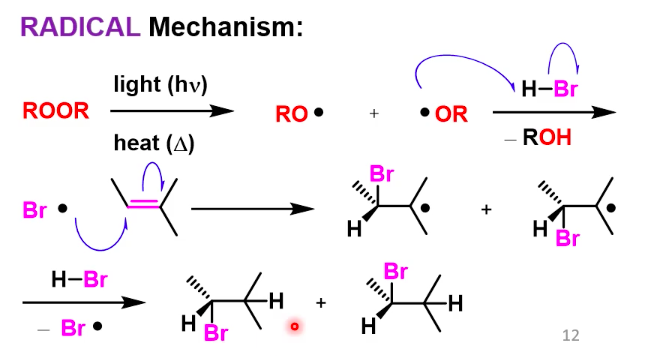
What is the regiochemistry and stereochemistry of H and OH addition reactions?

Why is a different arrow used for radical reactions?
Represents the movement of 1 electron
What is the mechanism of this reaction?
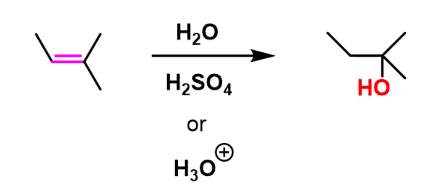
Pi bond extracts H from H3O+ and the H-OH bond is broken to from a tertiary carbocation (more stable) plus water. H2O then acts as a nucleophile and attacks the tertiary carbocation. The new molecule formed has a + charge on H2O, so another H2O extracts an H forming an OH markovnikov addition.
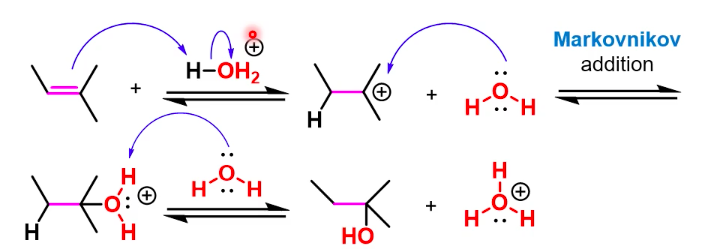
Why are two arrows used in this reaction?
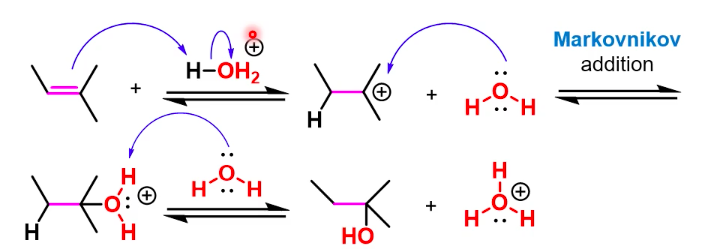
The reverse of the reaction is an E1 elimination reaction (H2O in the presence of acid creates a good LG)
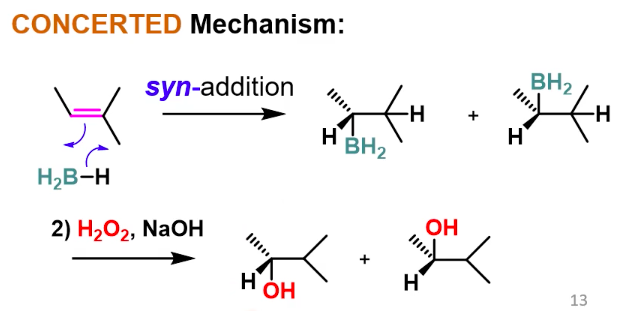
What are the reagents used to make a H and OH addition reaction anti-markovnikov and syn?

What is the mechanism used to make a H and OH addition reaction anti-markovnikov and syn?
Borane (BH3) does not have an octet (empty p orbital but no positive charge) making it very reactive. The solvent THF can donate electron density into the empty p orbital of borane to help stabilize it. However, borane still looks for areas of electron density (in this case the Pi bond which attacks the empty p orbital of borane and triggers a hydride shift). Borane ends up on the less substituted carbon because it is bulkier and is sterically hindered. An oxidation reaction with H2O2 and NaOH then occurs that replaces the borane with OH (see page 196 in textbook)