Exam 2
No description yet. This curated deck is ready for daily study.
Card preview (24)
Central Dogma
Crick DNA –transcription–> RNA –translation–> protein
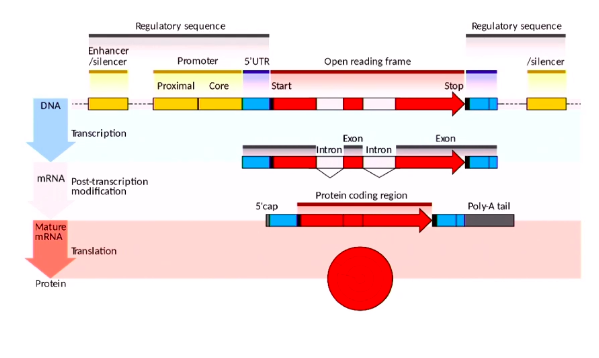
gene structure
promoter: initiates expression 5’UTR: regulates gene expression open reading frame: RNA information (introns and axons)
mRNA: location and function
functions in nucleus, migrates to ribsomes carries DNA sequence info to ribosomes
tRNA: location and function
functions in cytoplasm provides linkage b/w mRNA and AAs, transfers AAs to ribosomes
ribosomal RNA/rRNA: location and function
functions in cytoplasm structural component of ribosomes
post transcription regulation: how are eukaryotic genes segmented?
enzymes cut out introns exons spliced together to make mRNA more than 90% of pre-mRNA is destroyed (introns)
alternative splicing
single gene can code for multiple proteins by mixing and matching exons
mutations occurs as ____ and cause changes in the _____
random chance events, DNA sequence
if mutations occur in ____, then ____
gametes, they can be passed onto offspring
mutations may be caused by ____
exposure to toxins or radiation (mutagens) others lead to variations that are good for organism to adapt to environment
two kinds of gene mutations
• Gene mutations: • Single gene • Substitution, stop, inversion, insertion, and deletion • Chromosomal mutations: • Abnormal chromosome structure (affects multiple genes) • Substitution, stop, inversion, insertion, deletion, and translocation
down syndrome
trisomy 21 (extra 21 chromosome) alters child’s phenotype - characteristic facial features, short stature usually some mental retardation
major types of genetic disordesr
• Autosomal • single genes • multiple genes • Sex-linked • Chromosome abnormalities (eg down syndrome)
Recessive traits vs dominant
recessive: normally loss-of-function mutation dominant: normally gain-of-function mutation
autosomal genetic disorders + examples
caused by alleles on autosomes (chromosomes other than sex chromosomes) most are recessive (need two alleles) carriers ex (have 1 recessive) : CF, sickle cell dominant ex: huntingtons (only need 1 allele)
sex linked genetic disorders
common Y-linked disorder: male infertility X-linked recessive disorders (most common in males): hemophilia, color blindness, muscular dystrophy, fragile-X syndrome
2 ways of identifying disease mutations
• Linkage analysis: • Data collected for family members • Good for rare disorders • Genome-wide association studies (GWAS) • Data colleced for unrelated individuals • Good for common diseases
autosomal dominant vs recessive, how to identify
dominant: affected parents have affected children
how to identify x linked dominant vs recessive
• x-linked dominant: • affected mother: either son or daughter can be affected • affected father: only can pass to daughter, but not son • x linked recessive: • female carrier: only son can be affected
SNP vs microsatellite
single nucleotide polymorphyism: just one base changed at specific point microsatellite: series of bases repeated several times
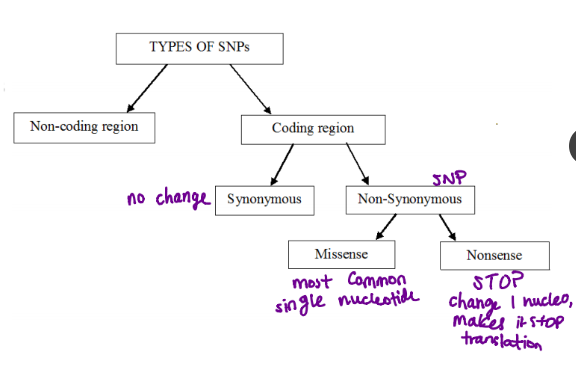
types of SNPs: figure
synonymous: single nucleotide change does not change AA sequence missense: one AA change
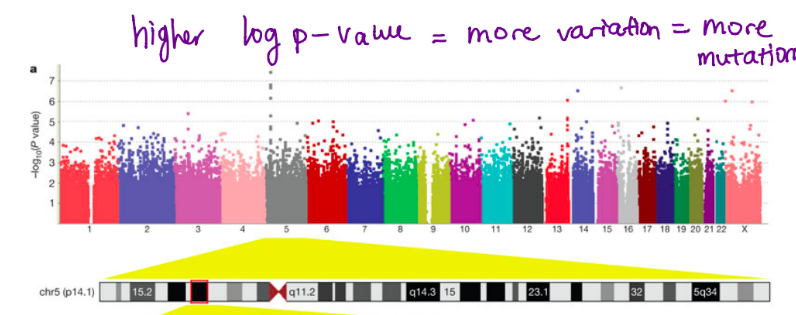
GWAS has been applied to ___, and what does graph mean
alzheimers, autism, schizophrenia
which animal models easy to house large numbers
best (a): C. elegans (worm), fruit fly, zebra fish also good (b): mice
which animals have large number of offspring
best (a): C. elegans, fruit fly, zebra fish also good (b): mouse