NB1-0 - Neurons, Glia, and Action Potentials DLAs
No description yet. This curated deck is ready for daily study.
Card preview (24)
Which two cells make up the nervous system and what are their primary functions? During development which cells appear first?
Neurons - receive and transmit information (APs) Glia - support, protect, regulate, and electrically insulate the neurons Neurons appear first during development
What are the following structures: Soma Nissl Bodies Axon Hillock Axolemma Axoplasm
Soma - neuron cell body Nissl Bodies - granules of rER in the soma Axon Hillock - the initial part of the axon Axolemma - axon plasma membrane Axoplasm - cytoplasm of axon
List the cytoskeletal elements of the neuron and their primary functions.
Microfilaments - form network near membrane that controls movement of the growth cone (development and repair) and endocytosis Microtubules - provide track for transportation of supstances up and down the axon Neurofilaments (neuronal intermediate filaments) - regulate axon diameter
Which proteins transport substances up and down the axon? How do they do this and in which direction do they do this?
Dynein and Kinesin do this by dragging vesicles up and down microtubule tracts. Kinesins carry cargo in the anterograde or positive direction (toward the axon terminal) Dyneins carry cargo in the retrograde or negative direction (toward the soma) Dying is a negative thing. Dyneins travel in the “-“ direction
What is the importance of the tau protein to neurons?
It cross links the MTs together in the axon. If these proteins dont function properly then the anterograde/retrograde transport of the neuron ceases to function
List the differences between fast and slow neuronal transport.
For a substance to undergo fast transport it has to be in a vesicle and trasnported via the MT network Slow transport only occurs in the anterograde direction and is usually just for cytoskeletal molecules and soluble proteins
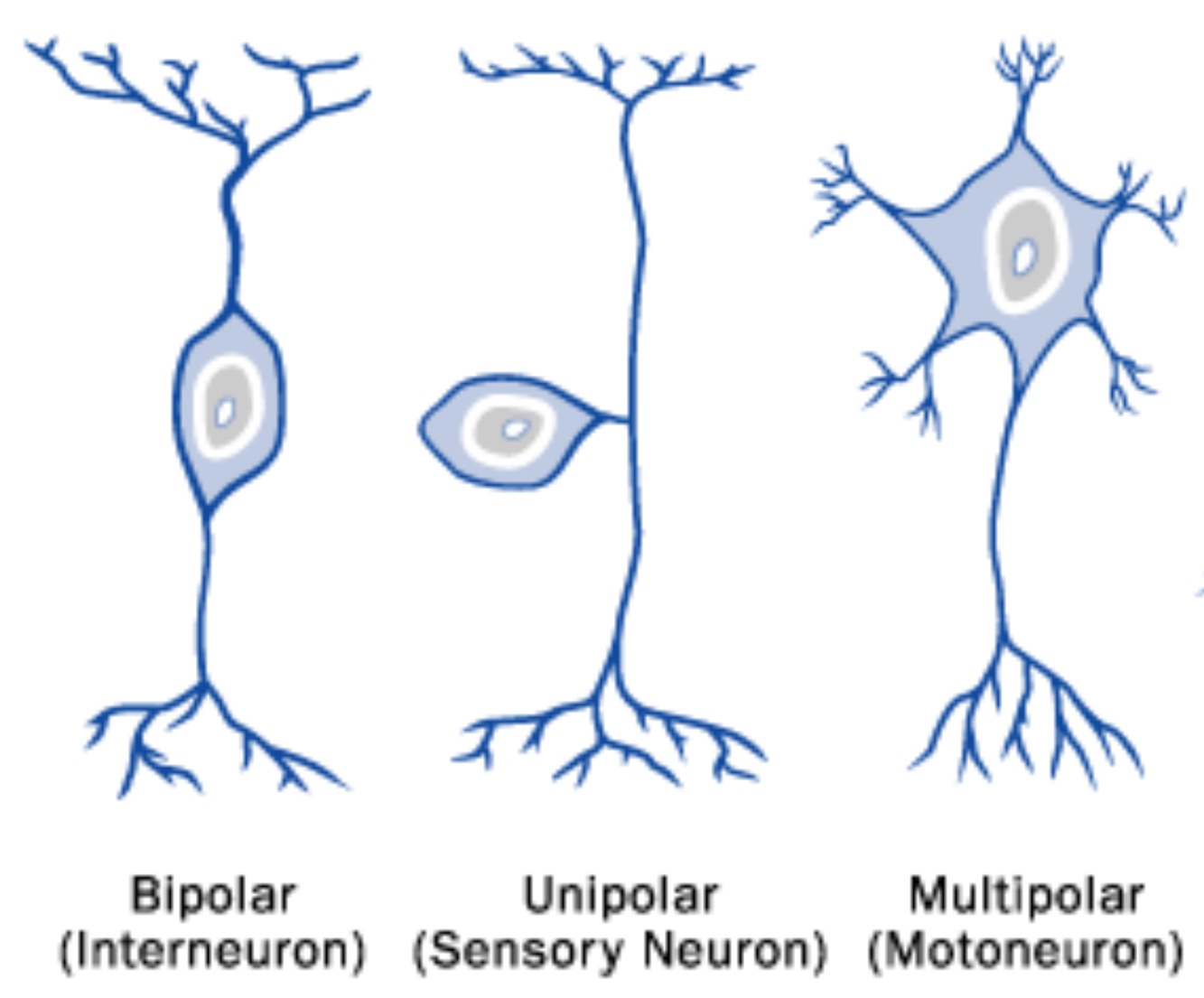
List the neuronal morphotypes and provide nerve examples for each.
• Psedounipolar - primary examples are the primary sensory afferents with the soma in the DRG • Biploar - special sesory nerves (olfactory bulb) • Multipolar • Golgi Type I (long axons) - motor neurons • Golgi Type II (short axons) - local interneurons
What are the two primary ways to increase AP velocity?
Increase the diameter of the axon (which decreases resistance) Myelinate the axons
What is an IPSP and EPSP and what determines which one occurs?
An Inhibitory Post Synaptic Potential occurs when the neurotransmitter released by a presynaptic neuron reploarizes the post synaptic cell An Excitatory Post Synaptic Potential occurs when the neurotransmitter released by a presynaptic neuron depolarizes the post synapti cell What determines which occurs are the receptors on the postsynaptic membrane
List the central glial cells.
• Astrocytes • Oligodendrocytes • Microglia • Ependymal Cells • Ependymocytes • Tanycytes • Choroidal Epithelial Cells
What are radial glia and what are their primary functions? What do these cells become after development is complete?
They are progenitors of the central glial cells and they provide a scaffold for neuronal migration during development. Radial glia will become Bergman glia in the cerebellum and Muller cells in the retina
What are the primary functions of astrocytes?
• They regulate neurons by regulating ion flow, NT release, and regional cerebral blood flow • They protect neurons by forming the blood brain barrier (BBB), limiting oxidative damage, and supplying lactate • They also release gliotransmitters
What are gliotic scars?
When certain pathologies affect the brain, the astrocytes will hypertrophy forming gliotic scars which can affect normal brain function
How do astrocytes regulate ion flow and why is this important?
During an AP, an axon will release K+ and Ca++ into the stroma. A build up of these ions could trigger APs in neighboring cells. Astrocytes from a syncitium with one another and can absorb and spread these ions out.
What are the primary functions of the microglia? How can microglia be harmful?
They are immunocompetent phagocytes that protect neurons from microorganisms and cellular debris. They will do this by phagocytosing them or releasing cytotoxins around them. They will also release neuron survival factors upon activation. Sometimes microglia can release too many cytotoxins or not enough survival factos which could initiate pathological neuronal degeneration
What are the primary functions of oligodendrocytes?
Form myelin sheath
Where are ependymocytes found and what are their functions?
They line the spinal cord and brain ventricles. They’re held together by tight junctions so they assist in forming the BBB. They also possess cilia and microvili that will manage the composition of the CSF. They do secrete some CSF but they mostle adjust its contents.
What are the primary functions of the choroid plexus epithelial cells?
Secrete CSF and transfer molecules from blood to CSF. Obviously, this occurs within the choroid plexus.
Where are tanycytes found and what are their primary functions?
They are found near circumventricular organs and they function as the interface between blood and CSF for these organs
List the peripheral glial cells
• Schwann Cells • Enteric Glia • Satellite Glia
What are the primary functions of schwann cells? From what do these cells develop?
These cells develop from neural crest cells and mainly serve to form the myelin sheath for peripheral neurons. They also will release trophic factors to guide axonal growth.
What are the primary functions of enteric glia?
They perform similar functions to astrocytes but within the enteric nervous system.
What are the primary functions of satellite glia?
These are essentially specialized schwann cells that cover the soma and dendrites found within the peripheral ganglia.