how fast
No description yet. This curated deck is ready for daily study.
Card preview (24)
Define rate of reaction.
the rate of a chemical reaction is the increase in concentration of products, or the decrease in concentration of reactants, per unit time. - It describes how quickly a reaction happens. - compares how much change occurs in a fixed amount of time.
How can rate be calculated using product concentration?
rate of reaction = increase in product concentration / time taken or rate = Δ[P] / Δt
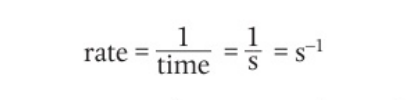
units for rate
rate takes the reciprocal value of time, so is expressed per unit time or, in SI units, per second (symbol = s-1). - rate is change in concentration per unit time.
How can rate be calculated using reactant concentration?
rate of reaction = decrease in reactant concentration / time taken or rate = −Δ[R] / Δt The negative sign is used because reactant concentration decreases, but rate is expressed as a positive value.
How can rate be calculated using product concentration?
rate of reaction = increase in product concentration / time taken rate = Δ[P] / Δt
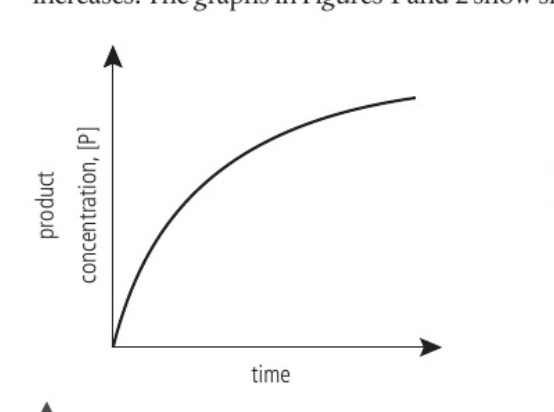
Describe a concentration-time graph for a product.
Product concentration increases over time as reactants are converted into products. The curve usually becomes less steep as the reaction slows down.
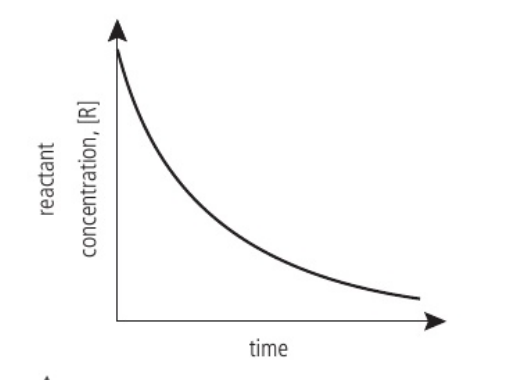
Describe a concentration-time graph for a reactant.
Reactant concentration decreases over time as it is used up. The curve usually becomes less steep as the reaction slows down.
What does the steepness or gradient of a concentration-time graph show?
The gradient shows the change in concentration per unit time, which is the rate of reaction.
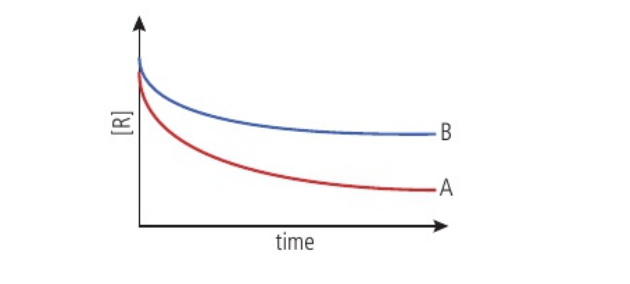
How can two reactions be compared using reactant concentration-time graphs?
The reaction with the steeper curve has a faster rate because the reactant concentration is decreasing more quickly.
Why must tangents be used to find rate from curved concentration-time graphs?
Because the gradient is not constant, so the rate can only be measured at a particular time by drawing a tangent to the curve. - the graphs are curves and not straight lines
How do you calculate rate from a tangent?
Draw a tangent at the specified time, calculate its gradient using change in concentration divided by change in time, then express the rate as a positive value.
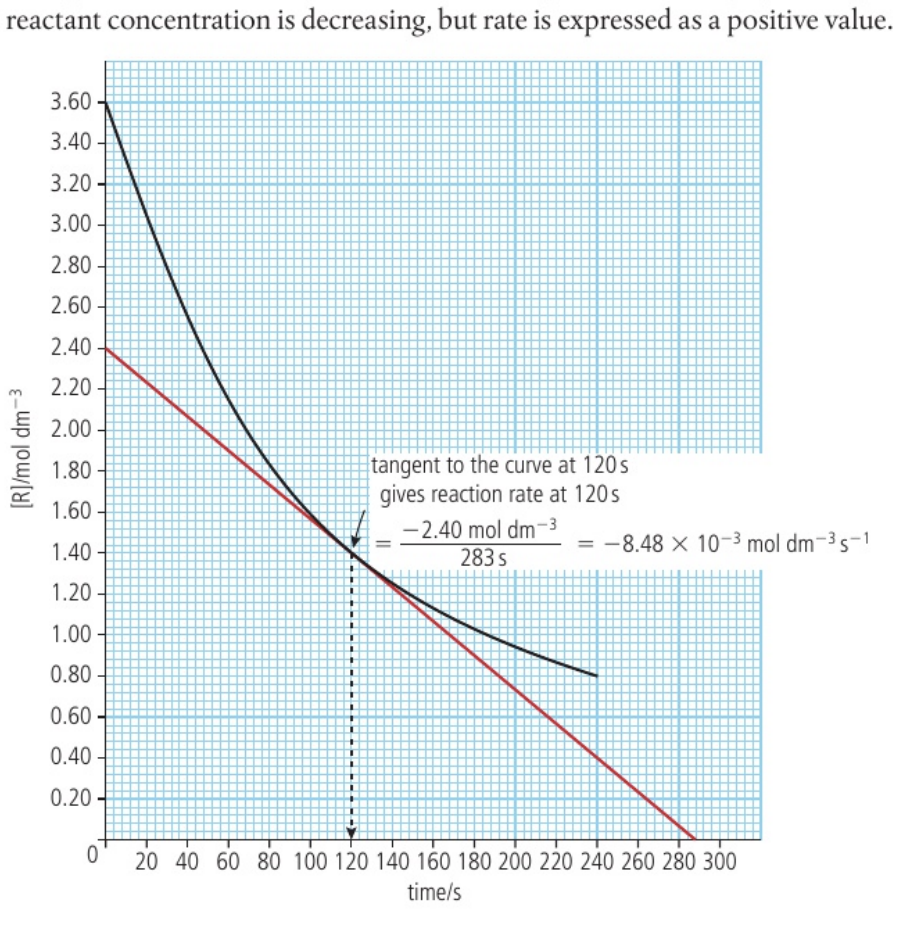
Why is the gradient negative for a reactant concentration-time graph?
Reactant concentration decreases over time, so the change in concentration is negative.
Is the rate of reaction constant during a reaction?
No. The rate is not constant; it is greatest at the start and decreases as the reaction proceeds.
Why is reaction rate still written as positive when using a reactant graph?
By convention, rate is always expressed as a positive value, so the negative gradient is converted to a positive rate.
Why is the rate greatest at the start?
Reactant concentration is highest at the start
Why does the rate decrease as the reaction proceeds?
Reactant concentration decreases as reactants are converted into products.
What is initial rate?
The initial rate is the rate at the start of the reaction, found by drawing a tangent to the curve at t = 0.
How can you make a tangent-gradient calculation more accurate?
Draw the tangent as long as reasonably possible so that the change in concentration and change in time are as large as possible.
Why are initial rates useful?
Initial rates are useful for comparing reactions under different conditions and analysing the effect of concentration on rate.
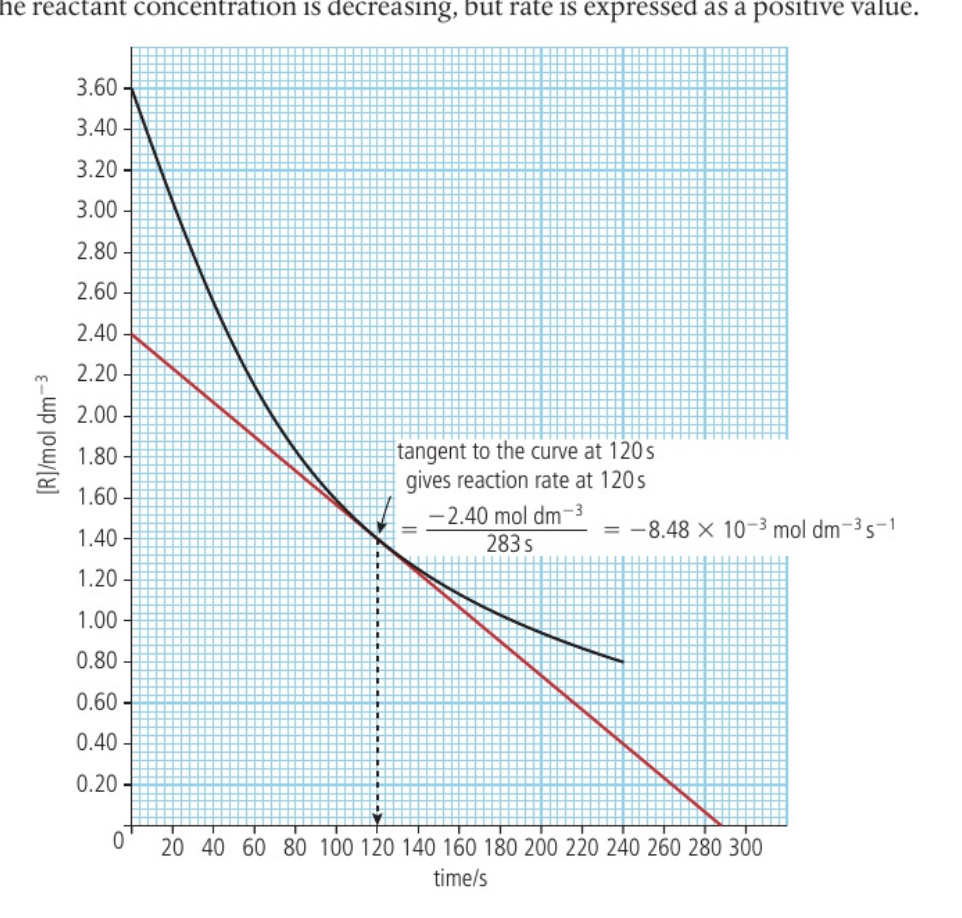
summary of rate of reaction.
The rate of a chemical reaction is the increase in concentration of products or the decrease in concentration of reactants per unit time. It can be calculated from the gradient of a concentration-time graph. For curved graphs, a tangent must be drawn at a specific time. Rate is always expressed as a positive value and has units of mol dm⁻³ s⁻¹. The rate is greatest at the start and decreases as the reaction proceeds.
State collision theory.
Collision theory states that species react as a result of collisions with sufficient energy and proper orientation.
What is the kinetic molecular theory of matter?
The kinetic molecular theory states that particles in substances move randomly because of the kinetic energy they possess. - because of this particles in a substance have a range of kinetic energy values rather than one single value. - a conveninet way to describe this is take the average of kinetic energy of particles
What is the relationship between temperature in kelvin and kinetic energy?
Temperature in kelvin (absolute temperature) is directly proportional to the average kinetic energy of the particles in a substance.
How does increasing temperature affect particles?
Increasing temperature increases the average kinetic energy of the particles. - Heating supplies extra energy to the particles, increasing their average kinetic energy and therefore increasing temperature.