M4 - Alkanes
No description yet. This curated deck is ready for daily study.
Card preview (22)
Name hydrocarbon D:
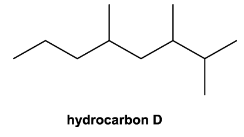
2,3,5-trimethyloctane
What is the name of the following molecule?
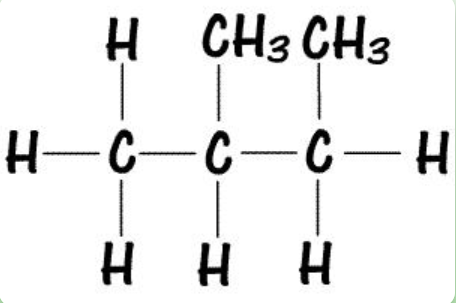
2-methylbutane
What is the name of the following molecule?
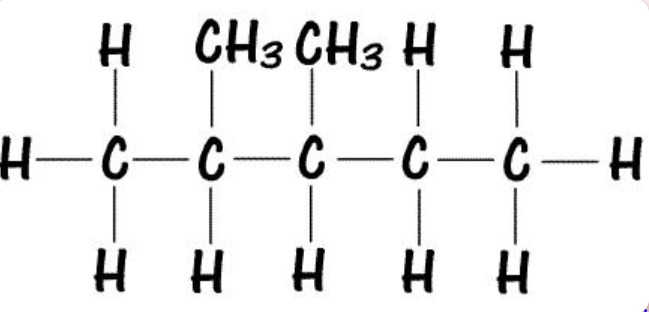
2,3-dimethylpentane
Which molecule has the highest boiling point?
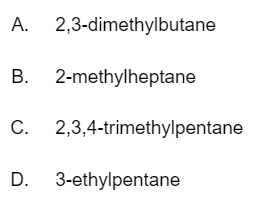
B
Explain the increase in boiling points of the cycloalkanes shown in the table [2]

More carbons (in ring) OR more (surface area of) contact AND more induced dipole-dipole interactions OR stronger induced dipole-dipole interactions ✔ More energy needed to break the intermolecular forces ✔
Compounds A, B and C are saturated hydrocarbons. The structures and boiling points of A, B and C are shown below. * Use the structures to explain what is meant by the term structural isomer. * Explain the trend in boiling points shown by A, B and C in the table [5].
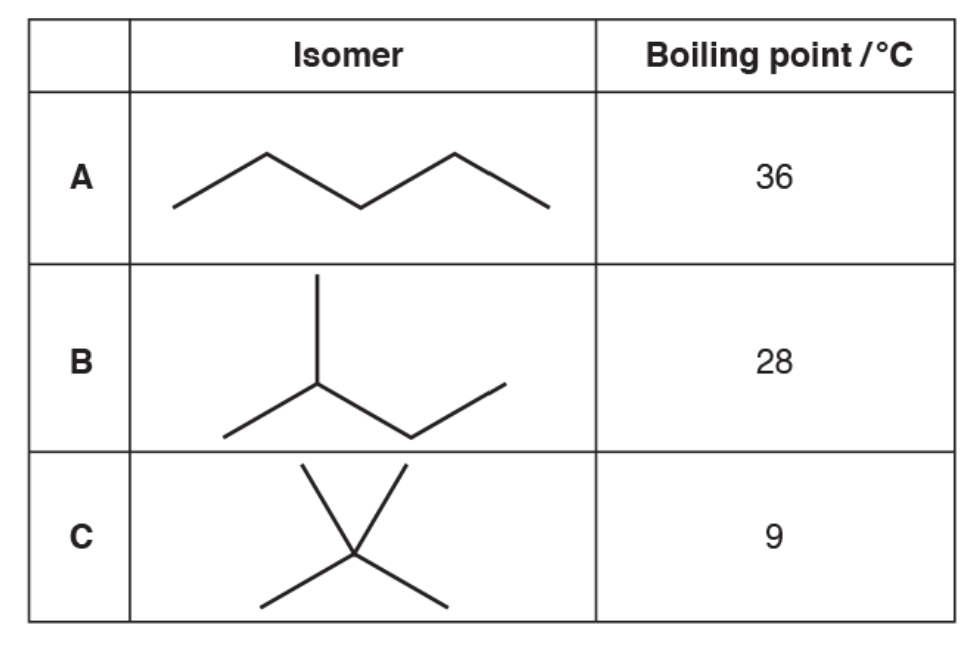
Different structural formulae AND same molecular formula ✓ C5H12 for all 3 hydrocarbons ✓ Boiling point decreases with more branching OR more methyl/alkyl groups/side chains OR shorter carbon chain ✓ More branching gives less (surface) contact AND fewer/weaker London forces ✓ Less energy to break London forces / intermolecular forces / intermolecular bonds ✓
What is the general formula of alkanes?
CnH2n+2
Describe how a (sigma) σ-bond forms.
• The σ (sigma) bond is formed between two carbon atoms or a carbon and hydrogen atom • by the single overlap of orbitals directly between bonding atoms
What is the shape and bond angle within methane?
• Tetrahedral • 109.5o • Four bond pairs around C atom repel each other equally and get as far apart as possible
How many σ and π bonds are present in a molecule of this hydrocarbon?
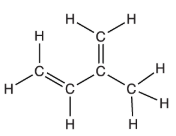
12 σ and 2 π bonds
Explain the trends in boiling points of alkanes:
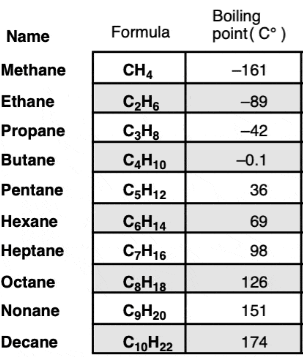
• As chain length increases, boiling point increases • More surface contact between molecules • More induced dipole – dipole interactions between the molecules • Which needs more heat energy to overcome
Explain the trends in boiling points of alkanes below:
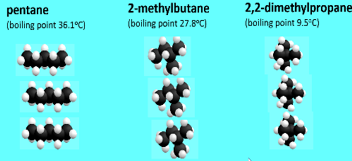
• As branching increases, boiling point decreases • In a more branched alkane, there is less surface contact between molecules • Leading to fewer induced dipole-dipole interactions • Which need less heat energy to break the weaker forces between molecules
What are the reasons for alkanes being fairly unreactive?
• C-C and C-H sigma bonds are strong • C-C bonds are non polar • Similar electronegativity of C and H
Write out a complete combustion equation for butane gas.
C4H10 (g) + 6½ O2 (g) -> 4 CO2 (g) + 5H2O (l)
Write out an incomplete combustion equation for liquid octane.
C8H18 (l) + 8½ O2 (g) -> 8 CO (g) + 9H2O (l)
What is the name of the mechanism for bromination of alkanes?
Free radical substitution
What are the three stages of radical substitution?
• Initiation • Propagation • Termination
Describe the initiation stage of radical substitution
Covalent bond in a bromine molecule is broken by homolytic fission. Energy provided by UV radiation. Br-Br -> Br* + Br*
Describe the propagation stage of radical substitution
Two propagation steps: Step 1 - CH4 + *Br -> *CH3 + HBr Step 2 - *CH3 + Br2 -> CH3Br + *Br
Describe the termination stage of radical substitution
Two radicals collide forming a molecule with all electrons paired. Br* + Br* -> Br2 *CH3 + *CH3 -> C2H6 *CH3 + *Br -> CH3Br
Limitations of Free Radical Substitution:
• Formation of a mixture of products forming different structural isomers (e.g. 1-cholooctane, 2-chlorooctane, 3-chlorooctane & 4-chlorooctane). • Further substitution means that a mixture of haloalkanes form (e.g. chloromethane, dichloromethane, trichloromethane and tetrachloromethane).
Disadvantages of Free Radical Substitution:
• Low % yield of the desired haloalkane (chloromethane above) • Separation, by fractional distillation, of the desired haloalkane from the product mixture is needed, which is **costly ** • To avoid further substitution, an excess of methane is used