6. Amount of Substance
No description yet. This curated deck is ready for daily study.
Card preview (24)
What is Avagadro’s Constant?
number of atoms in 12g of 12-C
Relative Atomic Mass (Ar) Equation

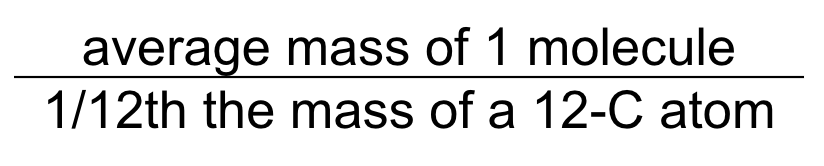
Relative Molecular Mass (Mr) Equation
Equation to work out the number of particles
Moles x Avagadro’s Constant
Equation to work out mass
Mr x Moles
Equation to work out concentration (mol dm-3)
moles / volume
% Yield Equation
(Actual Yield x 100) / Theoretical Yield
% Atom Economy
1 of the only instances when you use the big number when calculating

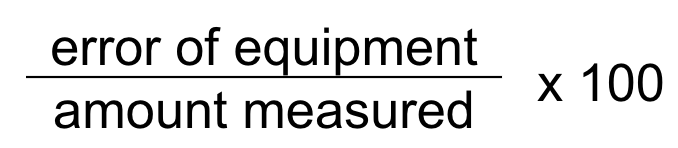
% error (% uncertainty)
Ideal Gas Equation
PV=nRT P = pressure in Pa, n = number of moles, V =. volume measured in m^3, R = molar gas constant (always 8.31 K K^-1 mol^-1 = always given), T = tempurate in K
How do you get from m^3 to cm^3? How do you get from cm^3 to m^3?
1) x 10^6 2) ➗ 10^6
How do you get from m^3 to dm^3? How do you get from dm^3 to m^3?
1) x 10^3 2) ➗10^3
How do you get from dm^3 to cm^3? How do you get from cm^3 to dm^3?
1) x 10^3 2) ➗ 10^3
How do you get from ℃ to K? How do you get from K to ℃?
1) +273 2) -273
Importance of atom economy
increases the mass of atoms in the reactants that are turned into products
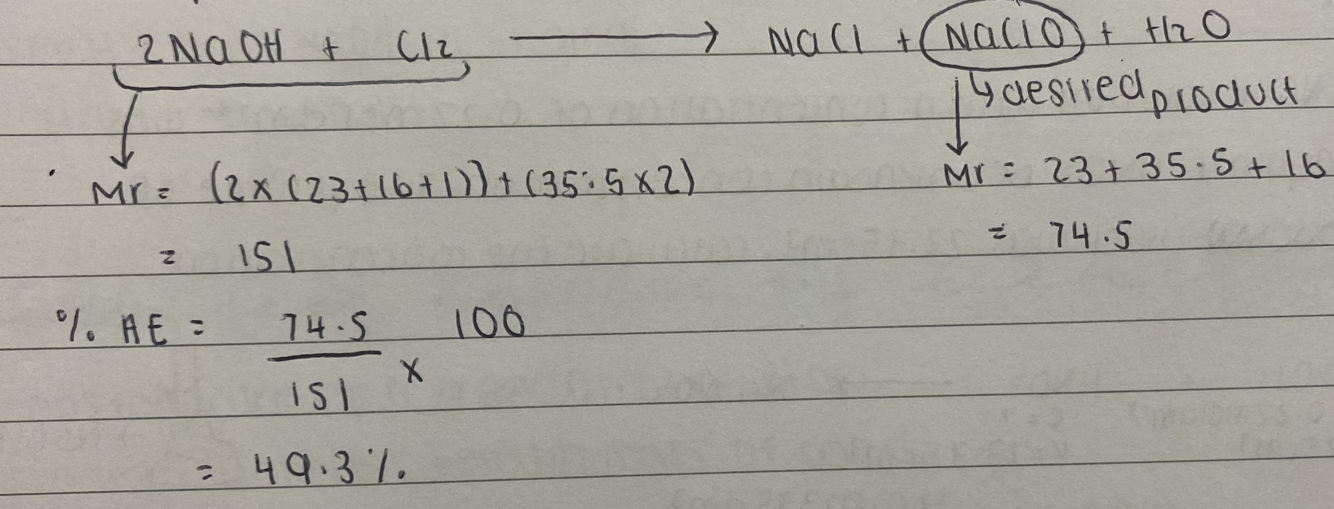
Example: Atom Economy Desired product = NaClO. Calculate atom economy. 2NaOH + Cl2 → NaCl + NaClO + H2O
Importance of % Yield
efficient conversion of reactants to products
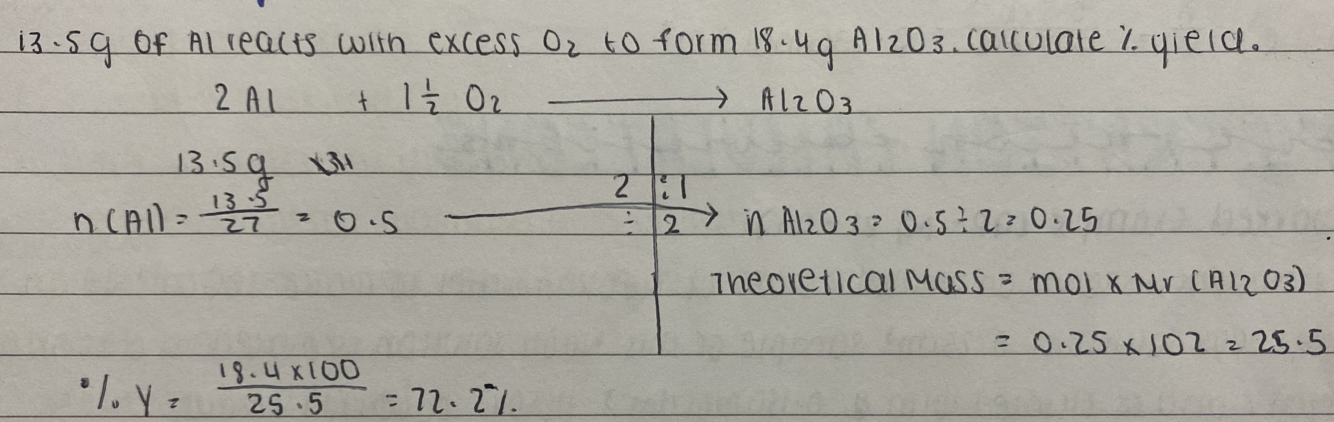
Example: % Yield 13.5 g of Al reacts with excess O2 to form 18.4g of Al2O3. Calculate % yield. 2Al + 1.5 O2 → Al2O3
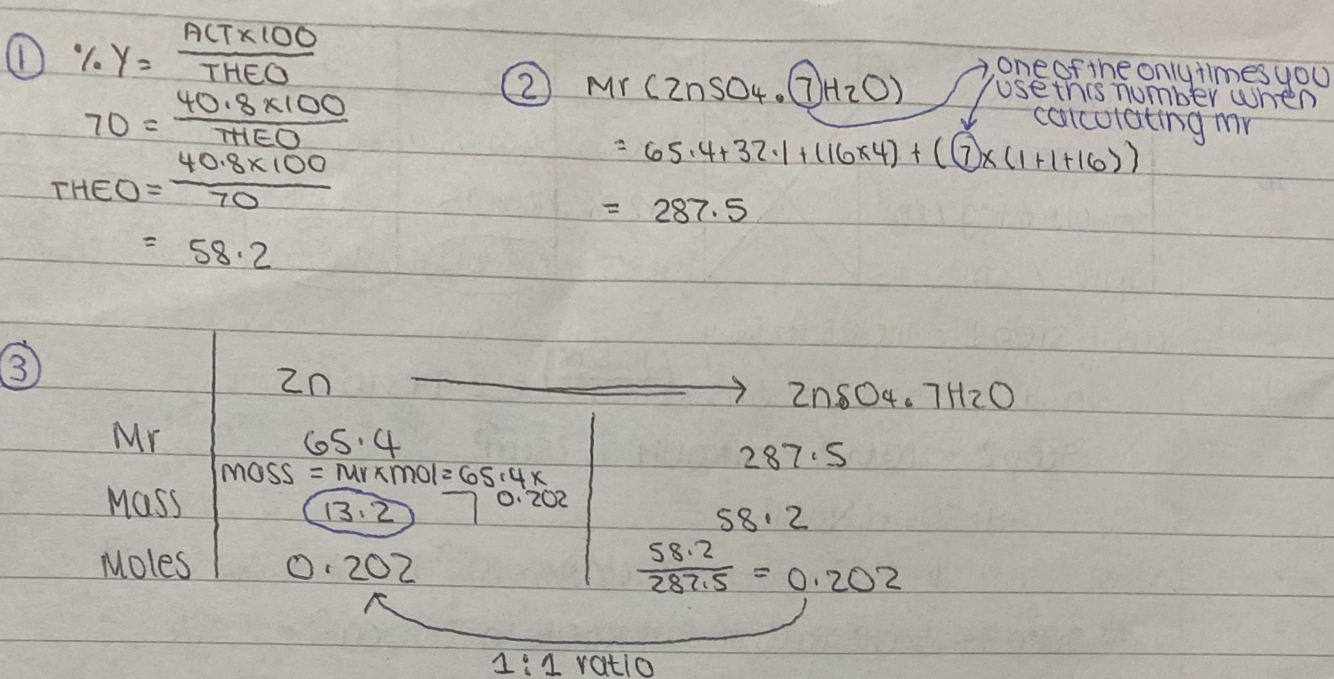
Example 2: % Yield (QP pg12, Q15) After reacting some Zn metal with some excess H2SO4, a student collected 40.8g of ZnSO4.7H2O crystals. What was the original mass of Zn used?
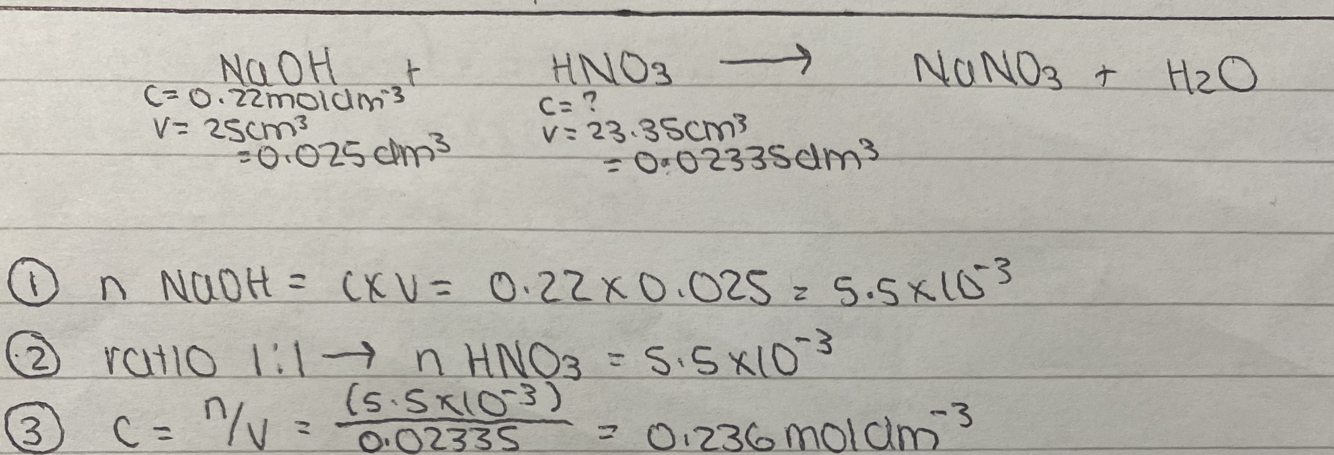
Example: Reaction in Solution 25cm^3 of NaOH solution with a conc of 0.22 mol dm^-3 is reacted against HNO3 of unknow conc. The vol of HNO3 used was 23.35cm^3. Calculate the concentrattion of HNO3. NaOH + HNO3 → NaNO3 + H2O
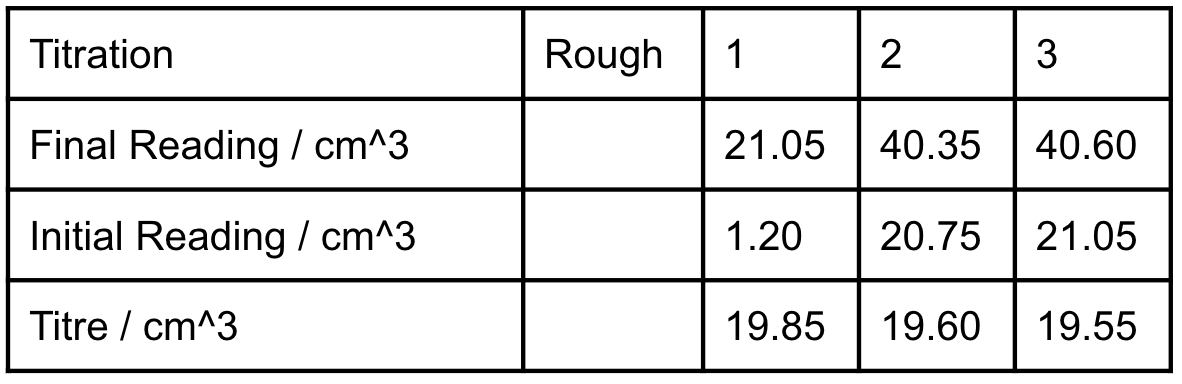
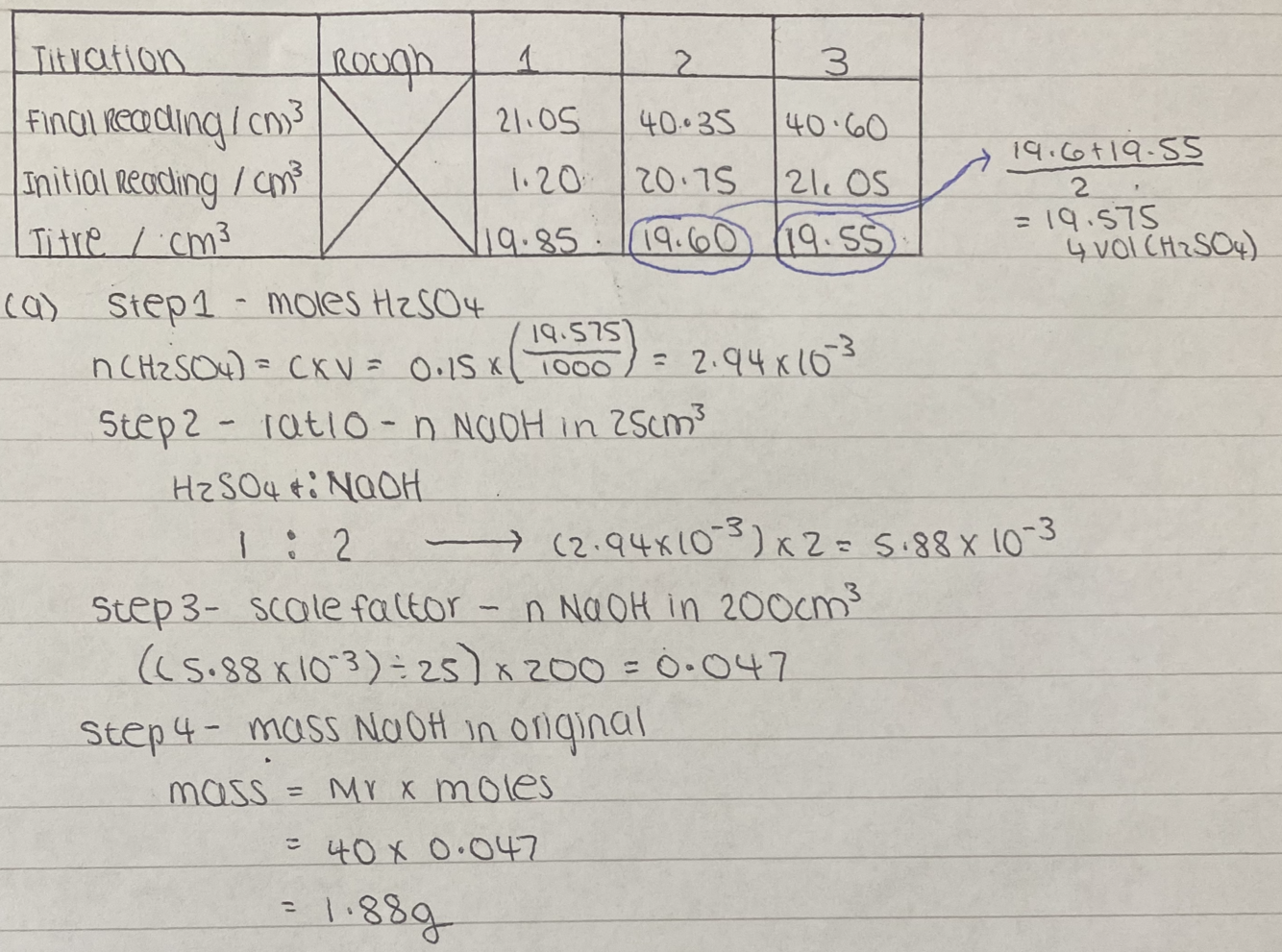
Example: Titration Calculations (QP - pg21, Q1) A student dissolved an uknown mass of NaOH in water to make 200cm^3 of an aq solution. A 25cm^3 sample of this NaOH solution is placed in a conical flask and is titrated with 0.15 mol dm^-3 H2SO4. 2NaOH (aq) + H2SO4 (aq) → Na2SO4 (aq) + 2H2O (l) Calculate the original mass of NaOH required to make the original solution
Steps to make up a standard solution
Stage 1: transfers known mass of solid - weigh solid sample and container on a 2 d.p - transfer solid sample to beaker and reweigh sample bottle - record difference in mass Stage 2: dissolves in water - add distilled water - stir with glass rod/swirl - until all solid has dissolved Stage 3: transfer washing and agitation - transfer to volumetric flask using a funnel - with washings - make up to 250cm^3 - shake/invert
Why are any air bubbles removed from the burette tap?
otherwise, the volume of the air bubble woll be counted in the reading resulting in a greater titre
Why is the funnel used to fill the burette removed before starting the titration?
solution drops could fall into the burettte and affect the burette reading which decreases the titre