Ch 16 Aromatic Rings
No description yet. This curated deck is ready for daily study.
Card preview (24)
What makes aromatic reactions unique
What’s already on the ring determines where new substituents are added
ROMP
R-group ortho 1,2 para 1,3 meta 1,4
alkyl group directorate
weakly activated ortho/para director because they create a carbocation intermediate
what happens to the product as alkyl chains get larger
goes to
what is the difference between strongly and weakly inducting substituents?
strong almost always donate electrons though resonance, weak through induction (conjugation)
strongly activating is ortho/para or meta?
ortho/para
strongly deactivating is ortho/para or meta?
meta
-OR directorate
ortho/para strongly activating
first step in reaction with a strongly activating agent?
electron pair donates to bond between benzene and activating group
steric number
number of σ bonds + lone pairs 4=sp3 3=sp2 2=sp
Hückel’s Rule
If a cyclic compound has a continuous ring of overlapping p orbitals, the number of pi electrons can predict its aromaticity: 4N+2, the system is aromatic 4N, the system is anti aromatic (N is an integer, commonly 0, 1, 2, or 3)
annulene
Annulenes are uncharged, cyclic molecules having even numbers of carbon atoms with alternating single and double bonds. Benzene is the most widely known, also called [6]annulene
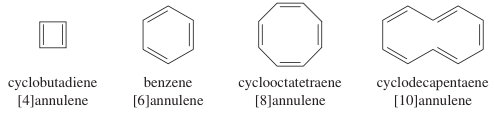
why do larger annulenes with (4N) systems not show antiaromaticity?
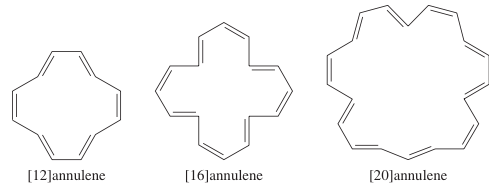
Like cyclooctatetraene, larger annulenes with (4N) systems do not show antiaromaticity because they have the flexibility to adopt nonplanar confor- mations. Even though [12]annulene, [16]annulene, and [20]annulene are (4N) systems (with N = 3, 4, and 5, respectively), they all react as partially conjugated polyenes.
what does Hückel’s rule predict about cyclic carbon compounds with odd numbers of carbon?
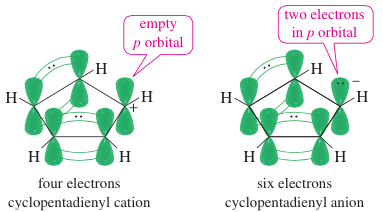
We can draw a five-membered ring of sp2 hybrid carbon atoms with all the unhybridized p orbitals lined up to form a continuous ring. With five pi electrons, this system would be neutral, but it would be a radical because an odd number of electrons cannot all be paired. With four pi electrons (a cation), Hückel’s rule predicts this system to be antiaromatic. With six pi electrons (an anion), Hückel’s rule predicts aromaticity.
why is cyclopentadiene unusually acidic?
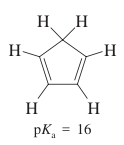
Cyclopentadiene is unusually acidic because loss of a proton converts the non-aromatic diene to the aromatic cyclopentadienyl anion. Cyclopentadiene contains an sp3 hybrid ( - CH2 - ) carbon atom without an unhybridized p orbital, so there can be no continuous ring of p orbitals. Deprotonation of the - CH2 - group leaves an orbital occupied by a pair of electrons. This orbital can rehybridize to a p orbital, completing a ring of p orbitals containing six pi electrons: the two electrons on the deprotonated carbon, plus the four electrons in the original double bonds.
which is more stable, aromatic benzene or aromatic cyclopentadiene?
When we say the cyclopentadienyl anion is aromatic, this does not necessarily imply that it is as stable as benzene. As a carbanion, the cyclopentadienyl anion reacts readily with electrophiles. Because this ion is aromatic, however, it is more stable than the corresponding open-chain ion.
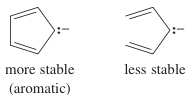
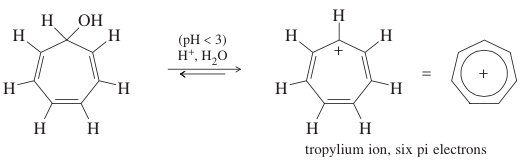
why is the cyclopentatrienyl carbocation stable in aqueous solution?
with six pi electrons, the tropylium ion becomes aromatic and
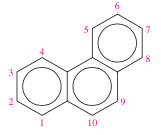
describe the relative stability of benzene and larger polynuclear aromatic hydrocarbons
As the number of fused aromatic rings increases, the resonance energy per ring continues to decrease and the compounds become more reactive. For example, phenanthrene has only 14 pi electrons in its three aromatic rings, compared with 18 electrons for three separate benzene rings (shown). Phenanthrene undergoes 1,2-addition at the 9- and 10-positions to give a product with two fully aromatic rings. (Because they are less likely to be substituted, the bridgehead carbon atoms of fused aromatics are often left unnumbered.)
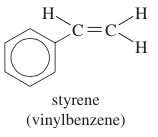
styrene
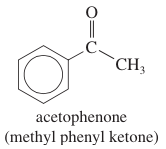
acetophenone
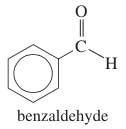
benaldehyde
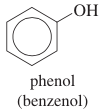
phenol
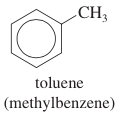
toluene
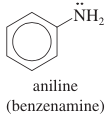
aniline