S.3.3 - Describe Chemical Reactions
No description yet. This curated deck is ready for daily study.
Card preview (11)
An electron in an outer orbital that can form bonds with other atoms
Valence Electron The electrons of the outermost shell of an atom are called valence elect
In a chemical equation, the substances on the left side of the equation; the starting materials in a chemical reaction
Reactants
In a chemical equation, the substances on the right side of the equation; the substances that are formed in a chemical reaction
products
What’s happening in the left of this picture? In the Right?
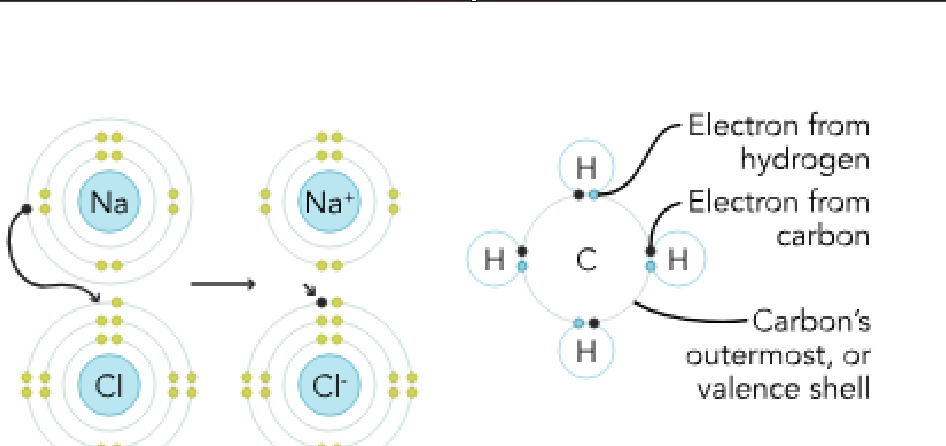
The Left is Ionic Bonding, the Right is covalent Covalent and Ionic Bonds Chemical bonds occur when two or more atoms hav
Mathematical representation of a chemical reaction
chemical equation
A unit of a substance that is equal to exactly 6.02214076 × 10 particles of that substance
mole
Which of these elements have the same number of valence electrons and similar chemical properties as strontium (Sr)? Use the periodic table to help you answer the question.
Magnesium (Mg) Elements in the same group have similar properties and the same number of valence electrons.
Which of the following sets of coefficients balances the following chemical reaction? ______ N2 + ______ H2 → ______ NH3
1, 3, 2 It works out to a total of (nitrogens) and (hydrogens) on each side of the reaction.
How many oxygen atoms are present on each side of the following reaction? 2C2H18+25O2 → 16CO2+18H2O
50 There are 50 on the left (25 × 2) and 50 on the right (16 × 2 + 18).
In the reaction 2AgCl → 2Ag + Cl2, assuming you started with 4 moles of AgCl, how many moles of Ag could be produced?
4 moles. From the balanced reaction, the ratio of moles of AgCl to moles of Ag is equal.