Topic 12.1 Strong and weak acids
No description yet. This curated deck is ready for daily study.
Card preview (24)
Brønsted-Lowry Theory
Proposed the theory into how acids and bases react with each other (in 1923)
Conjugate acid-base pairs
Acid + conjugate base Base + conjugate acid (strong reactactant forms weak opposite product)
Monoprotic
Donates one proton (HCl is monoprotic/monobasic- as 1 mol of acid can neutralise 1 mol OH- ions)
Diprotic
Donates two protons (Sulfuric acid is diuretic/dibasic)
Anphoteric
A substance that can act as both an acid and a base (water is anphoteric)
Ammonia acid-base pairs
-Weak acid NH3 + H2O ⇌ NH4+ + OH- Base Acid Acid Base (NH3 and NH4 conjugate pair) (H2O and OH- conjugate pair)
Strong acids
Strong acids are almost completely dissociated in solution. –> Reverse reaction doesn’t take place so single direction arrow is used (HCl –> H+) –> pH increases by a factor of one for each 10x decrease of conc
Weak acids
Weak acids only partly dissociate <10% (a significant amount of undissociated acid is present). –> Represented using a reversible reaction arrow (HA ⇌ H+ + A-)–>(CH3COOH ⇌ CH3COO- + H+) –> pH increases 0.5 for each 10x decrease in concentration.
Equilibrium constant Ka
• Ka is the acid dissociation constant. • Used to quantify the degree to which an acid dissociates.
Calculating pH
pH is related to the hydrogen ion concentration (moldm^-3) of a solution. pH = -log[H+] (eg: pH = -log0.100 pH = 1)
Calculating [H+] from ph
[H+] = 10^-pH
Calculating pH of a weak acid
-Need to know the degree of dissociation of the acid -Use Ka the acid dissociation constant to show this ____________
pKa
pKa = -logKa -Larger Ka = stronger acid -Smaller Ka = weaker acid
Dissociation of water
Water ionises to form some H+ and OH- ions H2O ⇌ H+ + OH- Kc = [H+][OH-] / [H2O]
The ionic product of water, Kw
• Kw = [H+][OH-] • Kw is the ionic product of water. • It has a constant value at a given temperature (298K).
Strong base
• Sodium hydroxide is a strong base. • It is completely dissociated in water.
What is a buffer solution?
• They resist changes in pH • A buffer solutions pH is almost unchanged on the addition of small amounts of acid or base • A buffer solution can be made from a weak acid and a salt of the acid.
A buffer solution can be made by mixing:
• A weak acid with its conjugate base • A weak base with its conjugate acid
Calculating buffer pH
pH = pka + log [acid]/[base] (?) –> pH = (-logKa) + log [salt]/ [acid] [H+] = Ka x [acid]/[salt] pH = -log[H+]
Ka
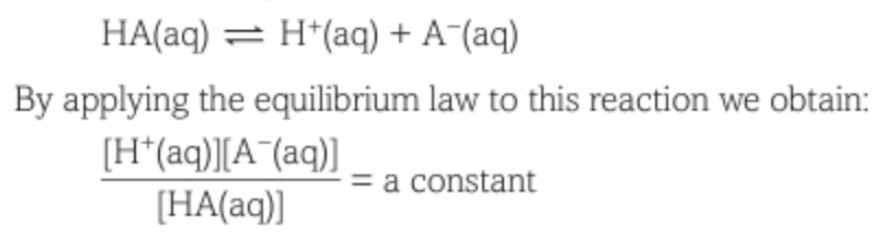
Acid dissociation constant. HA(aq) ⇌ H+(aq) + A-(aq)
pH of aqueous solutions of strong bases
When an acid is dissolved in water, it produces so many hydrogen ions that the small contribution of the water is insignificant, unless the acid concentration is very small. However the fact that water ionises is the reason why even the most alkene solutions contain some hydrogen ions. Sodium hydroxide is a strong base, so in dilute aqueous solutions we can consider it ions to be completely dissociated.
acid
• Proton donor • Positive charge/becomes more negative • Higher pH- weaker the acid • carboxylic- weak acid • Others strong
base
• Proton acceptor • Lone pair/becomes more positive • Higher pH- stronger base • OH- strong base • NH3- weak base
equivalence point
The equivalence point is where the moles of acid and the moles of base would neutralize each other according to the chemical reaction. (when an acid and base have reacted together in the exact proportions as dictatef by the stoichiometric equation)