6.12 Absorption
No description yet. This curated deck is ready for daily study.
Card preview (9)
Purpose of absorption
Absorption involves the movement of fluids or dissolved substances (such as nutrients) across a cellular membrane - The absorbed components then undergo assimilation within the cell in order to become fluid or solid parts of an organism.
Membrane transport: Secondary Active Transport
Glucose and amino acids are co-transported across the epithelial membrane with sodium ions (Na +)
Membrane transport: Facilitated Diffusion
Certain monosaccharides, vitamins and some minerals may be transported by epithelial channel proteins
Membrane transport : Simple Diffusion
Hydrophobic materials (e.g lipids) are capable of freely diffusing across the epithelial membrane.
Membrane transport: Endocytosis
Dissolved materials may be rapidly absorbed en masse via the process of pinocytosis (cell ‘drinking’)
Small Intestine
Serosa Longitudinal muscle Circular muscle Submucosa Mucosa
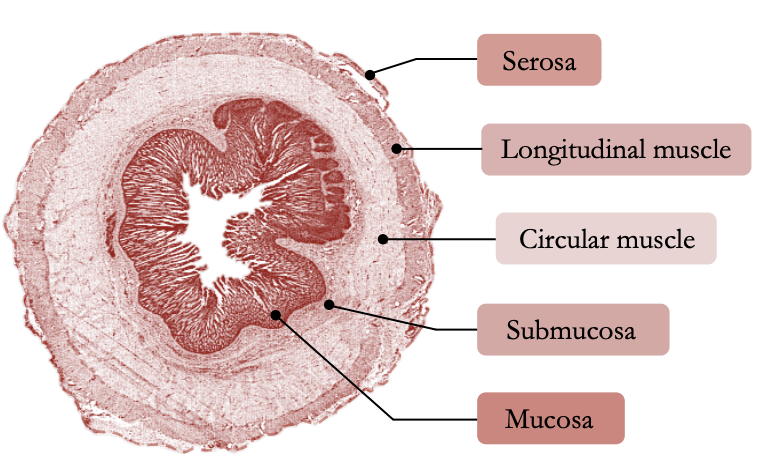
Longitudinal Cross-Section
Villi Mucosa Muscle Layers
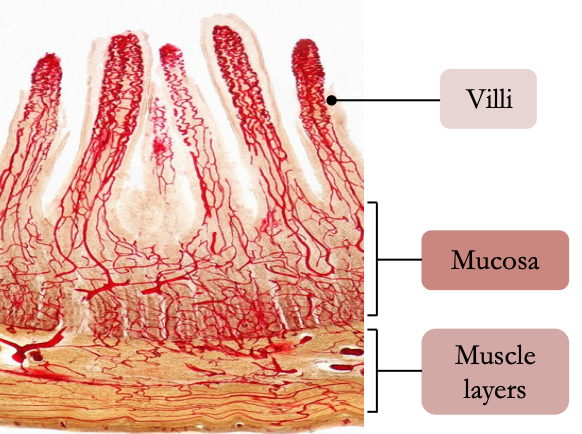
Villi
Villi are finger-like mucosal projections that increase the surface area of epithelium over which absorption is carried out Microvilli (Sa Vol) Rich blood network Single layer epithelium Lacteals (absorb lipids) Intestinal crypts (exocrine) Membran proteins
Modeling absorption
Dialysis tubing can be used to model the size specific permeability of a membrane. Large molecules cannot cross eg starch Smaller molecules can cross eg glucose