3.1.5 Kinetics
No description yet. This curated deck is ready for daily study.
Card preview (24)
What is a reaction rate?
Change in concentration (or amount) of reactant or product over time
State the formula for a rate of reaction

Name the 2 conditions needed for particles to react with one another when they collide
• Collide in right direction • Need to be facing each other in right way • Collide with certain minimum amount of kinetic energy
What is meant by activation energy?
Minimum (amount of kinetic) energy needed for a reaction to occur
Why do particles need a minimum amount of kinetic energy for them to react?
Need to have this much energy to break their bonds & start reaction
Molecules in gas don’t all have the…
same amount of energy
What does a Maxwell-Boltzmann distribution show?
Number of molecules in a gas with different kinetic energies
Draw a Maxwell–Boltzmann distribution
• (y axis) %/fraction of particles/molecules/atoms • (x axis) energy
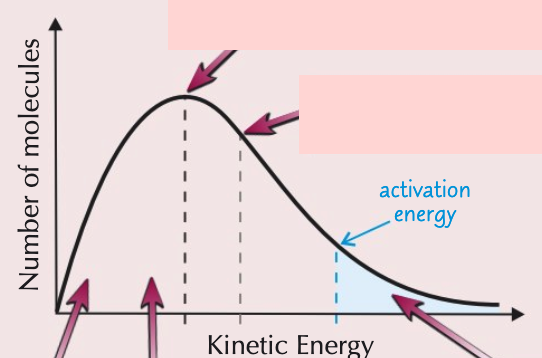
Maxwell–Boltzmann Distribution What does the peak of the curve represent?
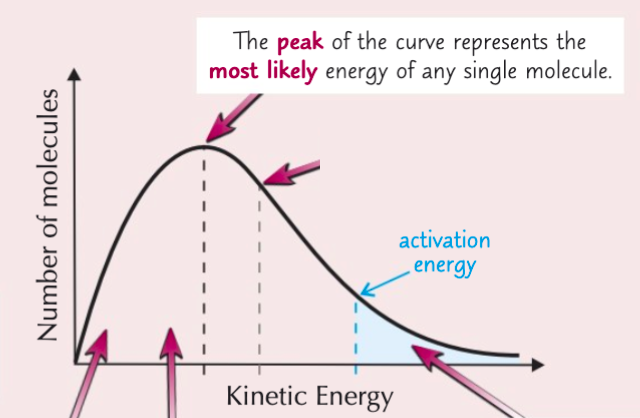
Maxwell–Boltzmann Distribution Where is the mean (average) energy of all molecules on the curve? Label it on your curve.
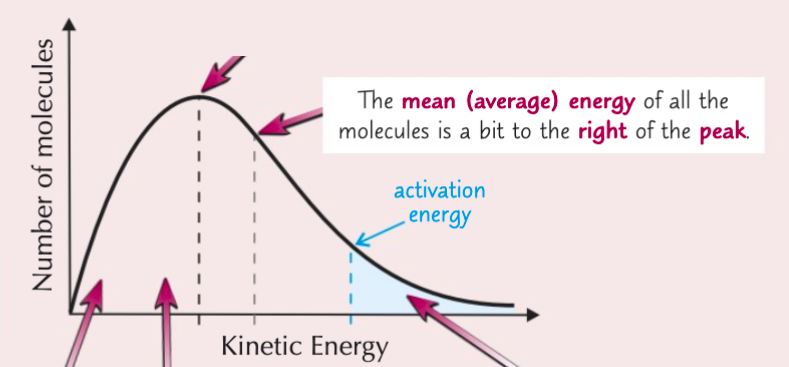
Maxwell–Boltzmann Distribution At what speed are most molecules moving at?
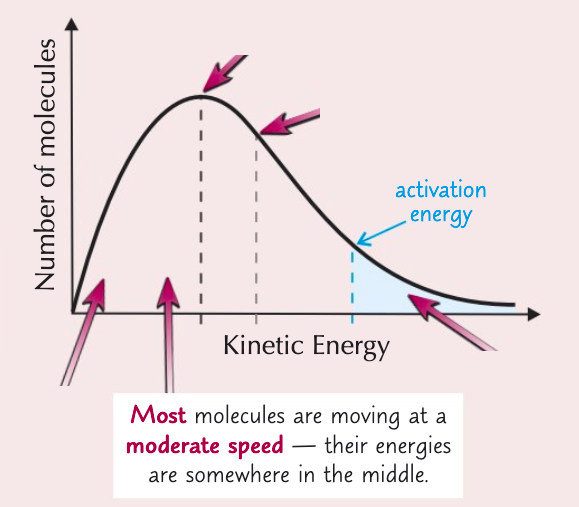
Maxwell–Boltzmann Distribution Shade the area where there’s molecules that can react
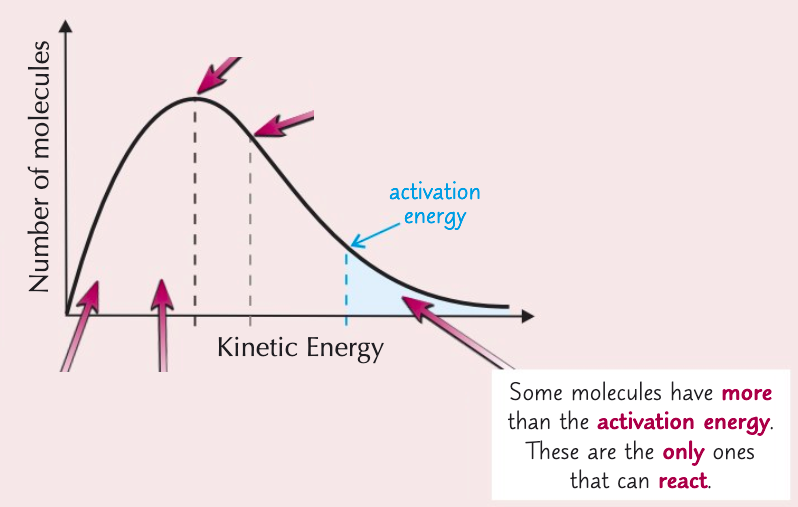
What is the area under a Maxwell–Boltzmann distribution curve equal to?
Total number of molecules
Why does the Maxwell–Boltzmann distribution curve start at (0,0)?
Because no molecules have 0 energy
Describe the effect of temperature on reaction rate
• ↑ temp of reaction = particles have more kinetic energy ∴ move faster • Greater proportion of molecules E ≥ Ea & able to react (have at least activation energy) • More frequent successful collisions in given time • Another reason why ↑ temp = reaction faster
Describe and illustrate the effect of an increase in temperature on Maxwell–Boltzmann distribution curve
Changes shape of Maxwell–Boltzmann distribution curve → shifts to the right
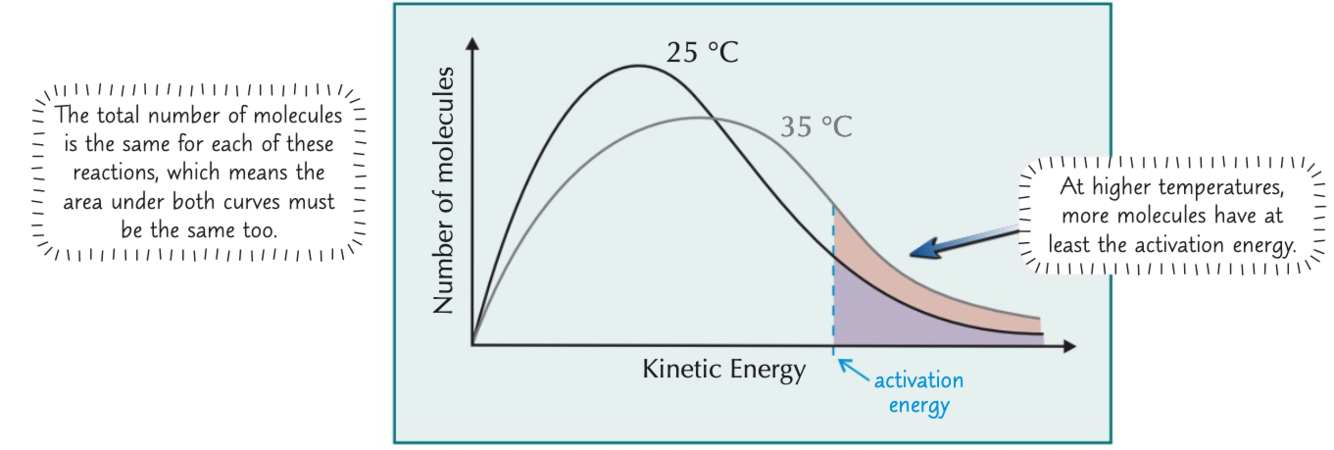
Why does a small increase in temperature create a large increase in reaction rate? (2)
• Many more molcules have E ≥ Ea (energy greater than the activation energy) • Far more successful collisions per second
Describe the effect of concentration on reaction rates
• ↑ concentration of reactants in solution = particles will be closer together • Closer = collide more often • Collisions occurring more frequently = more chances to react • Explains why ↑ concentration = ↑ reaction rate
Describe the effect of pressure on reaction rates
• Gas particles closer together • ↑ collsion frequencies = reaction rate ↑
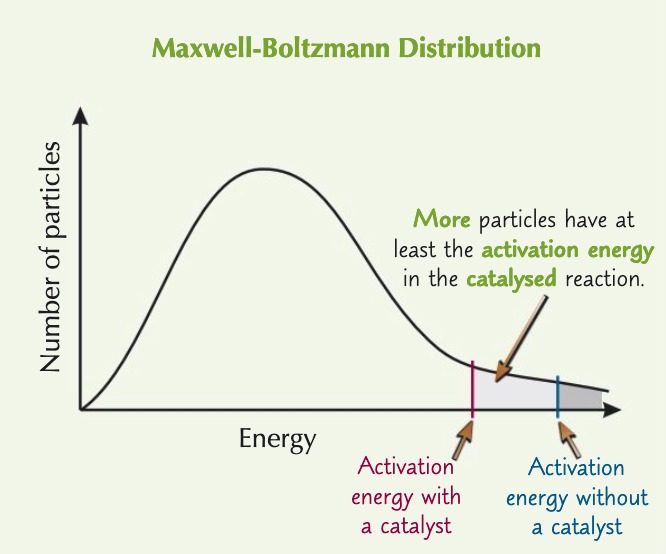
What is a catalyst?
• Substance that increases the rate of reaction by providing an alternative reaction pathway with lower activation energy • Catalyst is chemically unchanged by end of the reaction
Catalysts take part in reactions but…
are remade at end
Draw a Maxwell–Boltzmann distribution showing the effect of a catalyst work
Describe how you can measure reaction rates
Measure how fast reactants are used up or how fast products are formed
Name 3 ways to measure reaction rates
• Timing how long a precipitate takes to form • Measuring a decrease in mass • Measuring the volume of gas given off