Halogenoalkanes
No description yet. This curated deck is ready for daily study.
Card preview (24)
What is a halogenoalkane
An alkane with 1 or more halogens attached to it
State the trend in boiling points of halogenoalkanes as we go down the halide group
Boiling point of halogenoalkanes increases down the group
Explain the trend in boiling points of halogenoalkanes as we go down the halide group
Boiling point increases due to: - Atomic size increases - More electrons - Greater number of electrons - Stronger VDW forces - More energy needed to overcome these IMF
How do halogens affect the polarity of a bond
Halogens are electronegative and so pull the pair of electrons in a covalent bond towards it, making it polar
What is a nucleophile
An electron pair donor
Give 3 examples of nucleophiles
:CN- :NH3 ::OH-
Why can halogenoalkanes be attacked by nucleophiles
They contain polar bonds
When a halogenoalkane is attacked by a nucleophile in a substitution reaction, where is the first arrow from and where does it go to
From the lone pair on the nucleophile to the delta positive carbon bonded to the halogen
What is the name of the mechanism whereby hydroxide ions react with a halogenoalkane using an aqueous solvent
Nucleophilic substitution
What are the conditions required for the substitution reaction of hydroxide ions with a halogenoalkane
Warm aqueous NaOH (dilute) Carried out under reflux (heat gently)
Draw the substitution mechanism for the reaction of hydroxide ions with chloroethane using an aqueous solvent
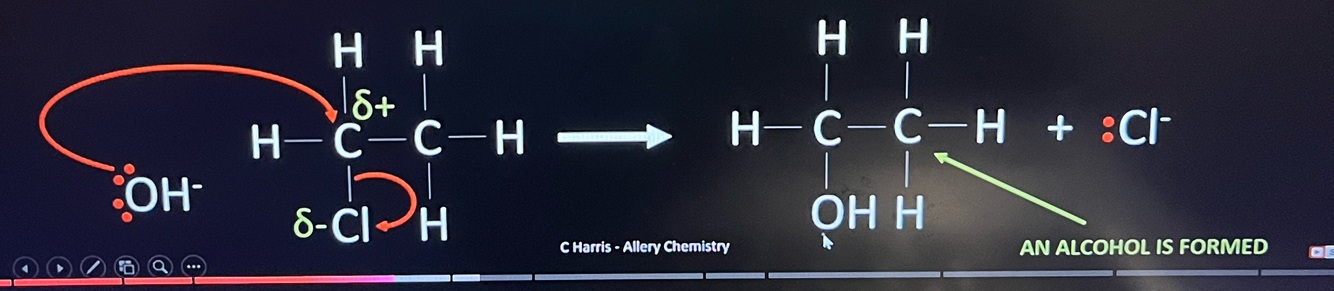
What is formed when hydroxide ions react with a halogenoalkane using an aqueous solvent
An alcohol
What is the general equation for the overall reaction between a halogenoalkane and hydroxide ions using an aqueous solvent
RX + NaOH –> ROH + NaX R - alkyl group (CH3) X - Halogen
What is formed when halogenoalkanes react with cyanide ions
Nitriles
What are the conditions required for the reaction of cyanide ions with a halogenoalkane
Warm ethanolic potassium cyanide Carried out under reflux
Draw the mechanism for the reaction of cyanide ions with chloroethane

What is the general equation for the overall reaction between cyanide ions and a halogenoalkane
RX + KCN –> RCN + KX R - alkyl group (CH3) X - Halogen
What is the name of the mechanism whereby cyanide ions react with a halogenoalkane
Nucleophilic substitution
What is the name of the mechanism whereby ammonia reacts with a halogenoalkane
Nucleophilic substitution
What are the conditions required for the reaction between ammonia and a halogenoalkane when the desired product is a primary amine
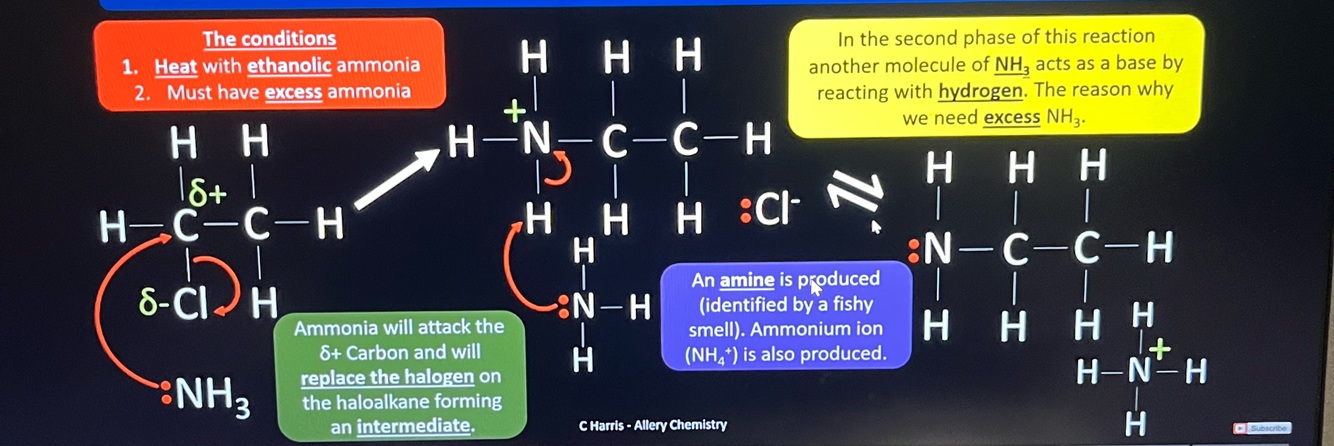
Warm ethanolic ammonia Must have excess ammonia Heat gently under reflux
What is produced when ammonia reacts with a halogenoalkane in excess ammonia
A primary amine, an ammonium ion, halide ion
Why do we need excess ammonia in the reaction between ammonia and a halogenoalkane
As in the second phase of the reaction another molecule of NH3 acts as a base by reacting with hydrogen
Draw the mechanism for the reaction of ammonia with a halogenoalkane
How can an amine be identified
Fishy smell