Aromatic Chemistry
No description yet. This curated deck is ready for daily study.
Card preview (15)
What are the 4 problems with Kekules suggested structure for benzene? (cyclic with a double bond every other bond)
1 - would expect electrophilic addition reactions with bromine water, but doesn’t react 2 - Would expect 4 isomers of dibromobenzene, however, 1,2 and 1,6 models were indistinguishable, so in reality only 3 (irregular = bonds) 3 - enthalpy of hydrogenation of benzene didn’t match predictions based off double and single bond data, being less exothermic than expected 4 - x-ray crystallography should show = to be shorter than - –> actually showed perfect hexagon
What is the name of the accepted benzene model?
Delocalised Model
What does the delocalised model for benzene show its structure to be?
A cyclic C hexagon, with p orbitals above and below. These orbitals are close enough to overlap, and so form a continuous pi bond above and below the planar of the ring to produce a pi system
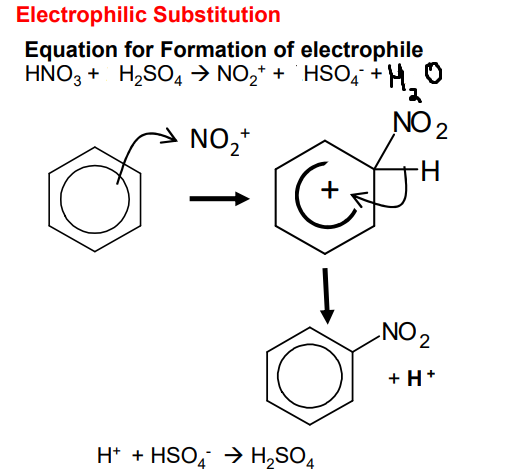
What are the conditions for nitration?
conc. HNO3 conc H2SO4 50*C
How is the nitronium ion generated for nitration?
1) HNO3 + H2SO4 –> H2NO3+ + HSO4- 2) H2NO3+ –> NO2+ + H2O
What are the uses of nitrobenzenes?
As explosives (TNT) To make aromatic compounds (amines, used to make dyes)
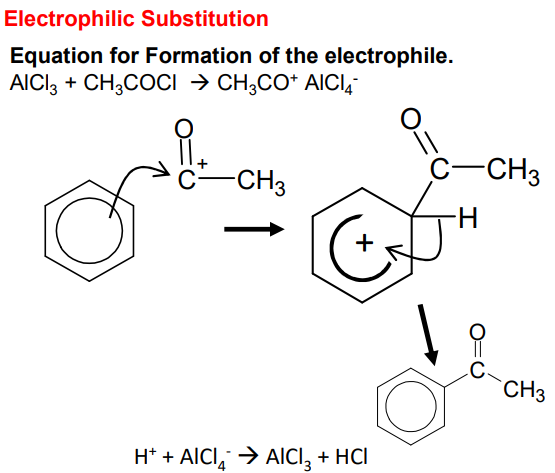
What are the conditions for Friedel Crafts acylation?
AlCl3 catalyst, dry
What are the reactants and products of Friedel-Crafts acylation?
Reactants - a benzene-based compound and either acyl chloride or an acid anhydride Products - An aromatic ketone and either HCl or a carboxylic acid
What type of reaction mechanism occurs in Friedel-Crafts acylation?
Electrophilic substitution
How does the AlCl3 catalyst form the electrophilic ion necessary for Friedel-Craft acylation, and what is the name of this ion?
AlCl3 + RCOCl –> AlCl4- + RCO+ RCO+ –> Acyllium ion
Describe and explain the difference in stability between the hypothetical cyclohexa-1,3,5-triene and benzene
Benzene is more stable Has 3 double bonds rather than 1, and its double bonds are close enough to overlap, thus allowing the electrons to become delocalised in a pi orbital above and below the ring, which is more stable
How should you explain the bonding in Benzene?
• Each carbon atom forms 3 covalent bonds • The remaining p orbitals overlap above and below the ring to form a pi system • The electrons in these p orbitals are delocalised
How should describe the shape of Benzene?
• Benzene is a planar molecule • Bond angles in Benzene are 120* • Carbon-Carbon bond lengths are identical
Show the nitration reaction between benzene and concentrated nitric acid, how the electrophile is produced and the regeneration of the catalyst
Show the Fridel-Crafts acylation process between benzene and ethyl chloride, how the electrophile is produced and the regeneration of the catalyst