C3- Analysis and Synthesis
No description yet. This curated deck is ready for daily study.
Card preview (24)
Describe a flame test to test for positive ions.
1) Clean a piece of nichrome wire with sandpaper, then water. 2) Dip wire into test substance. 3) Hold wire at the edge of a blue Bunsen flame.
What colour flame do each of these metal ions produce in a flame test: • Lithium? • Sodium? • Potassium? • Calcium? • Barium?
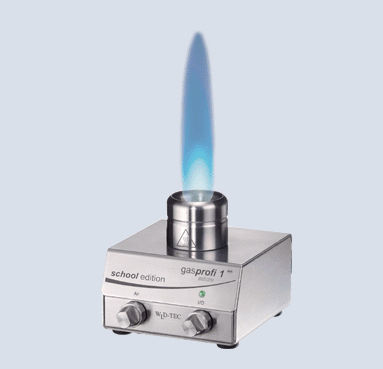
• Lithium➡️Crimson. • Sodium➡️Yellow. • Potassium➡️Lilac. • Calcium➡️Red. • Barium➡️Green.
Describe a sodium hydroxide test for positive ions.
1) Dissolve substance in water. 2) Add a sodium hydroxide solution until in excess.
In a sodium hydroxide test for positive ions, what ions produce no precipitates?
Sodium (Na+) or Potassium (K+)➡️Because these hydroxides are soluble.
In a sodium hydroxide test for positive ions, what ions produce white precipitates which do not redissolve?
Calcium (Ca2+) or Magnesium (Mg2+)➡️Because these hydroxides are both white and insoluble.
In a sodium hydroxide test for positive ions, what ions produce white precipitates which dissolve when excess sodium hydroxide is added?
Aluminium (Al3+)➡️Because the hydroxide is insoluble in water but soluble in sodium hydroxide solution.
In a sodium hydroxide test for positive ions, what ions produce a coloured precipitate and what colours are produced?
• Copper (Cu2+)➡️Blue. • Iron (II)(Fe2+)➡️Dirty green. • Iron (III)(Fe3+)➡️Brown.
Describe a test for carbonates for negative ions.
1) Add dilute hydrochloric acid. 2) If it fizzes, test for CO2 with lime water (which goes cloudy). This indicates a carbonate (CO32-).
Describe a test for sulphates for negative ions.
1) Add a little dilute hydrochloric acid followed by barium chloride solution. 2) A sulphate (SO42-) gives a white precipitate.
Describe a test for halides for negative ions.
1) Add a little nitric acid followed by a few drops of silver nitrate solution.
What coloured precipitates do non-metal ions produce in a test for halides?
• Chloride (Cl-)➡️White. • Bromide (Br-)➡️Cream coloured. • Iodide (I-)➡️Yellow.
What are the advantages of using instrumental methods in chemical analysis?
✅Quicker. ✅You can use very small samples. ✅More sensitive. ✅Accurate.
Balance this ionic equation: Fe3++3OH-➡️…
Fe3++OH-➡️Fe(OH)3
Describe the method for titration.
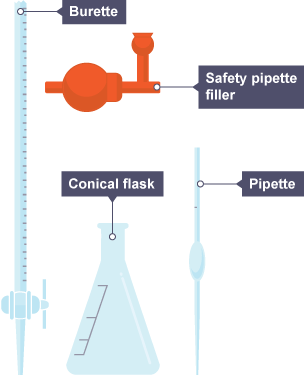
1) Use a graduated pipette and safety filler to put 25cm3 of 0.1M sodium hydroxide solution into a 250cm3 conical flask. 2) Add 3-5 drops of indicator. 3) Place a white tile under the burette, then fill to the 0 mark with hydrochloric acid. *Remember the bottom of meniscus must be in line with the 0 line* 4) Add the acid from the burette 1cm3 at a time until you approach the end point (given your indicator colour change). Swirl the conical flask constantly. Now add the acid one drop at a time until you have reached the end point, as seen by the colour change. 5) Repeat the experiment until 3 concordant results are obtained.
What is a titration used for?
A titration is used to measure accurately how much acid and alkali react together completely.
What is the difference between a pipette and burette?
• A pipette measures a fixed volume, has a single graduation and has no tap. • A burette measures different volumes, has graduations and has a tap.
What are concentrations of solutions measured in?
g/dm3 or mol/dm3.
How can the number of moles of a solution be calculated?
n=vc/1000 n= no. of moles (mol). v= volume (cm3). c= concentration (moldm-3 or M).
We found that 25.2cm3 of 0.1moldm-3 hydrochloric acid was needed to neutralise a 25cm3 sample of sodium hydroxide. Calculate the concentration of NaOH.
1) n=(25.2 x 0.1)/1000= 0.00252 moles of HCl. 2) HCl + NaOH➡️NaCl + H2O= 1 mole of HCl always reacts with exactly 1 mole of NaOH. 3) c= 1000n/v= (1000 x 0.00252)/25= 0.1008M.
How can the mass of a solute be calculated from the number of moles in it?
n= m/Mr n= number of moles (mol). m= mass (g). Mr= relative formula mass.
What is the mass of sodium hydroxide in 100cm3 of a solution with a concentration of 0.2mol/dm3? 1 mol NaOH= 40g.
1) (100 x 0.2)/1000= 0.02mol. 2) 0.02 x 40= 8g.
How are qualitative methods for chemical analysis used?
Qualitative methods are used to find out if a substance is in a sample.
How are quantative methods for chemical analysis used?
Quantative methods can tell us how much of a substance is in a sample.
What is meant by equilibrium?
When the rates of the forward and reverse reactions of a reversible reaction are equal or when the amounts of reactants and products in a reversible reaction are constant.