Metal Reactivity Trends (topic 10)
No description yet. This curated deck is ready for daily study.
Card preview (19)
What are the characteristics of - Group 1 alkali metals
Soft Low density Low melting point Highly reactive
What are the trends as you go down Group 1 metals.
Reactivity increases Melting and boiling points decrease
Why are group 1 metals so reactive?
As they only have one electron in their outer most shell so it is very simple to lose only one and react with something
Why do group 1 metals become more reactive as you progress down the group?
As the number of shells increase the single electron on the outer shell becomes further and further away from the positive nucleus. This decreases the attractive force between electron and nucleus meaning the electron can react more easily.
What is produced when an alkali metal reacts with water?
Metal Hydroxide + Hydrogen
Metal + acid = ?
salt + hydrogen gas
How can you measure the reactivity of metals in acid?
By observing how vigorously or violently something reacts. Or measure the change in temperature - most reactive metals produce the most heat.
How can displacement reactions prove the reactivity of something?
As more reactive materials displace less reactive ones. eg. Iron oxide + aluminium -> Aluminium oxide + Iron
Name the reactivity series:
Potassium Sodium Lithium Calcium Magnesium Aluminium Zinc Iron Hydrogen Copper Silver Gold
What is oxidation?
The loss of electrons or the gain of oxygen
What is reduction?
The gain of electrons or the loss of oxygen
What is a redox reaction?
A reaction where both reduction and oxidation are taking place
What is an oxidising agent?
A substance that can cause another substance to be oxidised. The oxidising agent undergoes reduction in this process.
What is a reducing agent?
A substance that can cause another substance to be reduced. The reducing agent undergoes oxidisation in this process
What does lithium react with oxygen to form
Lithium Oxide Li2O
What does sodium react with oxygen to form
Mixture of Sodium Oxide (Na2O) and Sodium Peroxide (Na2O2)
What does potassium react with oxygen to form
Mixture of potassium peroxide (K2O2) and potassium superoxide (KO2)
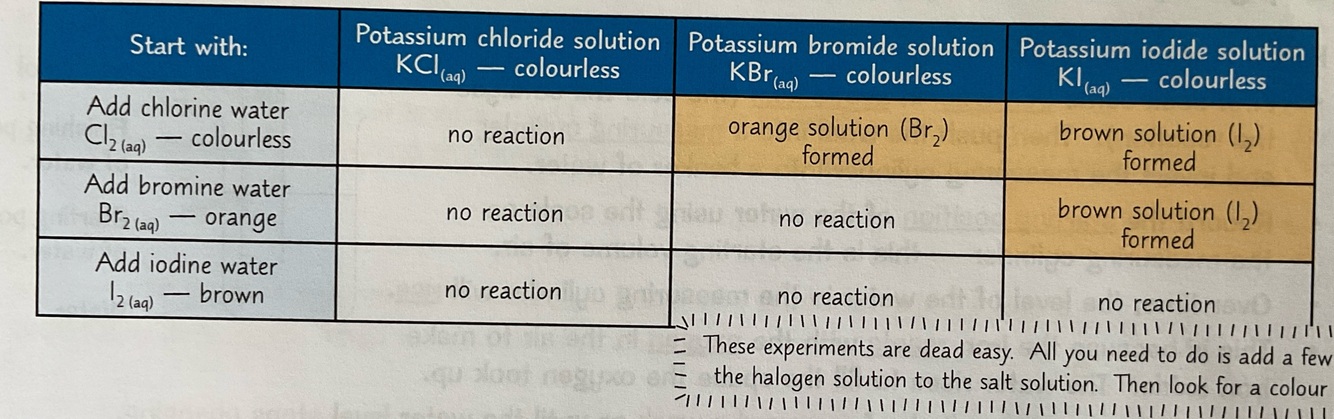
What does the displacement table look like?
Chloride bromide iodide - most reactive to least