M4 - Basic Concepts of Organic Chemistry
No description yet. This curated deck is ready for daily study.
Card preview (24)
Define the term Homologous Series
• A family of compounds containing the same functional group (1 mark) • but with each successive member of the series differing by a -CH2 (1 mark)
Define the term Hydrocarbon
A compound that contains ONLY hydrogen and carbon atoms (1 mark)
Define the term Saturated
A compound that contains single carbon-to-carbon bonds (1 mark)
Define the term Unsaturated
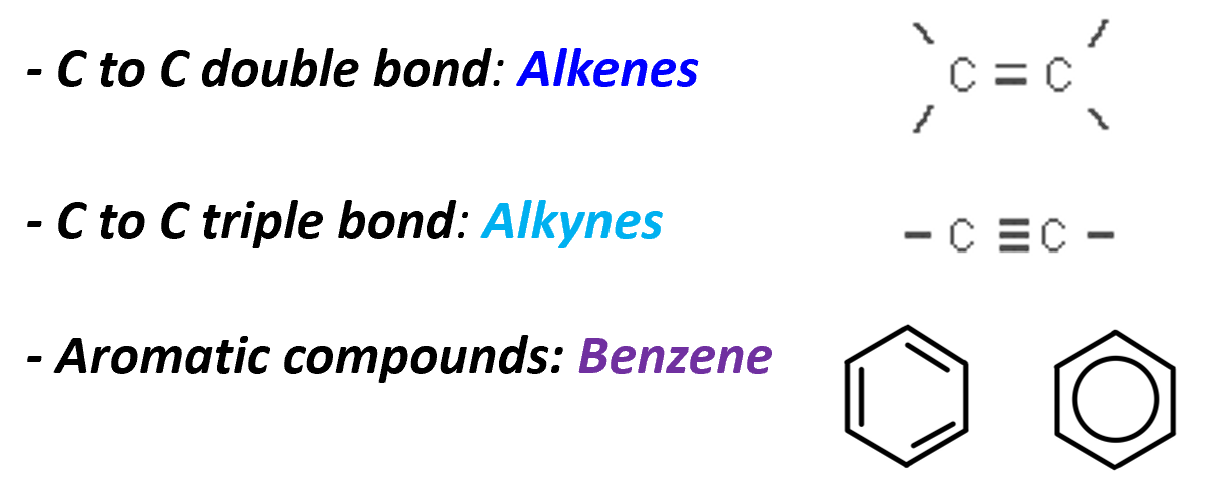
• Compound that contains at least one multiple bond between carbon atoms (1 mark) • This includes:
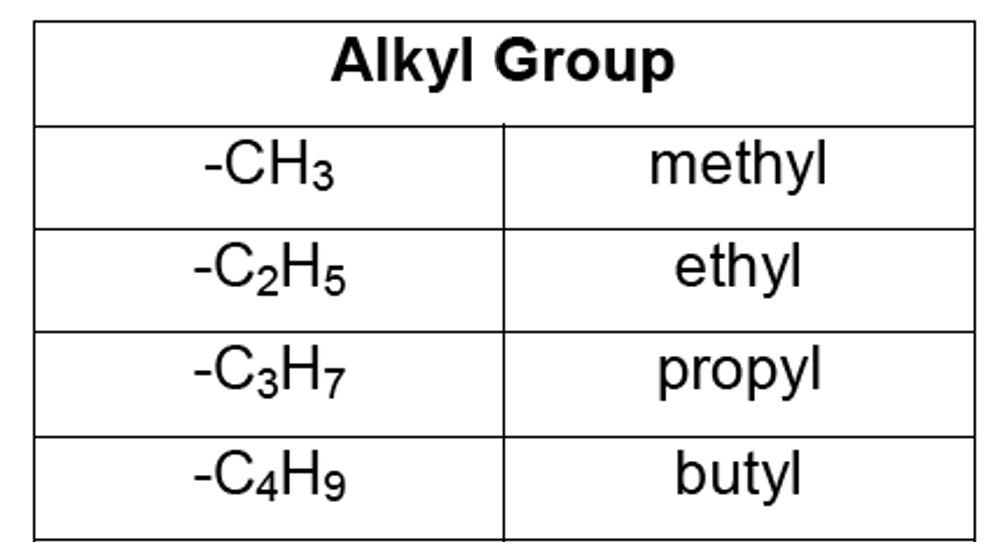
What is the general formula of an Alkyl Group? Provide some example of these groups
CnH2n+1
Define the term Functional Group
Atom/group responsible for the characteristic reactions of the compound (1 mark)
Why is an Alkane or Alkyl Group not classed as a Functional group?
• They are both relatively unreactive as they have strong C-H and C-C bonds • C-C & C-H bonds are non polar • C and H atoms have similar electronegativities
What are Aliphatic Compounds - provide some examples
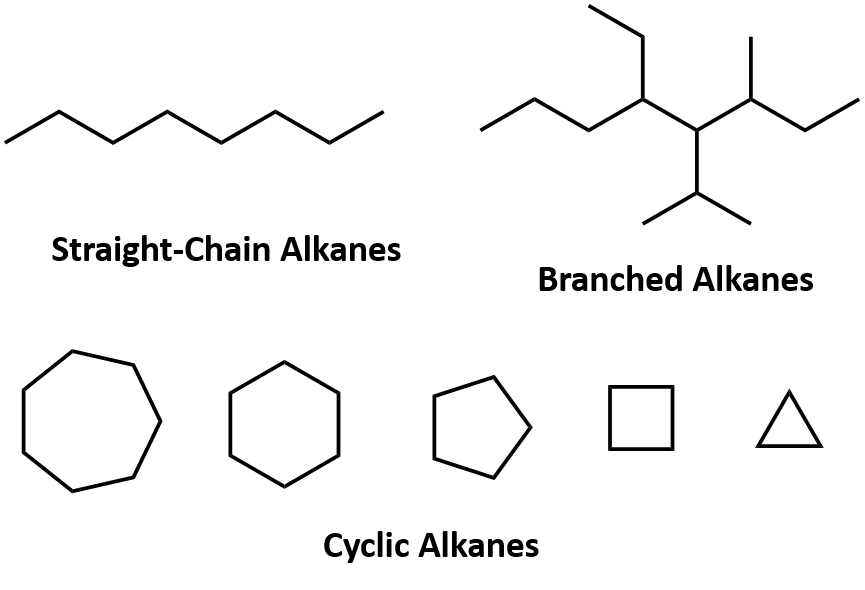
• A compound containing carbon and hydrogen joined together in straight chains, branched chains or non-aromatic rings • Examples include (not limited to alkanes):
What are Alicyclic Compounds - provide some examples
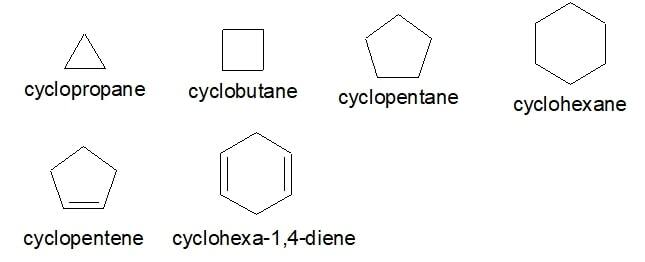
• An aliphatic compound arranged in non-aromatic rings with or without side chains • Examples include (not limited to):
What are Aromatic Compounds - provide some examples
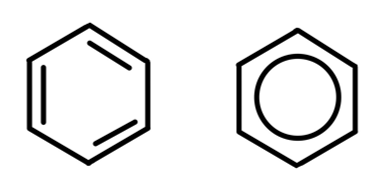
Compounds that contain a benzene ring which has the formula C6H6 and can be represented as:
The organic compounds in the table below can be termed: aliphatic, alicyclic or aromatic. Identify, using letters E, F, G, H, I & J, the compound(s) which are the above types (3 marks). Each response may contain more than one letter.
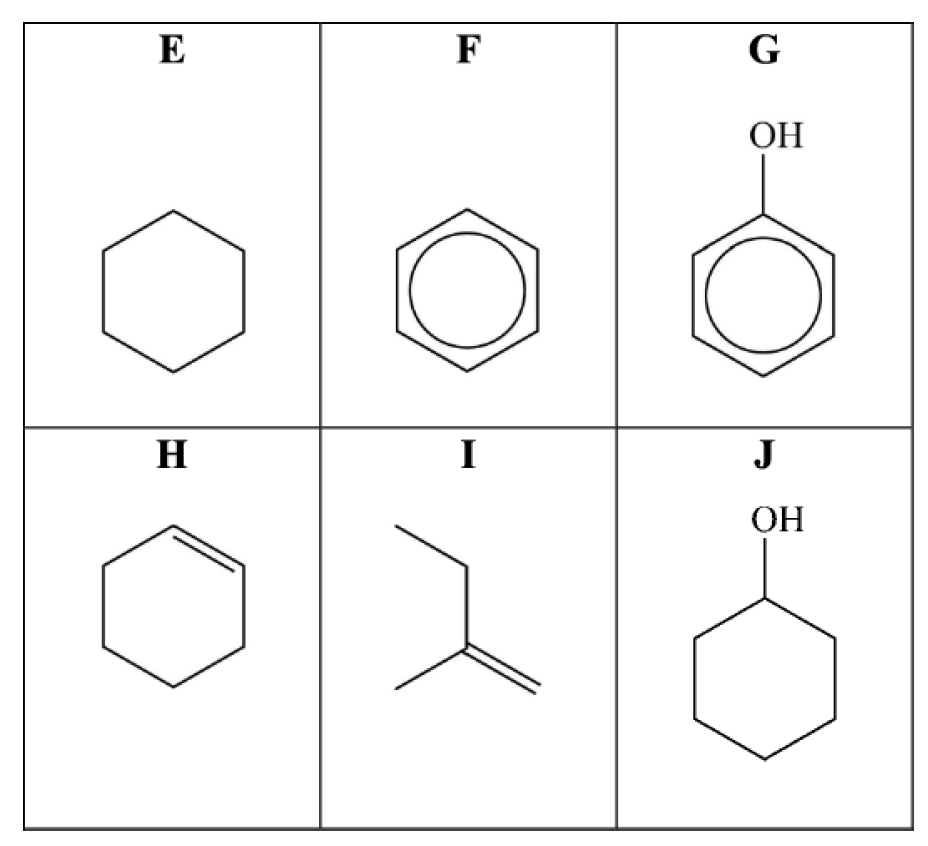
• Aliphatic: E, H, I & J (1 mark) • Alicyclic: E, H & J (1 mark) • Aromatic: F & G (1 mark)
Propyne, CH3C≡CH, is a member of the alkynes homologous series with the C≡C functional group. What is the general formula of the alkynes?
CnH2n-2
Define the term Homolytic Fission
The breaking of a covalent bond, where one electron (from the bond pair) goes to each atom, forming 2 radicals
Define the term Heterolytic Fission
The breaking of a covalent bond, where one bonding atom receives both electrons, forming a positively and negatively charged ion
Define the term Radical
A specie with an unpaired electron (1 mark). This is formed via Heterolytic fission of Cl2
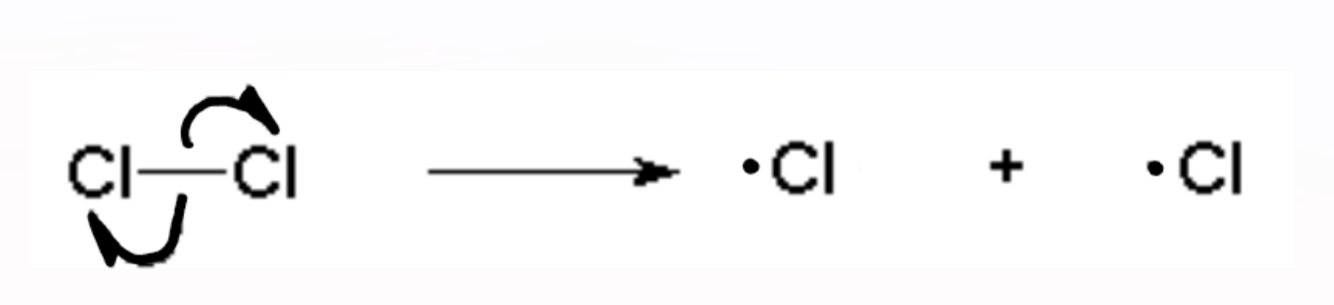
What does a curly arrow represent in a reaction mechanism?
Movement of a pair of electrons
Name, draw the displayed formula and skeletal formula for this compound: CH3CH2CH(CH3)CH3
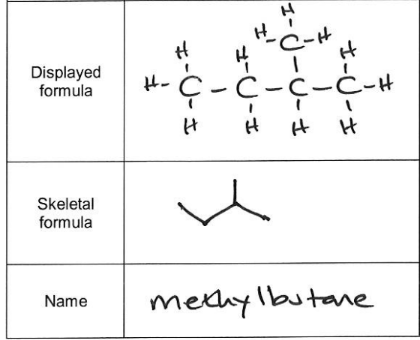
Draw the skeletal formula and write out the name and structural formula for this compound:
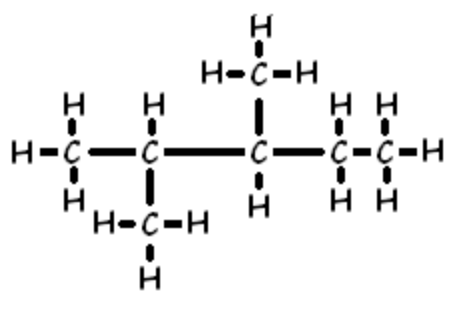
Name: 2,3-dimethylpentane Structural formula: CH3CH(CH3)CH(CH3)CH2CH3 Skeletal formula:
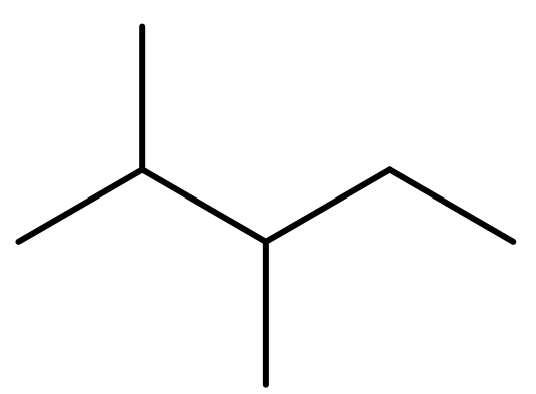
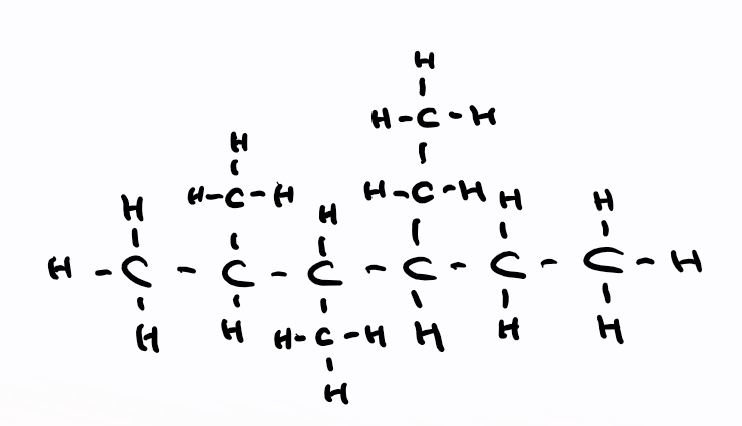
Draw the displayed formula and write out the name and structural formula for this compound:
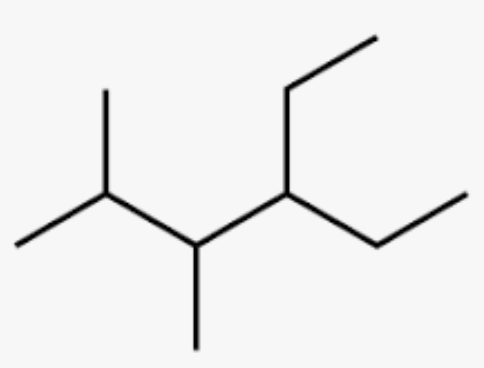
Name: 4-ethyl-2,3-dimethylhexane Structural formula: CH3CHCH3CH(CH3)CH(CH2CH3)CH2CH3 Displayed formula:
Name, draw the displayed formula and skeletal formula for this compound: CH3CH2CHCH2
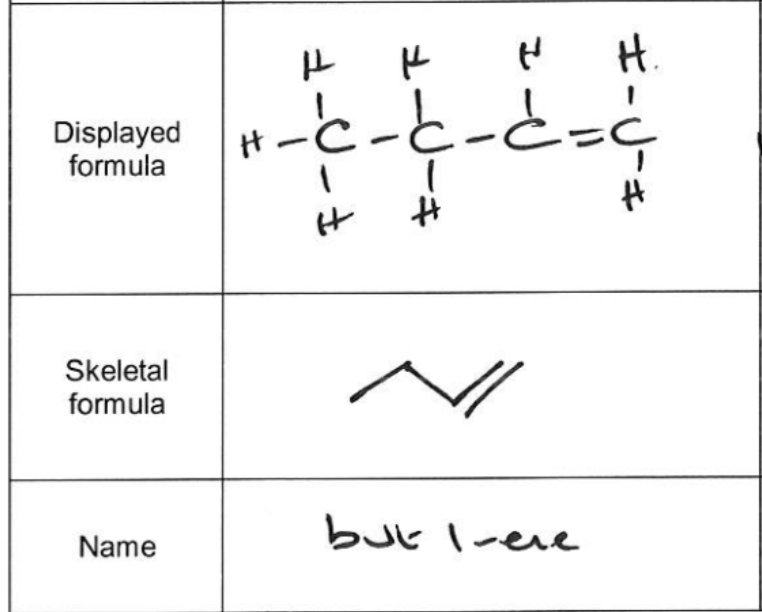
Draw the skeletal formula and write out the name and structural formula for this compound:
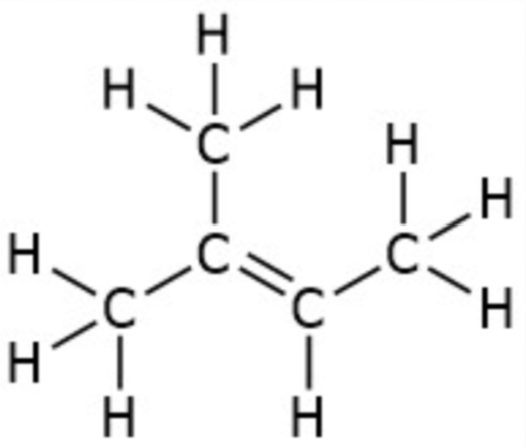
Name: 2-methylbut-2-ene Structural formula: CH3CCH3CHCH3 Skeletal formula:
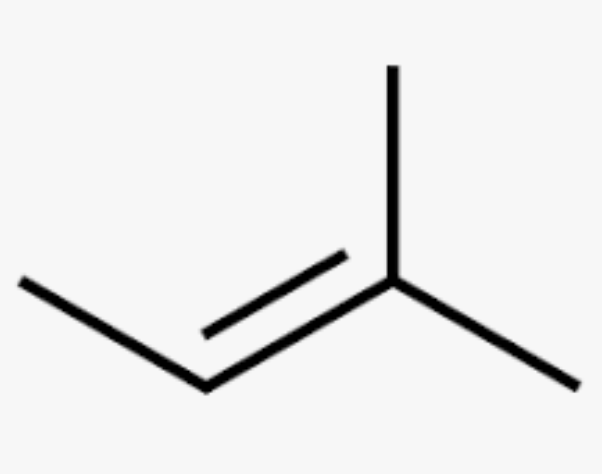
Draw the displayed formula and write out the name and structural formula for this compound:
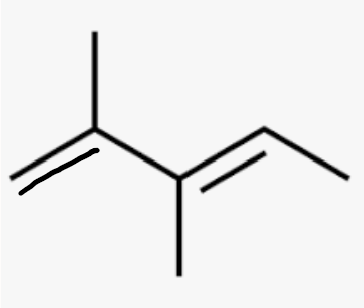
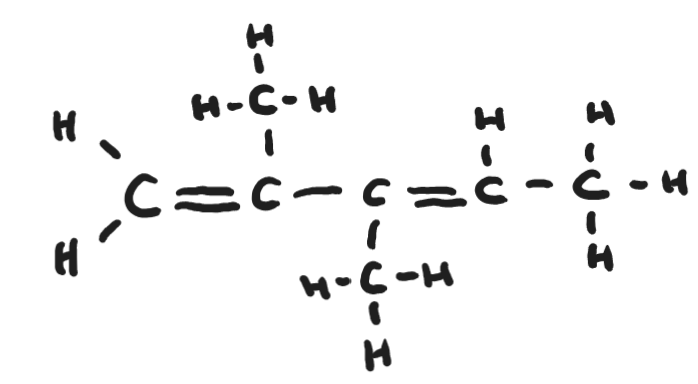
Name: 2,3-dimethylpenta-1,3-diene Structural formula: CH2C(CH3)C(CH3)CHCH3 Displayed formula:
Name, draw the displayed formula and skeletal formula for this compound: CH3CH2Br
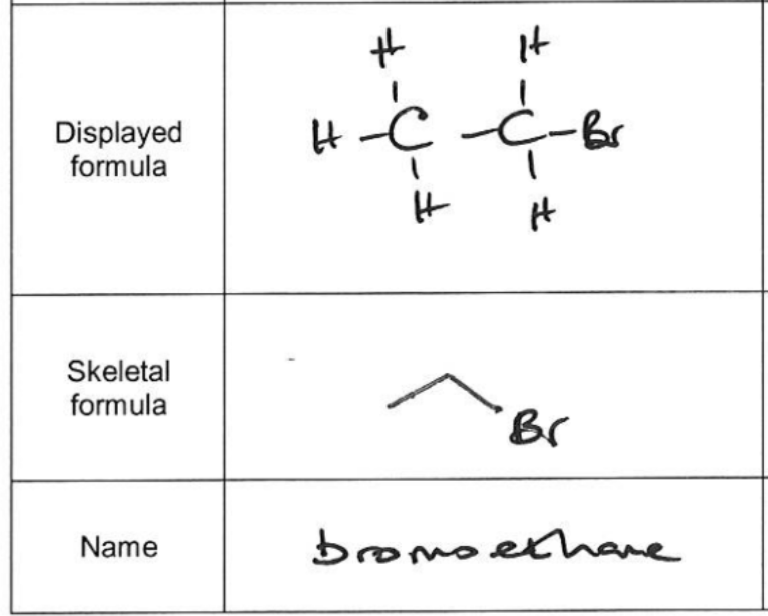
Draw the displayed formula and write out the name and structural formula for this compound: