13 - PERICYCLIC REACTIONS
No description yet. This curated deck is ready for daily study.
Card preview (13)
why can 4+2 thermal diels-alder happen?
similar symmetry of the HOMO and LUMO, whether the HOMO is the diene or the dienophile, and vice versa for LUMO
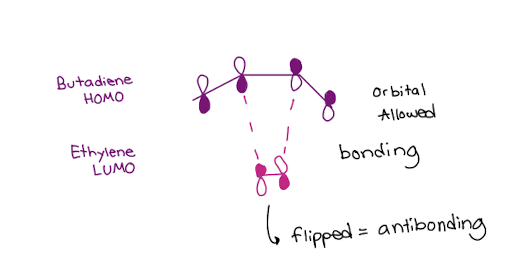
why does 2+2 thermal diels alder not happen?
not the same symmetry between the HOMO and the LUMO for example if you want to combine two ethenes two electrons go down and two electrons go down it cancels each other out, not beneficial
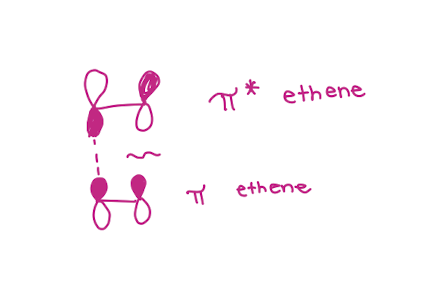
how do the edge signs change for HOMO and LUMO as you add more double bonds?
for HOMO: smallest unit, same carbon, start with edge orbitals being the same on the same side as you add one double bond, (two more carbons) you switch to the edges being opposite signs every time you add a double bond, you switch from same to opposite, starting with same for LUMO: smallest unit, same carbon, start with edge orbitals being the opposite on the same side as you add one double bond, (two more carbons) you switch to the edges being same signs every time you add a double bond, you switch from same to opposite, starting with opposite opposite=odd number of nodes same=even number of nodes
how do molecules interact base on whether their edge orbitals or same or opposite?
opposite binds with opposite and same with same mixing the two together does not work well together
what type of reactions work for 4n+2 vs 4n?
suprafacial cycloadditions are thermally allowed for 4n+2 but don’t work with 4n reactions antarafacial reactions work thermally with 4n reactions but that is too strained so it doesnt happen
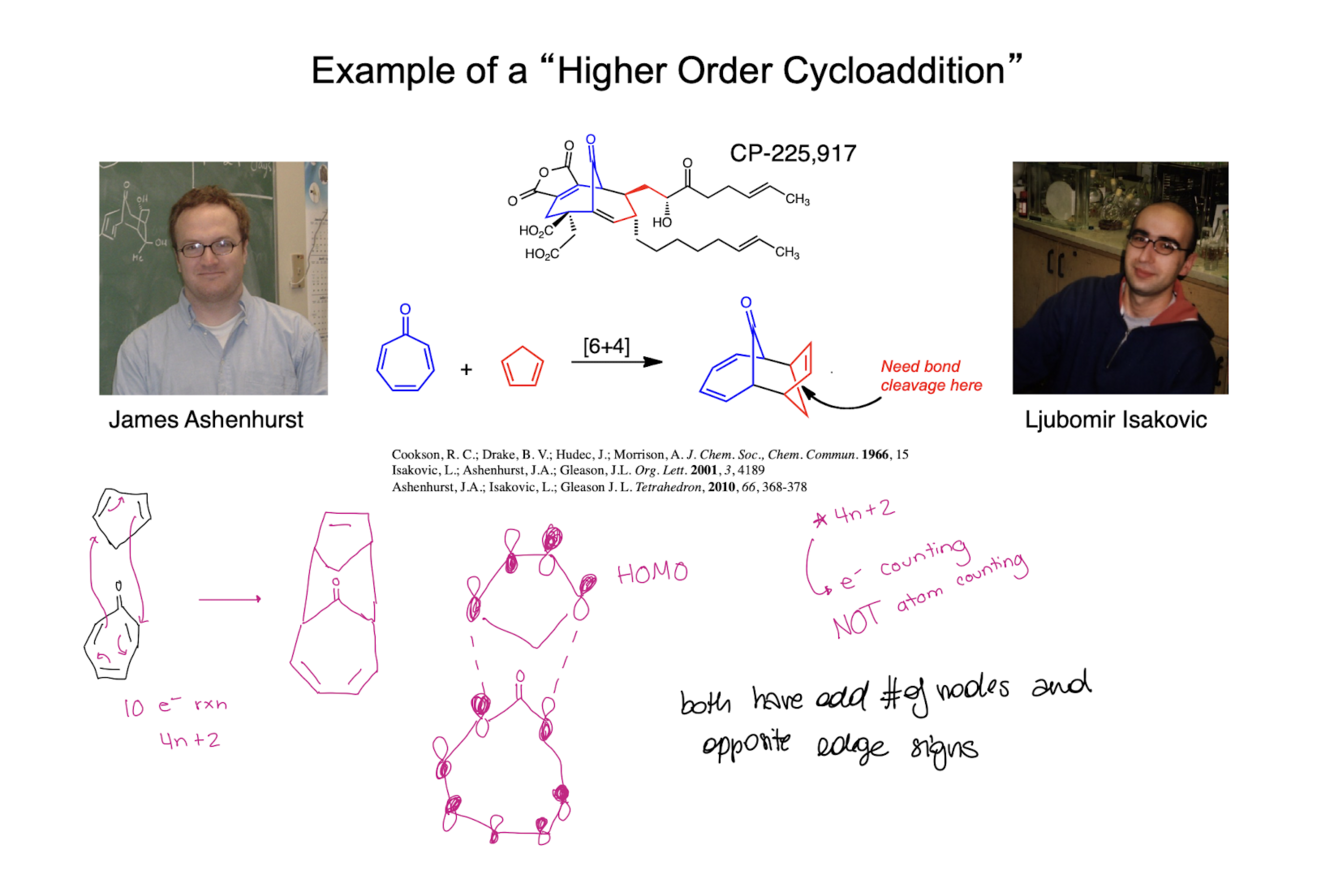
what is an example of a higher order cycloaddition?
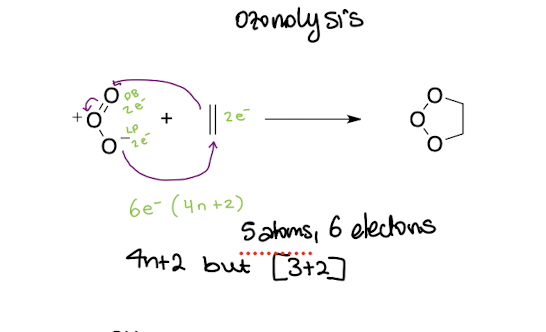
what is an example of a [3+2] dipolar cycloaddition
ozonolysis this is a 4n+2 reaction [3+2] counts the number of atoms 4n+2 counts the total number of electrons participating (in this case 6)
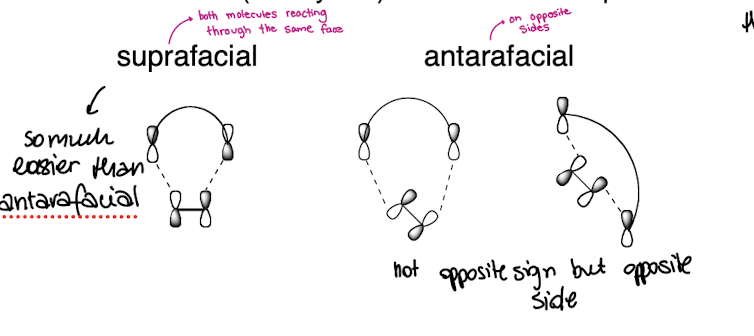
suprafacial vs antarafacial
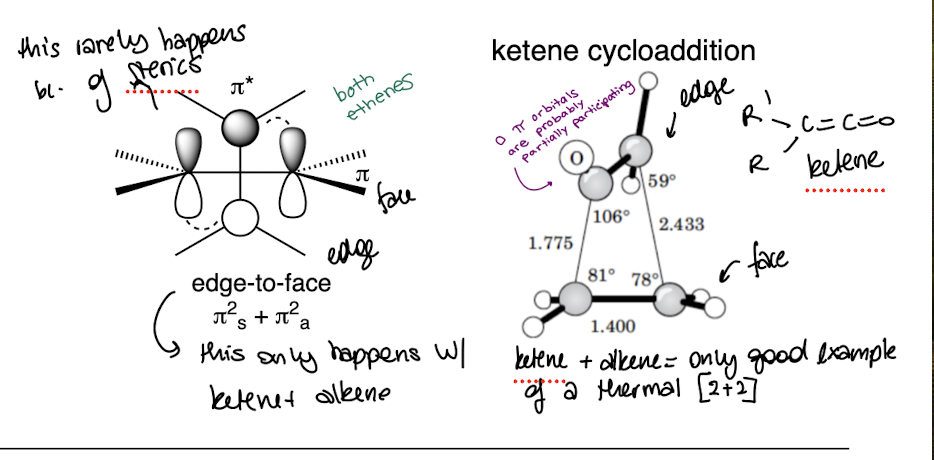
what is an edge-to-face reaction and what is an example of this reaction happening?
rarely happens because of sterics, but the only known example is ketene + alkene, which is the only good example of a thermal 2+2 the pi orbitals of the oxygen probably partially participate in this reaction
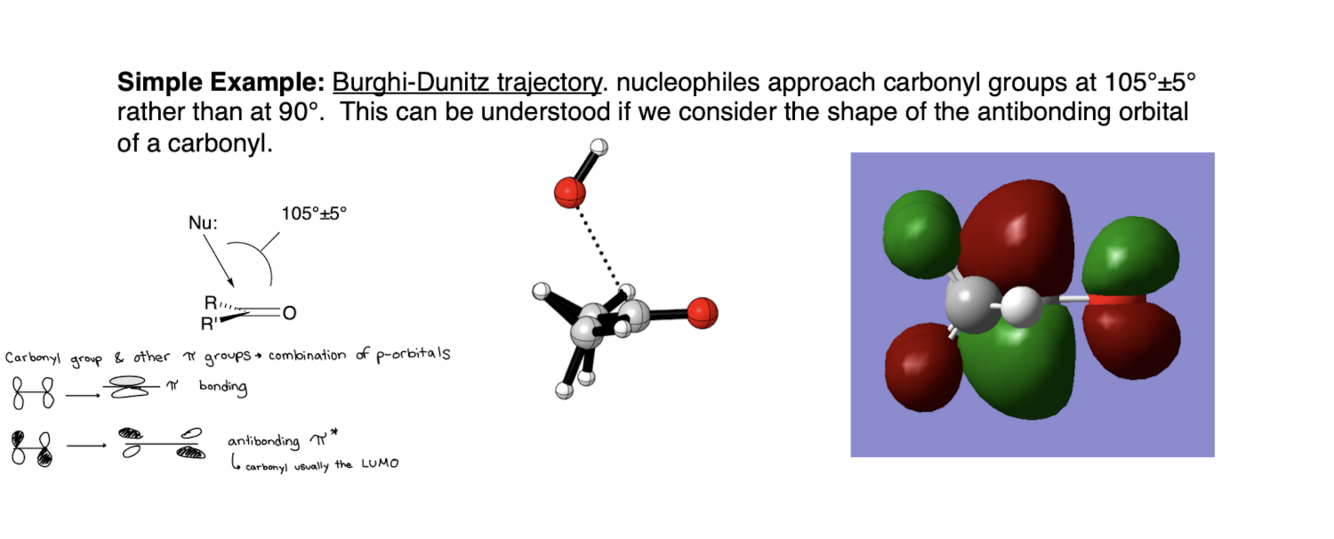
what is the burghi dunitz trajectory?
nucleophiles approach carbonyls at an angle of 105+-5°C instead of at 90°C that can be understood when we consider the shape of the antibonding orbital of the carbonyl
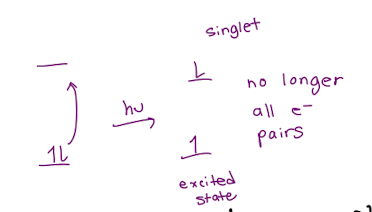
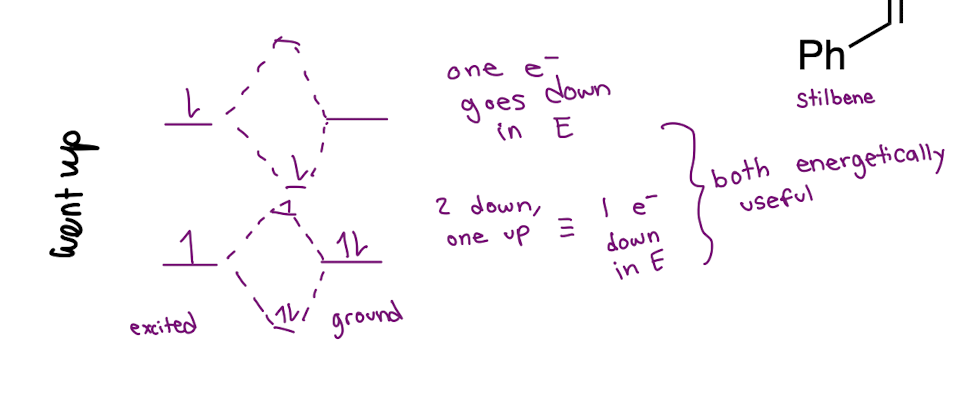
what happens when you shine light on a molecule?
excited electrons, and one goes to a higher orbital
why are suprafacial cycloadditions of 4n ([2+2]) allowed when you shine light on them?
excited interacts with ground state one electron has gone up when they interact, from the excited state one electron goes down from the ground state 2 go down and 1 goes up in net energy there is more going down than going up and they do not cancel each other out therefore that is energetically useful and 4n can happen, suprafacially
how do EWG and EDG affect energy of HOMO or LUMO?
EWG drops the energy of both HOMO and LUMO EDG raises the energy of both therefore you want to raise one and lower another to bring them as close as possible together to get a reaction to happen