Anatomy
No description yet. This curated deck is ready for daily study.
Card preview (24)
This region of the brain is responsible for decision-making, emotional reactions and processing memory. It consists of two groups of nuclei.
Amygdala
The pia mater, the arachnoid mater, and the dura mater are the three membranes that envelop the mammalian brain and spinal cord. They are known collectively by what term?
Meninges
In mammals, the small intestine is made up of three parts. One is the duodenum; what is the name for either of the other two?
Jejunum, Ileum
The plantar fascia is a fibrous band that helps to maintain the structure and shape of which part of the human body?
Foot
What collective name is given to the seven rounded bones in the foot, including the cuboid, talus and calcaneus?
Tarsals
From a Greek term also applied to a body of close-order infantry, what name denotes the fourteen bones found in the toes?
Phalanges
Which bone links the scapula with the sternum?
Clavicle (Collarbone)
Epinephrine, norepinephrine, aldosterone, and cortisol, as well as certain male sex hormones (androgens), are all hormones produced in the human body by what glands?
Adrenal glands
This is the name of the small depression between your nose and upper lip.
Philtrum
Whereas placental mammals have separate digestive and urogenital openings, the majority of vertebrates—including most reptiles, amphibians, and birds—have a single posterior chamber into which the digestive, urinary, and reproductive tracts all enter. What is the term for this orifice?
Cloaca
You’ll find your philtrum just below this organ.
Nose
The name of what gland was obscured three times on this textbook diagram?
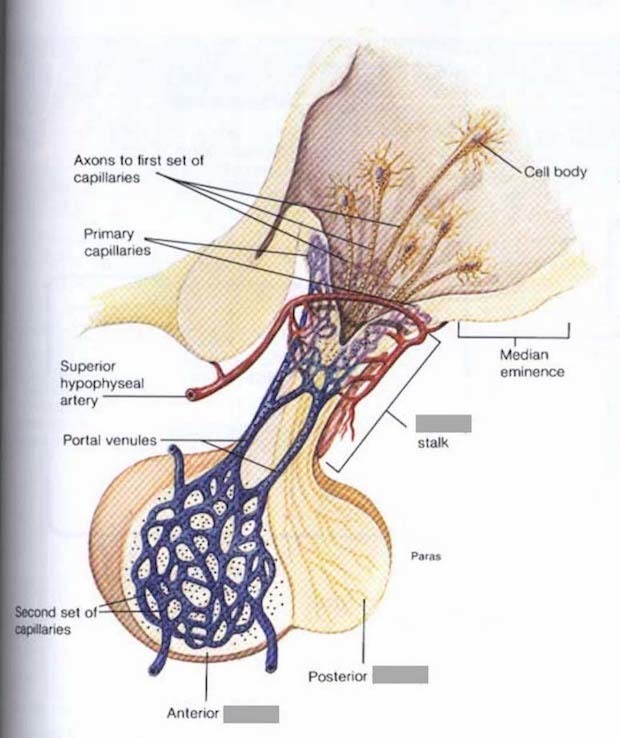
Pituitary
Veins in the human body carry deoxygenated blood, with two exceptions. One exception is the umbilical vein, which is present during prenatal development and transports oxygenated blood from the placenta to the fetus. What is the other exception—the only vein (actually four in number under normal conditions) that carries oxygenated blood and is present in all humans?
Pulmonary
In what part of the body would you find the anterior cruciate ligament and medial collateral ligament?
Knee
This arm bone was named for its supposed resemblance to the spoke of a wheel.
Radius
What’s the more common name for the pair of body parts also called nares?
Nostrils
What is the physiological term for the wavelike muscular contractions that pass along tubular organs, such as what propels food through the esophagus into the stomach?
Peristalsis
What part of your body is a trichologist most likely to help you with?
Hair
The medical term “syndactyly” refers to a condition where a person is born with which body parts fused together?
Fingers or toes
Adventitious, subcutaneous, synovial, and sub-muscular are the four types of what fluid sacs around your joints, which can become painfully inflamed when irritated or infected?
If you’ve ever had bursitis, it might be because someone punched the bursa.
It’s the 9-letter medical name for the heel bone, the largest bone in the foot.
Calcaneus
The liquid part of blood (i.e., blood minus the blood cells) is plasma. What is the term for blood plasma from which fibrinogens and clotting factors have been removed?
Serum
What word, used colloquially to refer to a person’s nose, is the scientific term for the trunk of an elephant as well as for the elongated feeding and sucking organ of some invertebrates?
Proboscis
Bile aids digestion by breaking up large molecules of fat; it’s stored in the gallbladder but made by this organ.
Liver