Exam 1
No description yet. This curated deck is ready for daily study.
Card preview (24)
what are the two systems that are present in all cells, but are highly elaborated in neurons?
• Molecular machines for moving material around the neuron • Ion channels/transporters and the machinery required to properly localize them and adjust their number
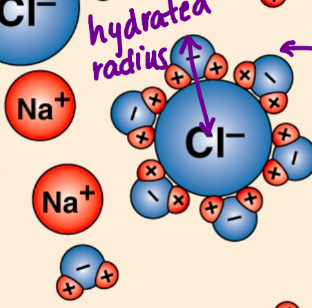
relationship b/w ions and water
ions in solution have layer of water around them, forming hydrated and dehydrated radius (both are important in determining whether ions can get in and out of cells through ion channels)
cations and anions important in neurophysiology
Cations: Na+, K+, Ca2+, Mg2+ Anions: Cl-
structure of phospholipids? what can pass phospholipid bilayer?
polar head containing phosphate + nonpolar hydrocarbon tail charged and polar molecules cannot pass through (need membrane protein)
electrically, phospholipids act as ____…..
as insulators, giving membranes the property of capacitance (can separate charges)
thickness of bilayer and membrane potentials
thickness is ~4nM, so a potential of 100mV has field strength of 25million V/m voltages greater than ±200 mV cause bilayer to break down so all biological potnetials are less than this
amino acids: polar (hydrophilic) vs nonpolar (hydrophobic) mnemonics
nonpolar: Grandma Always Visits London In May For Winston’s Party polar: Santa’s Team Crafts New Quilts Yearly
charged amino acids mneumonic
Dragons Eat Knights Riding Horses
which amino acid can form disulfide bonds
cysteine
which amino acids can be phosphorylated
Serine (Ser, S), Threonine (Thr, T), Tyrosine (Tyr, Y)
proper protein folding sometimes requires:
chaperone proteins or post-translational modification
post-translational modifications in neurons + enzymes
disulfide bonds link cysteines to constrain structure (reductase breaks bonds, oxidase forms bonds) phosphorylation adds negative charge to temporarily alter structure/function (kinase adds PO4-, phosphatase removes)
mammals have hundreds of different neuronal types that can be characterized by what properties?
• Pattern of connectivity to other neurons • Electrical properties • Biochemistry –> New method is to create single cell gene expression profiles
Nobel prize in physiology/medicine in 1906: names
Golgi and Cajal
Camillo Golgi developed what?
golgi stain: first to reveal complexity of neuronal structure fix/section tissue, soak in potassium dichromate, add silver nitrate → black participate stains few cells completely
what did golgi and cajal disagree on
disagreed on what images obtained from golgi method meant Cajal: Neuron Doctrine (neurons unit of function of brain) Golgi rejected neuron doctrine
what is special about golgi labeling/staining
staining is sparse, so axonal and dendritic geometry can be observed
dendrites: excitatory and inhibitory input
for pyramidal neurons: most of the excitatory synaptic input is onto dendritic spines most of inhibitory synaptic input is onto dendrite shaft or cell body
axons make their presynaptic contacts at:
enlargements referred to as boutons boutons may be along the axon (en passant) or at the end of fine terminal branches of the axon –> studied by Cajal
1899 Cajal: two major classes of cerebellar neurons
purkinje neurons: elaborate dendritic treets, planar granule neurons: not planar
not all neurons have dendrites: two examples
spherical bushy cell of the cochlear nucleus rat submandibular ganglion neurons
retrograde vs antergrade transport
retrograde: toward cell body anterograde: toward nerve terminals
classic experiment to measure rate of axonal transport
• Inject radioactively labeled AAs into extracellular space of cell body • Usually in spinal cord or DRG (sensory ganglion) to avoid spillover • AAs are taken up into cell, used to synthesize proteins, some of which travel down axon • Cut chunks of axon, isolate proteins using gel electrophoresis
slow vs fast axonal transport
slow: 0.2-8 mm/day fast: 50-400 mm/day