LO 4.2 - Cation exchange capacity – definition
No description yet. This curated deck is ready for daily study.
Card preview (5)
Question What is Cation Exchange Capacity (CEC)? Cation exchange capacity (CEC)
• Cation exchange capacity is the ability of a soil to hold onto nutrients and prevent them being leached. High values indicate a fertile soil. Cation exchange capacity (CEC)
Question How is CEC expressed? Cation exchange capacity (CEC)
• CEC is expressed in milligram equivalents (meq) per 100 g of soil. Cation exchange capacity (CEC)
Question What does the meq figure refer to? Cation exchange capacity (CEC)
• The meq figure is an estimate of the number of negatively charged sites available to hold cations. Cation exchange capacity (CEC)
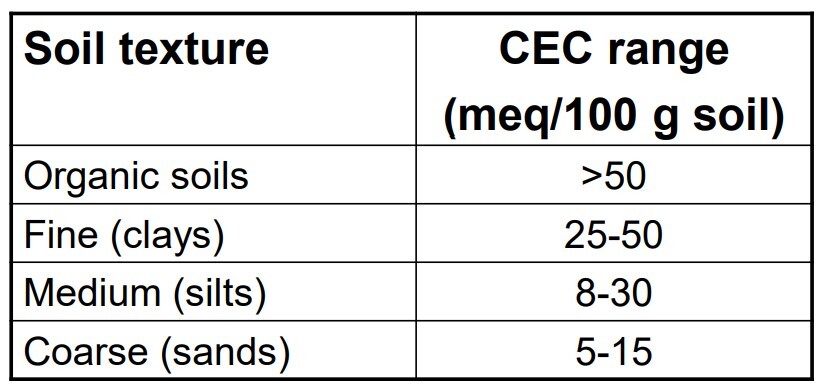
Question Which types of soils have higher CEC? Cation exchange capacity (CEC)
• Finer textured soils have a higher CEC (review soil texture – clay particles are the finest ones) • This is partly because of the higher surface area (relative to volume) of smaller particles, and partly because the clay particles have a negative charge. • Organic matter also has a high CEC. Cation exchange capacity (CEC)
Question What is important about soils with a high CEC? Cation exchange capacity (CEC)
Soils with a high CEC provide a nutrient reserve for plant uptake between fertiliser applications. Cation exchange capacity (CEC)