Triple & Further Science: Physics (III)
No description yet. This curated deck is ready for daily study.
Card preview (24)
What are X-rays used for and what properties do they have?
X rays are high frequency, short wavelength EM waves (wavelength roughly the same size diameter of an atom)
How do X-rays work?
X-rays are transmitted (pass through) healthy tissue and are absorbed by denser materials such as bone and metal
How are X-rays formed electronically?
Charge-coupled devices (CCDs) are silicon chips which detect X-rays
What are CT scans?
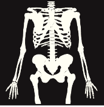
Computerised axial tomography (CT) scans use X-rays to produce high res. images of soft and hard tissue
How do CT scans form a 3D image?
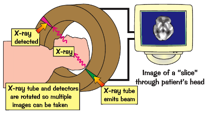
X-rays are passed through the patient and many 2D images are linked forming a 3D image
How do X-rays treat cancer?
X-rays are carefully focused to ionise cancer cells without damaging too many normal cells X-rays are focused on the tumour and the beam rotated minimizing healthy cell exposure
What precautions must be taken around X-rays and CT scanners?
X-ray dosage needs to be minimised by workers: lead aprons, stand behind lead screens or leave the room Patients have lead shields across areas of the body which are not being scanned and exposure time is minimised
What is the human hearing range and what is ultrasound?
20Hz – 20’000Hz A higher frequency of this upper limit is ultrasound
What happens to ultrasounds at the boundary between mediums?
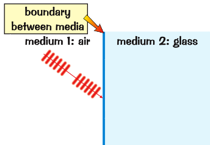
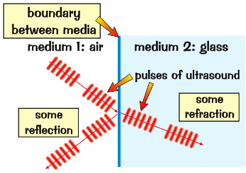
The ultrasounds are partially reflected (some reflected and some transmitted and refracted) The time it takes for reflections to reach the detector calculates the distance
What would the following ultrasound pulse reflect and refract like?
How can an oscilloscope trace be used to find boundaries?
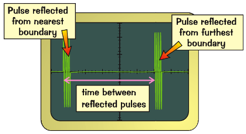
If the speed of sound in the medium is known distance can be worked out using s = v x t • s = distance (m) • v = speed (m/s) • t = time (s)
What is ultrasound used for?
Breaking down kidney stones; pre-natal scanning; cleaning machinery
What are the pros / cons of X-rays, CT scanning and ultrasound?
X-rays and CT scans are ionizing (cause cancer if too high a dosage) and CT scans use many X-rays, whilst ultrasound are non-ionising and safer Ultrasound images are fuzzier whilst X-rays are clear and CT scans are very detailed with high resolution.
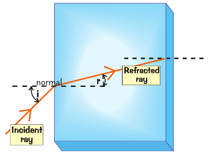
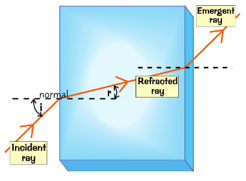
What is refraction?
Refraction is the change of direction of a wave when entering a different medium (due to wave speed change)
Where is the likely path of the emergent ray?
What is the refractive index?
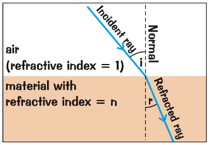
Refractive index of a medium is the ratio of the speed of light in a vacuum to the speed of light in that medium
What is the equation for reactive index?
Refractive index (n) = sin i ÷ sin r
What are the two main types of lens?
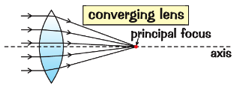
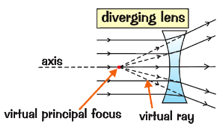
Converging lens – convex shape (bulges out) Diverging lens – concave shape (caves inwards)
Draw a converging lens (convex)
Parallel rays of light converge (move together) at the principal focus
Draw a diverging lens (concave)
Parallel rays of light diverge (spread out)
What is the axis of a lens?
A line passing through the middle of the lens
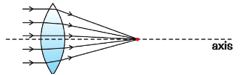
What is the principal focus of a converging lens?
Where the rays hitting the lens parallel to the axis all meet
What is the principal focus of a diverging lens
Where the rays hitting the lens parallel to the axis appear to all come from
What is the focal length?
The distance from the centre of the lens to the principal focus (occurs on each side of the lens)