M2 Bonding Q&A
No description yet. This curated deck is ready for daily study.
Card preview (14)
Explain how the ‘Electron Pair Repulsion Theory’ can be used to predict the shape of a molecule
• Electron pairs repel each other to get as far apart as possible • Lone pairs of electrons repel more strongly than bonding pairs • Shape is determined by the number and type of electron pairs (bond pairs / lone pairs) around the central atom • YOU MUST STATE THE NUMBER OF BOND PAIRS AND LONE PAIRS OF ELECTRONS
State and explain the shape and bond angle in CH4
• Shape is tetrahedral and bond angle 109.5o • There are 4 bonding pairs of electrons around the C atom • Bonding pairs repel equally
State and explain the shape and bond angle in NH3
• Shape is pyramidal and bond angle 107o • There are 3 bonding pairs of electrons and 1 lone pair around the N atom • Lone pair of electrons repel more strongly than bonding pairs
Explain why water, H2O is a polar molecule
• O is more electronegative than H • Makes a permanent dipole across the O-H bonds • (water is not symmetrical so dipoles don’t cancel)
Explain why carbon dioxide, CO2, is non-polar although the C-O bond is polar
• CO2 is symmetrical (linear) • Dipoles cancel
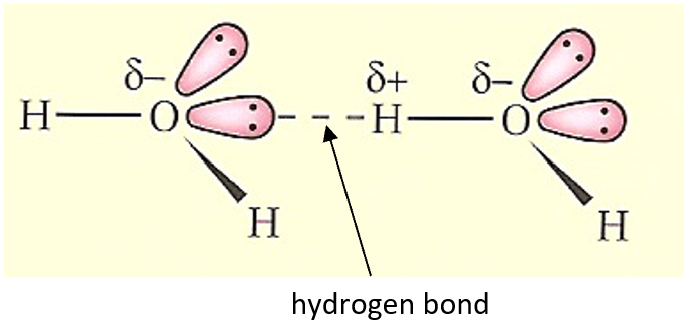
Describe the hydrogen bonding between two water molecules
• Well labelled diagram • Hd+ on one water molecule attracts lone pair of electrons on Od- atom of another water molecule
Describe and explain two anomalous properties of water, resulting from hydrogen bonding
• The boiling point of water is higher than expected (or the melting point of ice), as hydrogen bonds between molecules are the strongest intermolecular force and more heat energy is needed to break them • Ice is less dense than water, as hydrogen bonds are longer than covalent bonds, so they hold the molecules apart in an open lattice
Explain the boiling points of the three substances shown in the table below

• All are simple covalent / molecular substances, with weak intermolecular forces between molecules • Water is a polar molecule with O-H bonds, so has hydrogen bonding between molecules • Trichloromethane is a polar molecule, so has permanent dipole-dipole interactions between the molecules (as the C-Cl bond is polar and the molecule is not symmetrical) • Chlorine is a non-polar molecule, so has induced dipole-dipole interactions between molecules • Hydrogen bonds are the strongest intermolecular forces so more heat energy is needed to overcome them; induced dipole-dipole interactions are the weakest intermolecular forces so less heat energy is needed to overcome them; permanent dipole-dipole interactions have intermediate strength
In terms of structure and bonding, describe the melting / boiling point, and electrical conductivity of diamond
• Giant covalent lattice • Very high melting/boiling point; all strong covalent bonds between atoms so lots of heat energy needed to break them • Does not conduct electricity as there are no ions or electrons; all electrons are fixed in covalent bonds
In terms of structure and bonding, describe the melting / boiling point, and electrical conductivity of graphite
• Giant covalent lattice • Weak induced dipole-dipole interactions between layers of atoms • High melting/boiling point as there are many strong covalent bonds between atoms so lots of heat energy needed to break them • Conducts electricity as there are delocalised electrons which are free to move between the layers and carry charge
In terms of structure and bonding, describe the melting / boiling point, and electrical conductivity of graphene
• Giant covalent lattice • High melting/boiling point as there are many strong covalent bonds between atoms so lots of heat energy needed to break them • Conducts electricity as there are delocalised electrons which are free to move and carry charge
In terms of structure and bonding, describe the melting / boiling point, and electrical conductivity of sodium chloride true of any compound of metal + non-metal
• Giant ionic • High melting/boiling point as there are strong electrostatic attraction between oppositely charged ions (ionic bonds) so lots of heat energy needed to break them • Does not conduct electricity when solid as the ions are fixed in the lattice; does conduct electricity when molten or in solution as the ions are free to move and carry charge
In terms of structure and bonding, describe the melting / boiling point, and electrical conductivity of iodine true of any element or compound of non-metals
• Simple covalent / molecular • They have induced dipole-dipole interactions between molecules • Low melting/boiling points are little heat energy is needed to overcome intermolecular forces • Does not conduct electricity as there are no mobile ions or electrons (charge carriers); all electrons are fixed in covalent bonds
In terms of structure and bonding, describe the melting / boiling point, and electrical conductivity of sodium true of any metal
• Giant metallic lattice • High melting/boiling point as there are strong electrostatic attraction between the lattice of positive metal ions and delocalised electrons (metallic bonds) so lots of heat energy needed to break them • Conducts electricity as the delocalised electrons can move and carry charge