Chapter 22 (Substituted Benzenes)
No description yet. This curated deck is ready for daily study.
Card preview (24)
Characteristics of CBenzylic—H Bonds
• CBenzylic—H bonds are weaker (i.e. lower bond-dissociation energy) than Csp3—H bonds. • CBenzylic—H bonds are more acidic (i.e. lower pKa value) than Csp3—H bonds. These atypical Benzylic properties are caused by the resonance stabilization facilitated by the adjacent phenyl group.
Characteristics of Benzylic Alcohols
Benzylic alcohols are more easily oxidized than standard alcohol-containing compounds. The oxidation of Benzylic alcohols requires the MnO2 oxidative reagent. (Jones Oxidation and PCC are too strong of oxidation processes to effectively oxidize the Benzylic alcohol group.)
Characteristics of Benzylic Halides
Benzylic halides are more reactive in SN1 reactions than standard alkyl halides. This atypical Benzylic property is caused by the resonance stabilization facilitated by the adjacent phenyl group.
Alkylbenzene ⟶ Benzylic Halide
Radical Benzylic Halogenation
Reagents: Radical Benzylic Halogenation Starting Material = Benzylic Alkane
• X2, hv • X2, Δ
Alkylbenzene ⟶ Haloalkylbenzene
Halide Electrophilic Aromatic Substitution (Halide EAS)
Reagents: Halide Electrophilic Aromatic Substitution Starting Material = Benzylic Alkane
• X2, FeX3 • X2, AlX3
Dominant Reaction: Radical Benzylic Halogenation vs. Electrophilic Aromatic Substitution
• Electrophilic Aromatic Substitution is favored if a Lewis-acid catalyst is present. • Radical Halogenation is favored if heat (Δ) and/or light (hv) is added.
BDE: CBenzylic—H Bond (BDE = Bond-Dissociation Energy)
87 kcal/mol The relatively low BDE of CBenzylic—H bonds is brought about by the resonance stabilization of the resulting benzylic radical. (Conjugation with the π electrons of the adjacent phenyl group delocalizes the radical throughout the benzene ring.)
pKa: CBenzylic—H Bond
pKa ≈ 41 The relatively high acidity of CBenzylic—H bonds is brought about by the resonance stabilization of the resulting benzylic anion. (Conjugation with the π electrons of the adjacent phenyl group delocalizes the negative charge throughout the benzene ring.)
Alkylbenzene ⟶ Benzylic Anion
n–Butyl Lithium Deprotonation
Reagents: n–Butyl Lithium Deprotonation Starting Material = Alkylbenzene
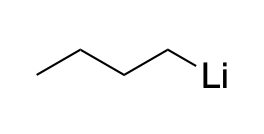
n–Butyl Lithium, TMEDA n–Butyl Lithium = CH3CH2CH2CH2Li
n–Butyl Lithium
n–Butyl Lithium is a strong base used to deprotonate CBenzylic—H bonds (and CAllylic—H bonds).
Why does SN1 Addition to a CBenzylic—H bond always occur at the CarbonBenzylic (instead of another resonance-form’s cationic Carbon)?
SN1 attack at the CarbonBenzylic creates the most stable addition product because the benzene’s aromaticity is maintained. SN1 attack at a cationic Carbon of another resonance form would create a less stable addition product because the benzene’s aromaticity would be destroyed.
1° Alkylbenzene ⟶ Acylbenzene
Room-Temperature Jones Oxidation The room-temperature Jones Oxidation reaction cannot break C—C bonds.
1° Alkylbenzene ⟶ Benzoic Acid
Heated Jones Oxidation The heated Jones Oxidation reaction will break CBenzylic—C bonds.
Reagents: Room-Temperature Jones Oxidation
• Na2Cr2O7, H2SO4 • CrO3, H2O, H2SO4
Reagents: Heated Jones Oxidation
• KMnO4, Δ • H2O, H2SO4 • Na2Cr2O7, H2SO4, Δ • H2O, H2SO4
Why is the Heated Jones Oxidation reaction able to break CBenzylic—C bonds?
The CBenzylic—C bond is a weak C—C bond, so it is readily broken under the strong/unstable Jones Oxidation conditions.
Benzylic Alcohol ⟶ Benzylic Carbonyl
MnO2 Oxidation
Reagents: MnO2 Oxidation Starting Material = Benzylic Alcohol Compound
MnO2 Oxidation MnO2 is a mild oxidizing agent that only oxidizes CBenzylic—OH bonds (and CAllylic—OH bonds).
Benzylic Ether ⟶ 1° Alkylbenzene
Benzylic Hydrogenolysis Benzylic Deprotection Typical CBenzylic—O bonds do not undergo Hydrogenolysis (within these conditions).
Benzylic Ether ⟶ Alcohol
Benzylic Hydrogenolysis Benzylic Deprotection Typical CBenzylic—O bonds do not undergo Hydrogenolysis (within these conditions).
Reagents: Benzylic Hydrogenolysis
H2, Pd-C Any transition-metal catalyst can be used during the Benzylic Hydrogenolysis reaction (in place of Pd-C).