14.1 - Standard electrode potential
暂无描述。系统推荐的高质量记忆内容,适合每天坚持背诵学习。
卡片预览 (24 张)
What are standard electrode potential?
Reactions and redox. Reaction involves equilibria.
What are the different tendencies of metals to release electrons and form positive ion?
When Metal like Mg is placed in water there is a tendency for the atoms to lose electrons and go into solution as ions. Electrons will remain on the surface of the metal. In short time there is a build up of electrons on the surface of the metal resulting in a negative charge attracting positive ions. Layer of positive ions is formed surrounding the metal. Some of the positive ions will regain their electrons from the surface of the metal and return to form a part of the metal surface.
What is the end point of this reaction?
Over time a dynamic equilibrium will be established which the rate at which the ions are leaving the surface of the metal to go into solution is the same as the rate which they are joining it from solution M+ + e- >< M
How can this be applied in a solution of magnesium and copper?
Difference between Magnesium and copper is that the equilibrium position will be further to the left hand side for the magnesium than for copper, tenancy of magnesium to release electrons is greater than that of copper so with Mg there will be a greater negative charge on the meta so more positive ions in solution.
What is absolute potential difference?
Measuring the potential difference between the metal and the solution.
Why is it not possible to measure the absolute potential difference between a metal electrode and its solution?
Its easy to connect metal electrode to one terminal of a voltmeter, other terminal would have to be connected to the solution. Only way of doing this is to dip another piece of metal into solution. However this would creates its own potential difference. So measuring P.D between the 2 metals
How do you solve this issue?
Create a reference electrode then measure the difference in potential between this reference electrode and the metal electrode
What is the standard hydrogen electrode?
Reference electrode is the standard hydrogen electrode. This electrode consists of hydrogen gas at a pressure of 100Kpa bubbling over a piece of platinum foil dipped into a solution of HCl with a H+ ion conc of 1moldm-3 temp of 298K Surface of plat foil covered with porous plat. Has a large surface area allows an equilibrium between hydrogen ions in a solution and the hydrogen gas to be established. H+ +e- >< 1/2H2
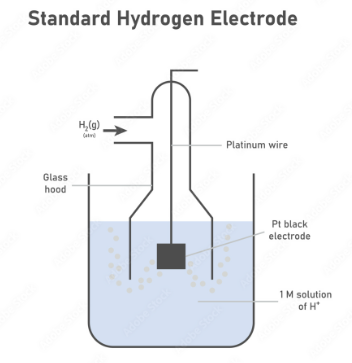
What is the importance of standard conditions for the hydrogen electrode?
Position of equilibrium can be changed by altering the conditions. Making a fair comparison the conditions have to be standardised 100Kpa gas pressure 298K temp 1moldm-3 ion conc
How is a standard electrode measured?
Measure the standard electrode potential between Mg2+ and Mg Connect the standard Hydrogen electrode to the Mg electrode via a circuit containing a high resistance voltmeter 2 Components of apparatus known as half cells combine to form a complete cell. Salt bridge is needed to complete electrical circuit. Usually contains a concentrated solution of KNO3. Allows the movement of ions. Salt bridge contain any ionic salt not allowed to interfere with component of half-cells.
Why can’t the 2 cells interfere with each other?
If the right hand half cells contains a solution of silver nitrate then potassium chloride is unsuitable for salt bridge because the chloride ions would interact with the silver ions to form a precipitate of silver chloride
Why is a high resistance voltmeter used?
The voltmeter should gave infinite resistance so that there is no flow of electrons around the external circuit. If this was possible the reading on the voltmeter would represent the difference in potential difference between the 2 half cells.
What are the 2 reactions for a Magnesium electrode?
H+ + e- >< 1/2H2 Mg2+ + 2e- >< Mg With Mg half cell connected to the standard hydrogen electrode the voltmeter reading is 2.37v
What is the difference between a negative and a positive sign for voltmeter reading?
A negative sign indicates that the metal electrode is negative with respect to the hydrogen electrode. A positive sign indicates the reverse The difference in potential measured, together with the sign is called the standard electrode potential of the metal or symbol E delta Mg2+ + 2e- >< Mg E=-2.37V Cu2+ +2e- >< Cu E=+0.34V Standard electrode potential of the standard hydrogen electrode is 0
What is the importance of E values?
Standard electrode potential is potential difference measured when half cell is connected to a standard hydrogen electrode Potential difference provides a comparison between position of the metal ion and the position of equilibrium of the hydrogen electrode
How can potential difference comparison be illustrated with Mg, H2 and CU?
Negative sign for Mg2+ / Mg indicates that the equilibrium position of this reaction is further to the left than the equilibrium position of the reaction in the hydrogen electrode Positive sign for the CU2+ / CU indicates that the equilibrium position of this reaction is further to the right than the equilibrium position of the reaction in the hydrogen electrode This shows Mg releases electrons more readily than H2 and CU but copper releases electrons less readily than H2 Mg is therefore a better reducing agent than both hydrogen and copper. Hydrogen better than copper
What is the summary of the importance of E values?
E values provide a method of comparing the position of equilibria when metal atom loses electrons and forms ions in solution. More negative E value the further the equilibrium lies to the left more readily the metal loses electrons to form ions. More positive the E value the further equilibrium lies to the right less readily metal loses electrons to form ions
What is electromotive force?
Potential difference is measured when no electrons are flowing throughout the external circuit. Potential difference measured under these conditions is called the Electromotive force of the cell. EMF can be positive or negative depending on the reference point which the P.D is measured. When measuring the electrode potentials the reference point is the potential of the standard hydrogen electrode is the positive electrode which is set at 0. EMF of a cell which the hydrogen electrode is the positive electrode will have a negative value. EMF of a cell which the hydrogen electrode is negative electrode will have positive value
How are the standard electrode potentials of more complicated redox systems measured?
Measuring the standard electrode potential for: 1/2Cl2 + e- >< Cl- Set up a half cell in which chlorine gas is bubbled into a solution containing chloride ions. In order to establish an equilibrium between the 2 and provide an electrical connection to the external circuit need to place a piece of platinum in solution. Half cell is then connected to a standard hydrogen electrode and EMF is measured in usual way.
How is the standard electrode potential of other systems measured?
Non-metal elements and their ions in solution: 1/2Br2 / Br- To determine the E of the redox system a half-cell containing a solution of Br2 and Br- ions, each of concentration 1moldm-3 is connected to a standard hydrogen electrode. Similar set up is used to determine the E of the redox systems 2 ions of the same element with different oxidation number
What is the electrochemical series?
Electrochemical series is built up by arranging various redox equilibria in order of their standard electrode potentials. Most negative E values are placed at the top of the series. Most positive at the bottom.
What are the reducing agents and oxidising agents in the electrochemical series?
Species on the right hand side of the half cell reactions are all capable of behaving as reducing agents because they can lose electrons. The most powerful reducing agents because its redox system has the most negative E value the value the equilibrium position of its half-cell reaction is furthest to the left. The least powerful reducing agent is because its redox system has the most positive E value. Position of equilibrium of its half cell reaction is furthest to the right.
What are the best oxidising agents?
Species on the left hand side of the half cell reactions are all capable of acting as oxidising agents because they can gain electrons
What is the summary of these values?
More negative the E value the more equilibrium lies towards the left and the more readily the species on the right loses electrons. More powerful reducing agent. More positive the E value the more the equilibrium position lies towards the right more readily the species of the left loses electrons. More positive the value the better oxidising agent