Radical Halogenation
No description yet. This curated deck is ready for daily study.
Card preview (10)
Which is the least stable carbocation?
methylcarbocation (CH3+)
As carbon chain in an alkane becomes longer, what happens to molecular stability?
Longer carbon chains increase stability of alkanes.
What results from heterolytic bond cleavage of halogen molecules?
Two reactive free radicals are formed. (Chlorine example shown).
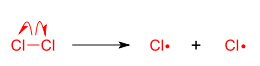
What is a free radical?
A species with an unpaired electron.
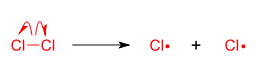
What is the first step in the general mechanism for free-radical halogenation?
Initiation: homolysis of a halogen molecule to form two halogen atoms, initiated by ultraviolet radiation or sunlight. A halogen atom has an unpaired electron and acts as a free radical. (Chlorination of methane shown).
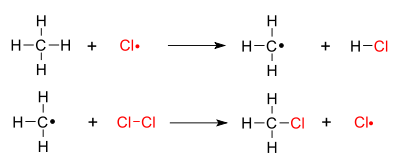
What is the second step in the general mechanism for free-radical halogenation?
Chain propagation: (two steps): a chlroine ion attracts a hydrogen atom away from methane (CH4) leaving a 1° methyl radical (CH3). The 1° methyl radical (CH3) then pulls a chlorine radical (Cl) from a different molecule of chlorine (Cl2), halogenating the methyl radical, but creating a new chlorine (Cl) radical. If there is sufficient chlorine, this process may repeat in a chain reaction until the third step in the general mechanism for free-radical halogenation.
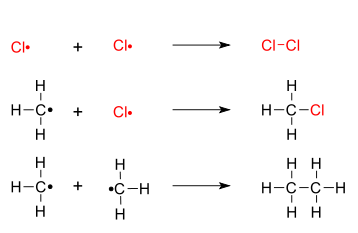
What is the third step in the general mechanism for free-radical halogenation?
Chain termination: recombination of two free radicals. Multiple recombination options exist, incliding two chlorine radicals (2 Cl) recombining to form molecular chlorine (Cl2); a chlorine radical (Cl) halogenating a previously deprotinated methyl radical (CH3) to form methane (Ch4); or two methane radiacals (CH3) reacting to form ethane (C2H6).
Is it easier to cleave a hydrogen from an alkane heterolyrically or homolytically?
Alkanes prefer heterolytic bond cleavage.
Is chloronation exothermic or endothermic?
exothermic
Is bromination exothermic or endothermic?
Endothermic.