C11 - Polymers 2️⃣✅
No description yet. This curated deck is ready for daily study.
Card preview (24)
What are monomers?
Small molocules that join together in log chains to make a polymer
What are polymers?
A long chain of small molocules
What is addition polymerisation?
The formation of long chain molocules from lots of small molocules joining together with no extra products produced
What is condensation polymerisation?
The formation of long chain molocules from lots of small molocules joining together with another small molocule (usually water/ H20) produced as well
What makes up a nucleotide?
• phosphate • sugar • base
DNA is made up of ____?
two long polymers that wind around in a double helix
How many different monomers does DNA contain and what are they called?
4 and they are called nucleotides
What does DNA stand for?
Deoxyribonucleic acid
What is a repeating unit?
The smallest part of a polymer that repeats itself throughout the chain
What is polymerisation?
A reaction that turns multiple monomers into polymers
What are the 2 types of polymerisation?
addition and condensation
What kind of monomers are involved with addition polymerisation?
molocules with C=C bonds e.g. alkenes
What kind of monomers are involved with condensation polymerisation?
monomers with two functional groups
What other product is (usually) produced in condensation polymerisation?
water
What is a natural polymer?
A polymer produced naturally by organisms
Give 3 examples of natural polymers
polypeptides,DNA & carbohydrates
What is a polypeptide?
A polymer made from many amino acids
What are amino acids?
The building blocks for polypeptides and protiens
What monomer makes up starch and cellulose?
glucose
What monomers are DNA made of?
nucleotides
How is DNA arranged?
double helix
What 3 things do you have to do when drawing displatyed formulas of addition polymerisation?
• Always draw bonds facing up and down, not diagonal • make sure the 2 empty bonds on each side of the repeating unit pass through the brackets • make sure the ‘n’ is in the middle left of the monomer and bottom right of repeating unit
How do monomers need to be drawn in addition polymerisation?
With all the carbons coming off of the C = C double bond (they cant conme from anywhere else, have to come from the bond; add the remaining carbons to a single bond just with a small formula of the remaining carbon & hydrogen of the monomer e.g.
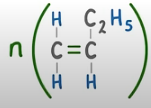
Do you draw the repeating unit or monomer with a C=C double bond?
The monomer has a C=C whereas the repeating unit just has a single bond with 2 bonds poking out of the side of the brackets