1C - Principles of chemistry (i) Electrolysis
No description yet. This curated deck is ready for daily study.
Card preview (14)
Why do covalent compounds not conduct electricity?
Because they have no delocalised particles which are free to move and carry current.
Why do ionic compounds only conduct electricity when molten or in aqueous solution?
When solid, the ions are in a fixed arrangement, so can’t move freely and carry current. When molten or in solution the ions are free to move, and carry current.
What is a anion and cation?
Anion - A negative ion, e.g. Br⁻ Cation - A positive ion, e.g. Na⁺
What is electrolysis?
The breaking down of a substance by passing electric current through it
When can ionic compounds undergo electrolysis?
When molten or in solution
What is the setup to carry out electrolysis?
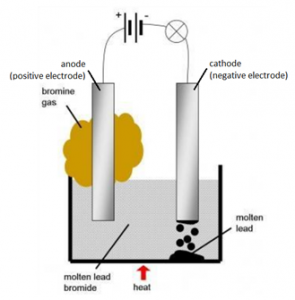
If the anode in on the left, and cathode on the right, where would ions from a solution of lead bromide form?
Lead - Cathode Bromine - Anode
What is the positively charged electrode called? What about the negatively charged electrode?
Positively charged - Anode Negatively charged - Cathode (PANIC)
When conducting electrolysis on an ionic solution, how do you work out what forms at the cathode?
• If the metal present is less reactive than hydrogen it will be produced • Hydrogen gas (H₂) will be produced (and effervesce) if the metal is more reactive than hydrogen
When conducting electrolysis on an ionic solution, how do you work out what forms at the anode?
• If a halide is present (Group 7), then a halogen gas will effervesce from the anode. • If not, hydroxide is discharged to form oxygen gas and will effervesce from the anode.
What is difference between electrolysis of molten and aqueous ionic compounds?
H⁺ and OH⁻ ions are present from the solvent (water), so other elements can be formed, as only one thing can be formed at each electrode.
What is the balanced half equation for the electrolysis of hydroxide at the anode?
4OH⁻ -> 2H₂O + O₂ + 4e⁻
How can you collect a sample of gas produced from electrolysis?
Place an inverted test tube into the solution over (but not fully covering, so ions are free to move in the solution) the electrode. These gases can then be tested to identify which gas it is.
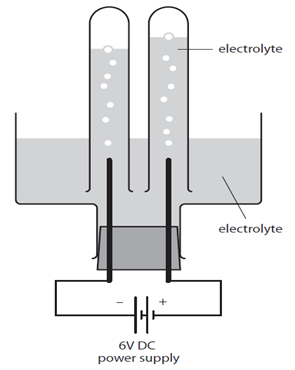
At which electrode does oxidation/reduction occur?
Oxidation - Anode Reduction - Cathode