Chapter 14: Ethers and Epoxides
No description yet. This curated deck is ready for daily study.
Card preview (20)
How do you synthesize a Grignard Reagent?
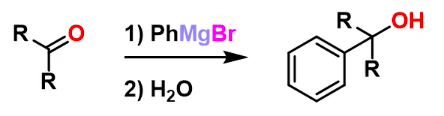
Using a metal (Mg) combined with an ether solvent

How do you form an ether from this compound?
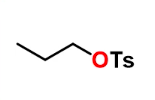
Via SN2 reaction with an alkoxide ion
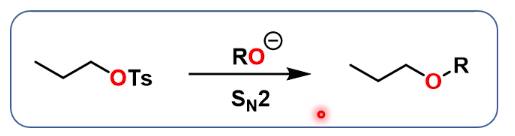
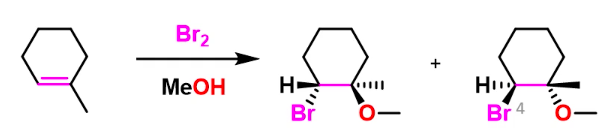
How do you form an ether from this compound?
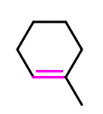
Via addition reaction
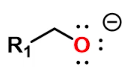
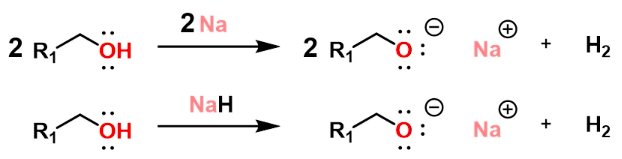
How do you form an alkoxide ion?
Can use elemental Na
What can an alkoxide ion be used for?
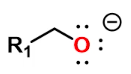
Acts as a nucleophile to convert an alcohol into an ether via Williamson ether synthesis (SN2)
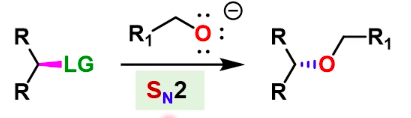
What type of substrate is important to use for ether synthesis?
Primary substrates bc they will favor SN2 reactions. Benzylic and allylic groups are the best to use. Can use a secondary substrate, but will also form E2 products
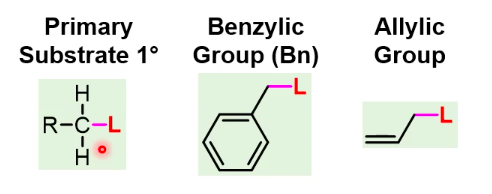
How can this ether be formed?

via SN2

What is the mechanism for this reaction? Reagents are H-Br
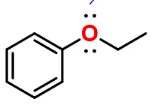
SN2 reaction that results in an alcohol and alkyl bromide

What is the mechanism for this reaction? Reagents are H-I
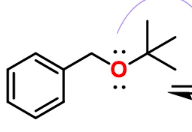
SN2 reaction Important: the nucleophile (in this case I-) will attack the less substituted carbon bc SN2 is faster than SN1 and the alcohol will form on the more substituted carbon Can convert the OH into alkyl iodide if you use the same reagents again

Note: SN1 occurs first in this reaction because it is faster than SN2 with the phenol

This is a unique example and probably won’t be on the test

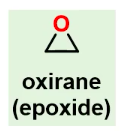
What is an epoxide?
AKA oxirane 3 membered cyclic ether
In an epoxide ring opening reaction, will a nucleophile attack the more or less substituted carbon?
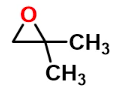
Depends on the conditions Basic - less substituted (SN2) Acidic - more substituted (SN1 like rxn)
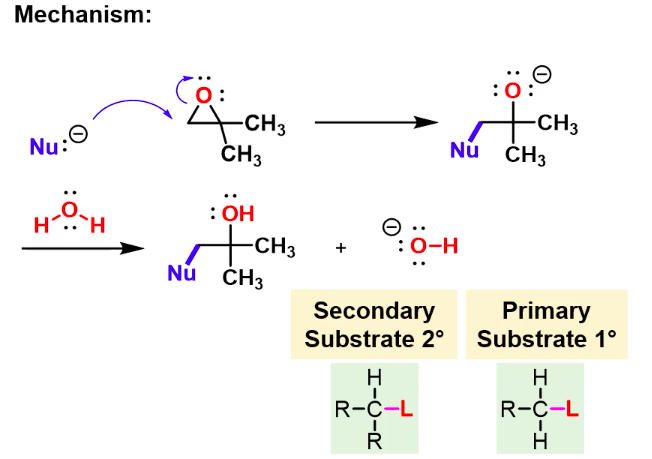
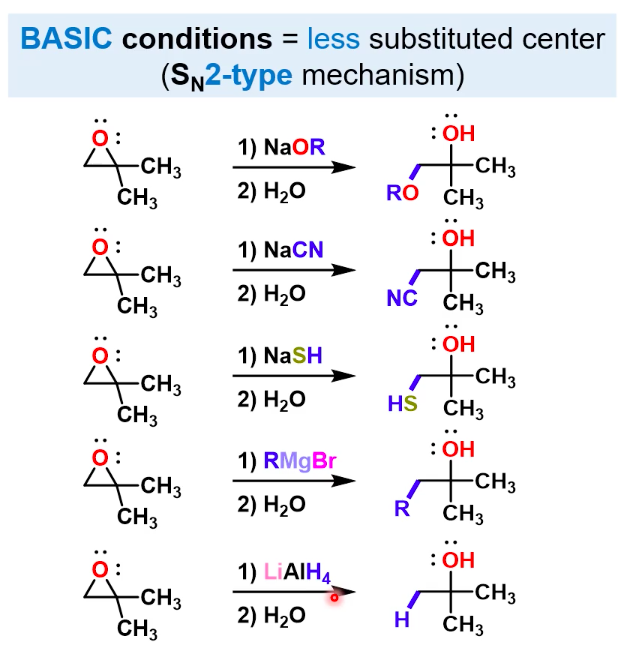
What is the mechanism for an epoxide ring opening reaction under basic conditions?
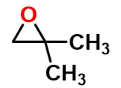
nucleophile attacks LESS substituted carbon
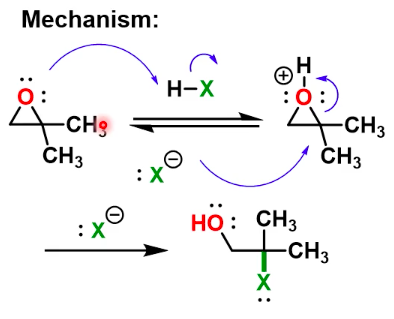
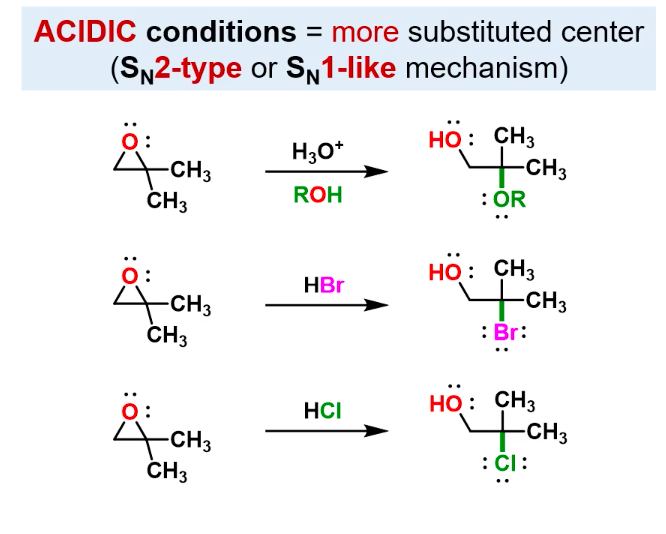
What is the mechanism for an epoxide ring opening reaction under acidic conditions?
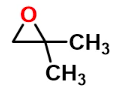
nucleophile attacks MORE substituted carbon
Epoxide ring opening reactions under basic conditions
Epoxide ring opening reactions under acidic conditions
What is important to know with SN2 reactions?
Inversion of configuration (only on the side the nucleophile attacks in epoxide ring opening reactions)

-OMe is the nucleophile basic conditions - nucleophile will attack less substituted carbon inversion of configuration on the side of the reaction where nucleophile attacks OMe points down and OH forms on the more substituted carbon

-OMe is the nucleophile acidic conditions - nucleophile attacks more substituted carbon inversion of configuration (SN2) OH forms on less substituted carbon

This will be SN1 so there will be no inversion of configuration There will be a racemic mixture of stereocenters at the side of the reaction the nucleophile attacks