Chapter 18- Reaction of Aromatics (Part II)
No description yet. This curated deck is ready for daily study.
Card preview (23)
What are the reactants used in a Friedel-Crafts Alkylation?
-An aromatic group -A halide group -AlX3
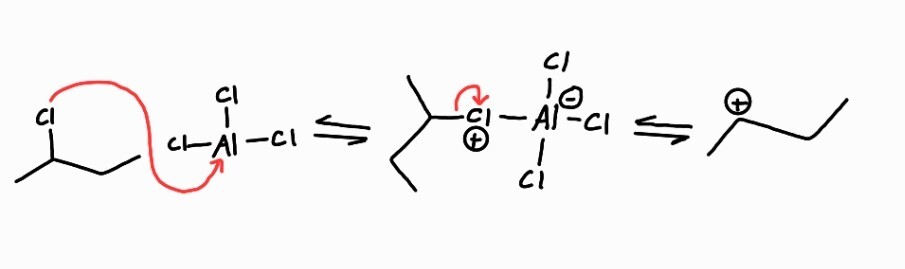
How do you form the strong electrophile in Fieldel-Crafts Alkylation? (Hint: Draw it out)
Make a carbocation:
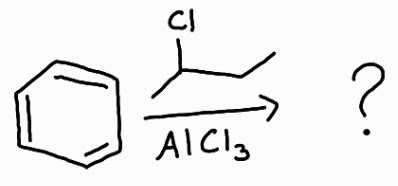
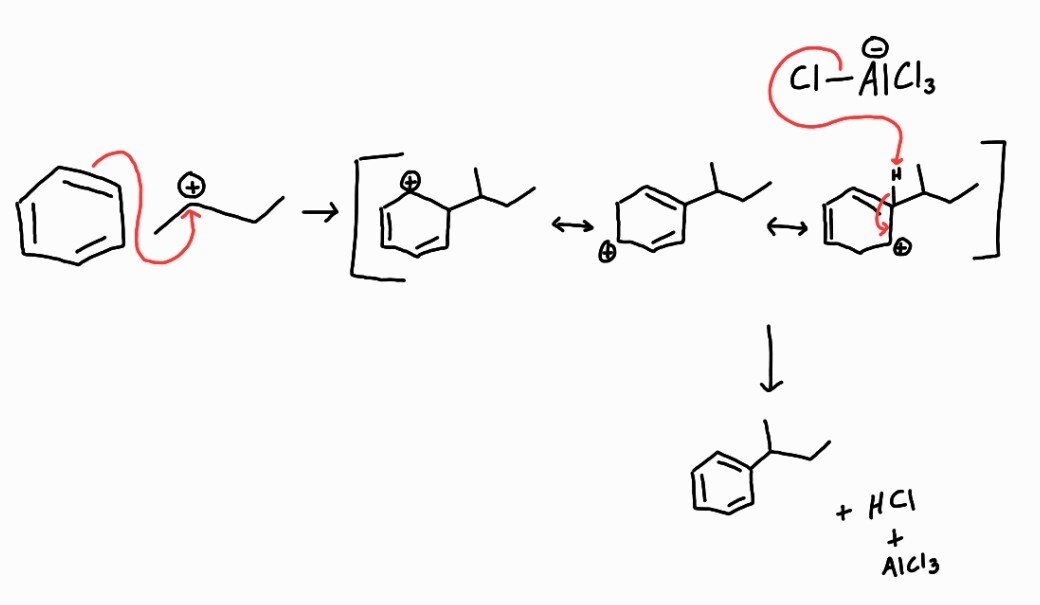
Provide a mechanism and product for the following reaction (Act as if the electrophile has been made):
In Frieldels-Craft Alkylation, what carbocation is favored? Secondary or Primary?
Secondary carbocations are favored because they are more stable.
Name three possible issues with the Frieldels-Craft Alkylation.
Even though the carbon-carbon bonds are hard to form and Friedels-Craft Alkylation allows us to do that, there are reasons why it is not that efficient and therefore did not win a Nobel Prize (Massive L, clearly this was a bad craft.). 1) Polyalkination often is a result of this reaction, meaning the halide compound will add to multiple parts of the benzene ring. 2) Some substituted rings (for example: nitrobenzene) will not react because the molecule is too deactivated. 3) Halides can ONLY be attached to an sp3 group. This means halides attached to aromatic rings or alkenes will result in there being NO reaction.
What is the Benzylic positon?
It is the position next to the benzene ring.
What compound can we use to protonate an alkene to form a carbocation?
HF
What can an alcohol be treated with to form a carbocation?
BF3
True or False: Aromatic rings and alkyl groups are easily oxidized.
False
True or False: Benzylic positons are easily oxidized.
True
What two compounds are oxidizers for the benzylic positions? Which one is the better choice?
-Na2Cr2O7 (Chromic Acid) -KMnO4 (Potassium Permaganate) KMnO4 is the better choice because then you don’t have to deal with Chromium. Potassium Permaganate is more “green”.
How many protons does the Benzylic positon need to undergo oxidation?
At least 1 proton is needed.
Where does Free Radical Bromination occur?
At the benzylic position.
Provide the two routes for Free Radical Bromination
-NBS (N-bromosuccinimide) and heat -Br2 and hv (light)
True or False: Benzylic bromides can NOT be used as synthetic intermediates.
False. They are great for elimination or substitution reactions.
What reactants are used Friedel-Crafts Acylation?
-An acyl group -AlX3
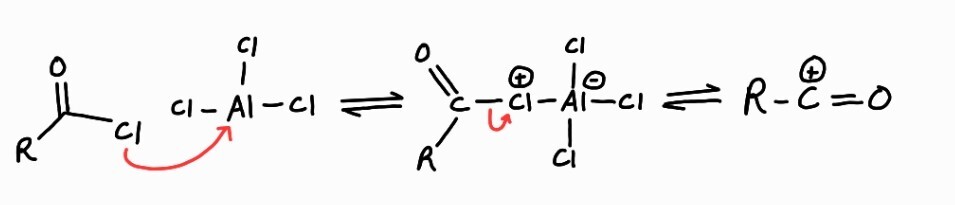
How is the strong electrophile (Acylium ion) made? (Hint: Draw it Out)
True or False: Polyacylation is NOT observed in Friedel-Crafts acylation.
True.
How is benzaldehyde made?
-Gatterman-Koch Synthesis (what a name)
What are the reactants in Gatterman-Koch?
-Benzene Ring -CO -HCl -AlCl3 or alternatively CuCl
What does Clemmensen reduction do?
Removes the C=O bond.
What are the reactants in Clemmensen reduction?
-Zn(Hg) -HCl, heat
What is an alternative to Clemmensen reduction?
H2 and Pd/C (or Pt, if you have money).