Chapter 5: Representation of Knowledge
No description yet. This curated deck is ready for daily study.
Card preview (19)
Abstraction theory
Book definition: “A theory holding that concepts are represented as abstract descriptions of their central tendencies. Contrast with exemplar theory. (p. 118)”
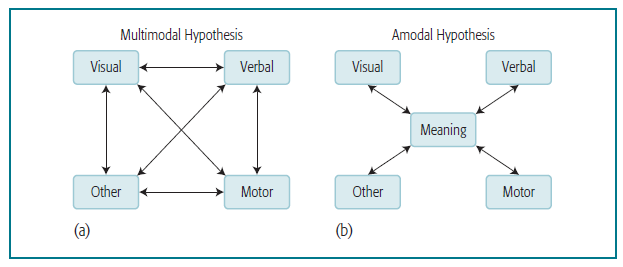
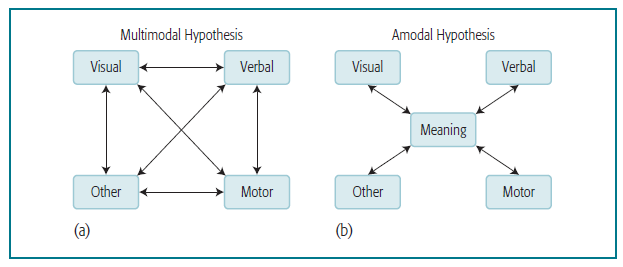
Amodal hypothesis
Book definition: “The proposal that meaning is not represented in a particular modality. Contrast with multimodal hypothesis. (p. 109)”
Amodal symbol system
Book definition: “The proposal that information is represented by symbols that are not associated with a particular modality. Contrast with perceptual symbol system. (p. 106)”
Argument
Book definition: “An element of a propositional representation that corresponds to a time, place, person, or object. (p. 105)”
Default value
Book definition: “A typical value for a slot in a schema representation. (p. 113)”
Dual-code theory
Book definition: “Paivio’s theory that there are separate visual and verbal representations for knowledge. (p. 106)”
Embodied cognition
Book definition: “The viewpoint that the mind can only be understood by taking into account the human body and how it interacts with the environment. (p. 108)”
Exemplar theory
Book definition: “A theory holding that we gain our knowledge of concepts by retrieving specific exemplars of the concepts. Contrast with abstraction theory. (p. 118)”
Isa link
Book definition: “A particular link in a semantic network or schema that indicates the superset of the category. (p. 110)”
Mirror neuron
Book definition: “A neuron that fires either when the animal is performing the action or when it observes another animal performing the action. (p. 108)”
Mnemonic technique
Book definition: “A method for enhancing memory performance by giving the material to be remembered a meaningful interpretation. (p. 103)”
Multimodal hypothesis
Book definition: “The theory that knowledge is represented in multiple perceptual and motor modalities. (p. 109)”
Perceptual symbol system
Book definition: “Barsalou’s proposal that all knowledge is represented by information that is perceptual and tied to particular modalities. Contrast with amodal symbol system. (p. 106)”
Proposition
Book definition: “The smallest unit of knowledge that can stand as a separate assertion. (p. 104)”
Propositional representation
Book definition: “A representation of meaning as a set of propositions. (p. 104)”
Relation
Book definition: “The element that organizes the arguments of a propositional representation. (p. 105)”
Schema
Book definition: “A representation of members of a category based on the type of objects that they are, the parts that they tend to have, and their typical properties. A slot-value structure is used to represent this information. (p. 112)”
Script
Book definition: “A schema representation proposed by Schank and Abelson for event concepts. (p. 116)”
Slot
Book definition: “An element of a schema that indicates different attributes of a concept. (p. 112)”