1.1 - States of Matter
No description yet. This curated deck is ready for daily study.
Card preview (10)
What are the 3 states of matter?
The three states of matter are solids, liquids and gases
What are the properties of the 3 states of matter?
What factors are dependant on in changing of matter?
The amount of energy needed to change state from solid to liquid and from liquid to gas depends on the strength of the forces between the particles The stronger the forces of attraction, the more energy that is needed to overcome them for a state change to occur Therefore, the stronger the forces between the particles the higher the melting point and boiling point of the substance
What is interconversion of state?
When matter changes from one state to another due to changes in temperature or pressure, the change is called an interconversion of state
How does forces change when there is changing in matter?
It is a physical change involving changes in the forces between the particles of the substances, the particles themselves remain the same, as do the chemical properties of the substance Physical changes are relatively easy to reverse as no new substance is formed during interconversions of state
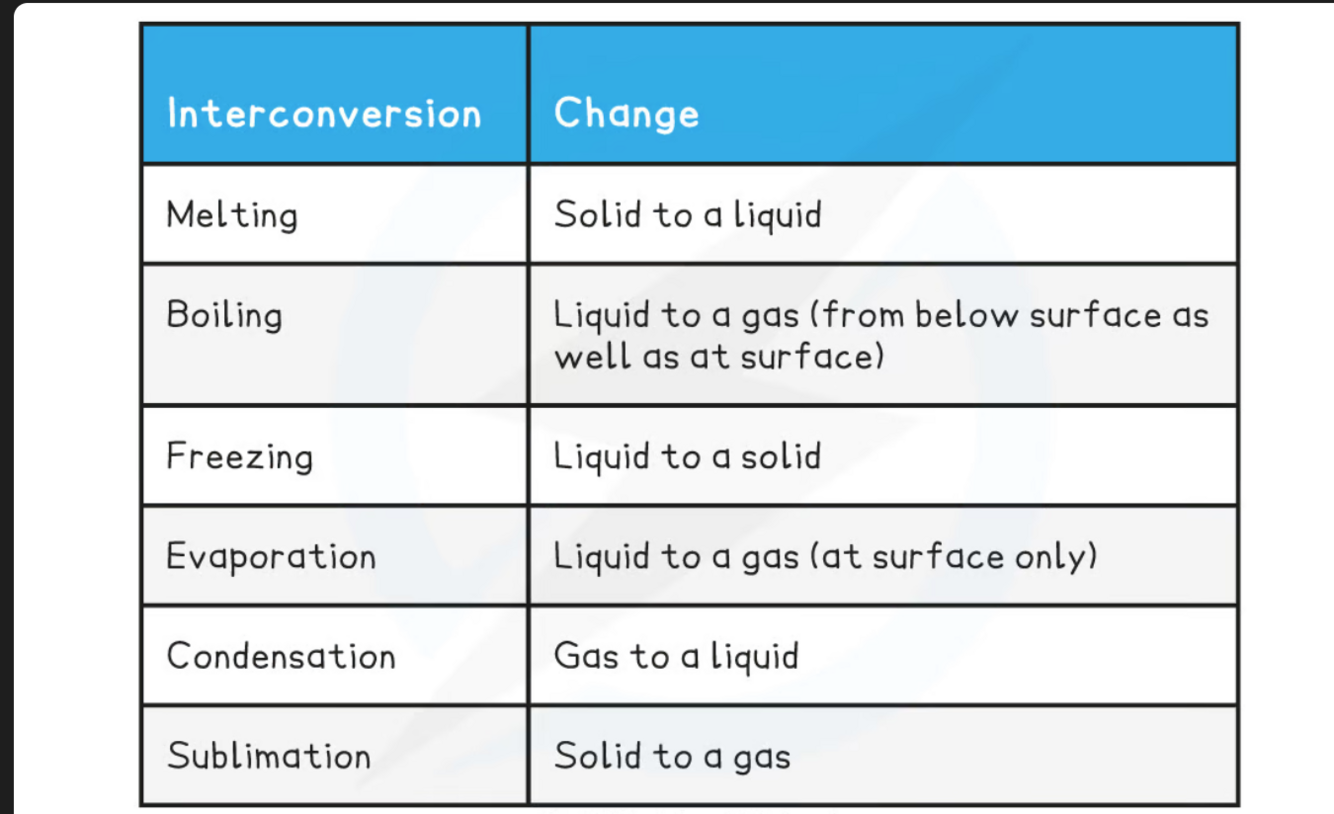
What are all of the changes in state?
What are diffusion and dilution?
Diffusion and dilution experiments support a theory that all matter (solids, liquids and gases) is made up of tiny, moving particles
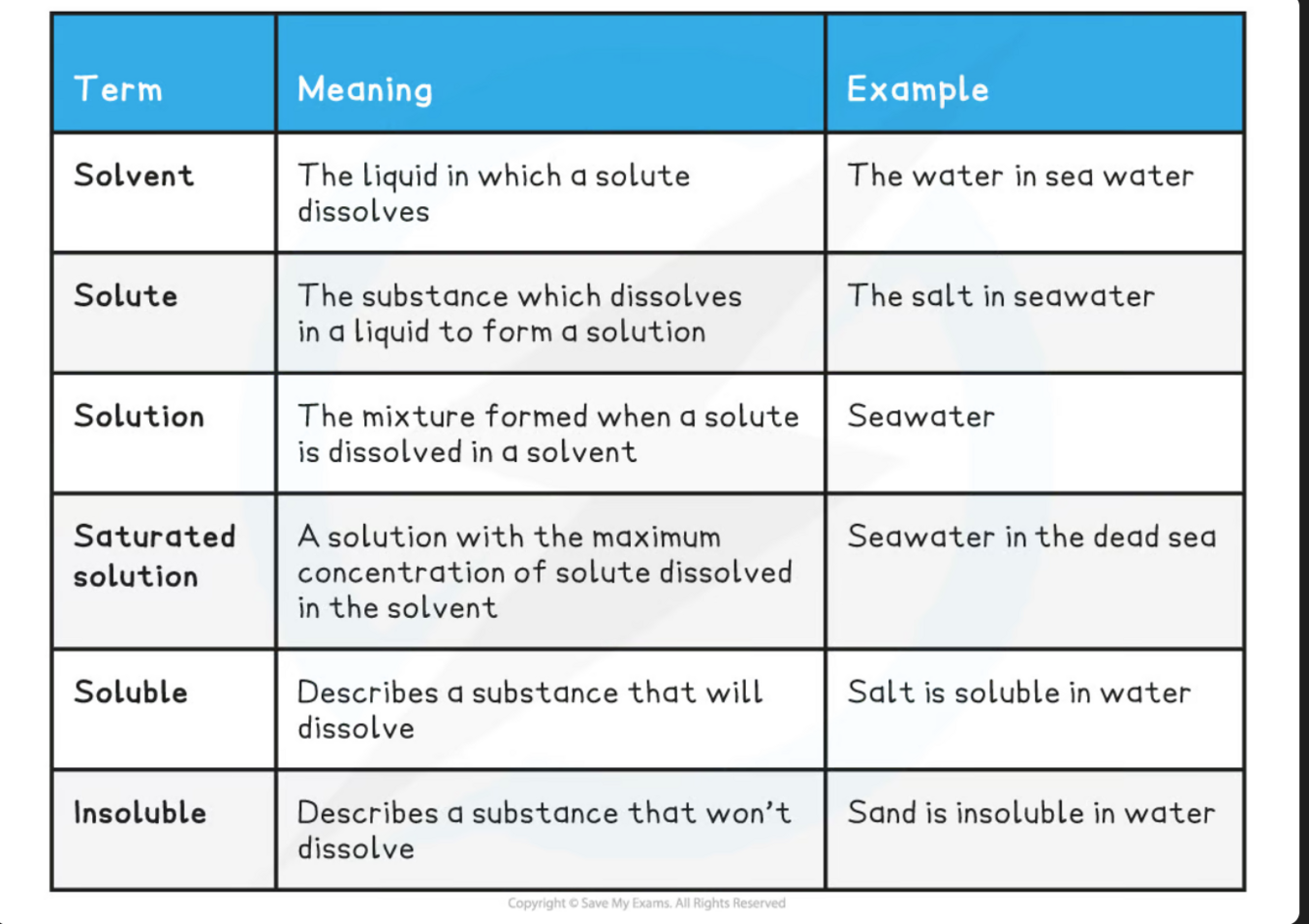
What are all of the terminology’s about solution?
What is solubility?
Solubility is a measurement of how much of a substance will dissolve in a given volume of a liquid The liquid is called the solvent The solubility of a gas depends on pressure and temperature Solubility of solids is affected by temperature As temperature increases, solids usually become more soluble Solubility of gases is affected by temperature and pressure; in general: As pressure increases, gases become more soluble As temperature increases, gases become less soluble
Explain the experiment of Practical: Investigate the solubility of a solid in a water at a specific tempreture?
To measure the solubility of a salt at different temperatures Method: Prepare a two beakers, one as a hot water bath and one as an ice bath Using a small measuring cylinder, measure out 4 cm3 of distilled water into a boiling tube. On a balance weigh out 2.6 g of ammonium chloride and add it to the boiling tube Place the boiling tube into the hot water bath and stir until the solid dissolves Transfer the boiling tube to the ice bath and allow it to cool while stirring Note the temperature at which crystals first appear and record it in a table of results Add 1 cm3 of distilled water then warm the solution again to dissolve the crystals Repeat the cooling process again noting the temperature at which crystals first appear. Continue the steps until a total of 10 cm3 of water has been added