S6) Health-related Behaviour
No description yet. This curated deck is ready for daily study.
Card preview (14)
What are health-related behaviours?
Health-related behaviours are anything that may promote good health or lead to illness e.g. smoking, drinking, drug use, exercise, healthy diet, safe sex
Why is there a concern about health-related behaviour?
• At least 1/3 of all disease burden in the developed world is caused by tobacco, alcohol, BP, obesity and cholesterol • Behaviour risk factors are responsible for 80% of CHD and cerebrovascular disease
Identify 7 behaviours that promote longevity
• Sleep 7-8 hours a night • Don’t smoke • Eat breakfast • Near your “ideal” weight • Don’t eat between meals • Regular exercise • Drink alcohol in moderation/not at all
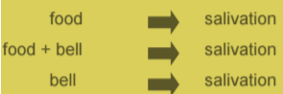
Classical conditioning is a learning theory to help understand people’s health-related behaviour. Outline it
Classical conditioning: behaviours can become linked to unrelated stimuli E.g. behaviours such as smoking & drinking can become unconsciously paired with environment (work break) or emotions (anxiety)
Which aversive techniques can arise from classical conditioning?
• Pairing a behaviour with an unpleasant response • E.g. Alcohol & medication to induce nausea (nausea is result of medication + alcohol but comes to be associated with alcohol)* • Break unconscious response – change habits
What are the limitations of conditioning theories?
No account of social context, cognitive processes, knowledge, beliefs, memory, attitudes, expectations etc.
Operant conditioning is a learning theory to help understand people’s health-related behaviour. Outline it
Operant conditioning: behaviour is shaped by the consequences (reward or punishment) • Behaviour increases if it is rewarded / a punishment is removed • Behaviour decreases if it is punished / a reward is removed
What are the limitations of operant conditioning?
• Unhealthy behaviours immediately rewarding e.g. alcohol, smoking, chocolate, unsafe sex • Driven by short term rewards
Social learning theory is a learning theory to help understand people’s health-related behaviour. Outline it
• Social learning theory: people can learn vicariously (observation/ modelling) • We learn what behaviours are rewarded, and how likely it is we can perform behaviour, from observing others
What are the positives and negatives of social learning theory?
• Negative: harmful behaviours will be modelled e.g. drinking, drug use, unsafe sex • Positive: peer modelling / education, celebrities in health promotion campaigns
Cognitive dissonace theory is a social cognition model to help understand people’s health-related behaviour. Outline it
Cognitive dissonance theory: discomfort when actions/events don’t match beliefs • Either reduce discomfort by changing beliefs or behaviour • Or provide health information which creates mental discomfort prompts behaviour changes
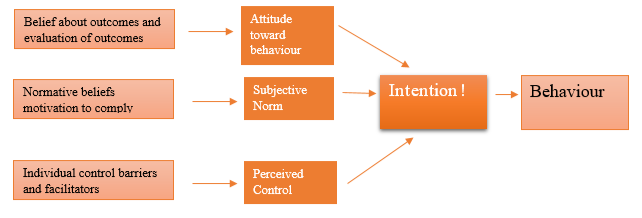
The theory of planned behaviour is a social cognition model to help understand people’s health-related behaviour. Outline it
What are the limitations of the Theory of Planned Behaviour?
• Good predictor of intentions but poor predictor of behaviour • Problem with translating intentions into behaviour
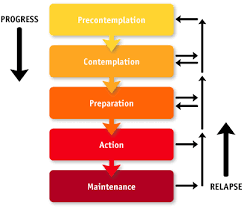
The stages of change model is a transtheoretical model to help understand people’s health-related behaviour. Outline it
• Stages of change model – 5 stages which people may pass through over time in decision making / change • The way people think about health behaviours, & willingness to change their behaviour, are not static