27.2 Amino Acids, Amides & Chirality
No description yet. This curated deck is ready for daily study.
Card preview (24)
What is an amino acid?
Organic compound containing both amine & carboxyl groups general formula RCH(NH2)COOH
Describe the reactions of Amino Acids in relation to its functional groups:
Amino acids react similarly to carboxylic acids & amines, since they have both carboxyl & amine functional groups
What is an alpha amino acid?
amino acid in which same carbon is attached to amine & carboxyl group
Amino acid + Acid ⟶
ammonium salt (H+ from acid forms dative covalent bond with :N ⟶ NH3+, then forms ionic bond with Cl-)

Amino Acid + Alkali ⟶
Salt + Water (metal from alkali substitutes H in carboxyl, leaving salt + H+ + OH-)

Amino acid + Alcohol ⟶
Ester + Water (esterification) Concentrated H2SO4 catalyst (acidic conditions protonate amine group)

Amino acid + Alcohol ⟶ Ester + Water What condition(s) is/are required for this reaction?
concentrated H2SO4 catalyst
What is an amide?
Molecule where nitrogen is bonded to carbonyl group formed from acyl chloride + amine/ammonia
What happens to the amine group during esterification of an amino acid?
protonated ⟶ NH3+ (because of acidic conditions)
How is an amide made?
Acyl chloride + Ammonia
Acyl chloride + Ammonia ⟶
Amide + HCl
Draw the general structure of a primary amide:
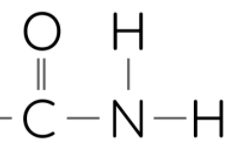
Draw the general structure of a secondary amide:
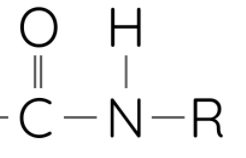
Draw the general structure of a tertiary amide:
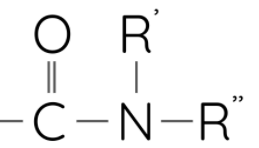
Amino Acids, Amides & Chirality Which type of molecules show optical isomerism?
molecules with chiral carbons
What is a chiral carbon?
carbon with 4 different groups attached
A molecule has 2 chiral carbons. How many optical isomers does it have?
4 (1 pair for each chiral carbon)
Can carbons with a double bond form optical isomers?
No because does not have 4 different groups attached
What is an enantiomer?
molecules which are non-superimposable mirror images of each other, AKA optical isomers
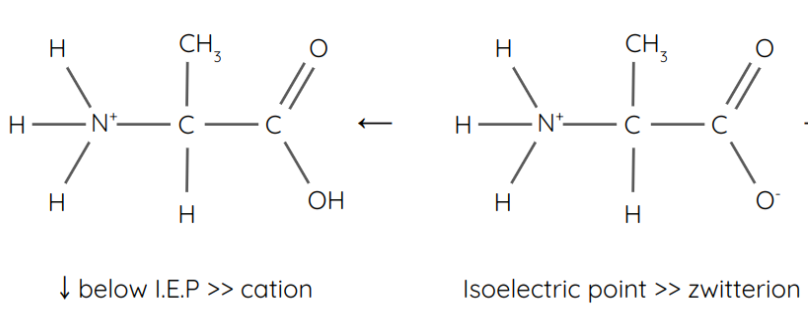
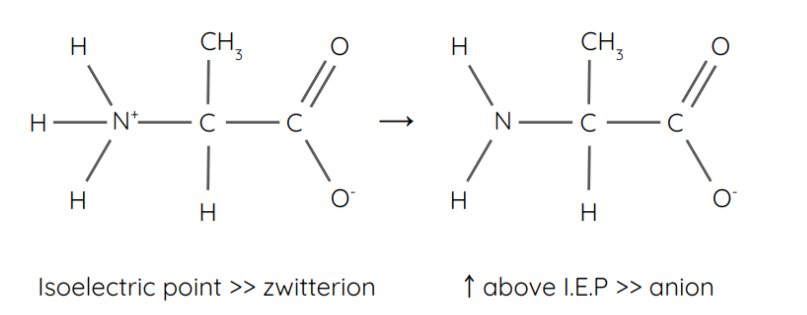
What is a zwitterion?
ion with both positive & negative charge
What is the isoelectric point of an amino acid?
pH at which it is present as a zwitterion unique to each type of amino acid
Describe the state of an amino acid molecule at it’s isoelectric point:
H+ from carboxyl accepted by amine group (by forming dative covalent bond :N) amino acid present as zwitterion, due to NH3+ & COO-
Describe the state of an amino acid above it’s isoelectric point:
Lower [H+(aq)], so NH3+ loses H+ ∴ amino acid present as anion due to COO-
Describe the state of an amino acid below it’s isoelectric point:
Greater [H+(aq)], so H+ in solution protonates carboxyl group ∴ amino acid present as cation due to NH3+