Unit 1 Rates of reactions Topic 1
No description yet. This curated deck is ready for daily study.
Card preview (17)
There are several ways in which we can increase or decrease the rate of a chemical reaction. What are the four ways?
• Change the temperature • Change the concentration • Change the particle size • Add a catalyst
When we increase the temperature of a chemical reaction, what happens to the reactants?
It makes the reactants move faster.
Why does a higher concentration of reactants increases the rate of a reaction?
There is a higher chance of a successful collision as more particles so therefore the reaction rate increases.
As the particle size decreases, what happens to the surface area of reactant particles?
It increases
How do you know if a chemical reaction has taken place?
There is a change in colour. A gas is given off. A new substance forms. A energy Change
The catalyst can be remains chemically unchanged and same quantity. True or False
True
Why does the rate of reaction decrease as the reaction proceeds?
The rate of a reaction decreases over time by as the reactants are used up.
What is a heterogenous catalyst?
This is where the reactants is in a different state to the catalyst. So the reactants are gases and the catalyst is a solid.
What is a homogenous catalyst?
This is where the reactants is in a same state to the catalyst. So the reactants are liquid and the catalyst is a liquid.
State the definition of the collision theory
For a reaction to occur the reactant particles must come into contact, or collide with each other with enough power. The more collisions that occur, in a given time, the faster the reaction.
Define a catalyst
A catalyst is a substance that speeds up chemical reactions but can be recovered chemically unchanged at the end of the reaction
How can the rate of chemical reaction that gives off gas be measured?
change of mass and change of volume
Does the rate of reaction increase or decrease over time?
The rate of reaction decreases over time as the reactants are being used up
State the formula for the average rate of a chemical reaction
average reaction rate = change in quantity of chemical ——————————————- time interval for the change or rate = Δ quantity ————- Δ time
State the units for measuring reaction rate
The quantity of chemical – mass (g), volume of gas (cm3), or concentration (mol l-1). AND The unit of time – seconds (s), minutes (min), or hours (hr).
If a reaction produced 120cm3 of gas in 15 seconds, what is the average rate of reaction?
Average rate = ∆ Quantity ÷ ∆ Time = 120 ÷ 15 = 8 cm3 s-1
Which graph shows the faster reaction? From a rate graph, how can you tell when the reaction is finished?
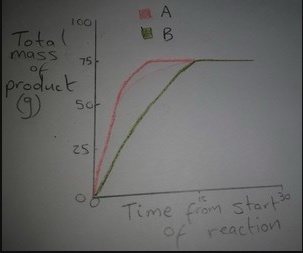
Graph A (red) is the faster reaction as it has the steeper curve. When the reaction is finished (the end-point) the graph goes flat as no more products are being produced. For graph B (Green) this is at 15 seconds from the start of the reaction.