Biology Quiz #2
No description yet. This curated deck is ready for daily study.
Card preview (24)
Particle Model of Matter (4)
• All matter is made of particles with varying size &composition • Particles are constantly in motion (adding & removing energy affects the movement) • Particles are attracted to one another or bonded together • Particles have spaces between them (spaced may be occupied by particles of another substance)
What are the two methods which molecules move in and out of cells?
• Passive Transport 2. Active Transport
Passive Transport
-Does NOT require additional energy -Includes simple diffusion, osmosis, facilitated diffusion
Active Transport
Requires energy & transport proteins because it is the movement of molecules against the concentration gradient
Simple Diffusion
Molecules moving from high concentration to low, until the concentration is equal • Caused by the collision of particles • Passive because no extra energy is required • All molecules diffuse but not at the same rate
Concentration gradient
The difference in concentration between two points
Diffusion Rate is affected by..
• Size of molecules (small molecules=faster diffusion) • Temperature (high temp.= more energy =faster diffusion) • Concentration (higher conc. = more collosions =faster diffusion • Medium through which it travels (solids restrict diffusion)
Osmosis
The diffusion of water across a semipermeable membrane • relies solely on the concentration gradient • cells are in extracellular fluid: solution consisting of a solvent and solute
Tonicity
• Used to determine the direction of diffusion • ability of an extracellular solution to make water move into or out of a cell by osmosis
Hyoptonic
Concentration of water greater on the outside -movement of water into swell (causes cell to swell)
Hypertonic
Concentration of water is greater on the inside -movement of water out of the cell (causes cell to shrink)
Isotonic
Concentration equal both in & out of cell -water moves into & out of the cell at same rate
Crenation
-process of cell losing water and shrinking
Cytolysis
Swelling & bursting of cell
Osmoregulation
The control of water balance
Turgor Pressure
Plants rely on osmosis to regulate the water pressure exerted on the inside of their cell walls -no turgor pressure = plants wilt
Plasmolysis
Occurs when cell membrane of plant cell shrinks away from cell wall due to being placed in a hypotonic environment
Deplasmolysis
Re-hydration of plant cell due to being placed in a hypotonic environment
Water Potential (4+formula)
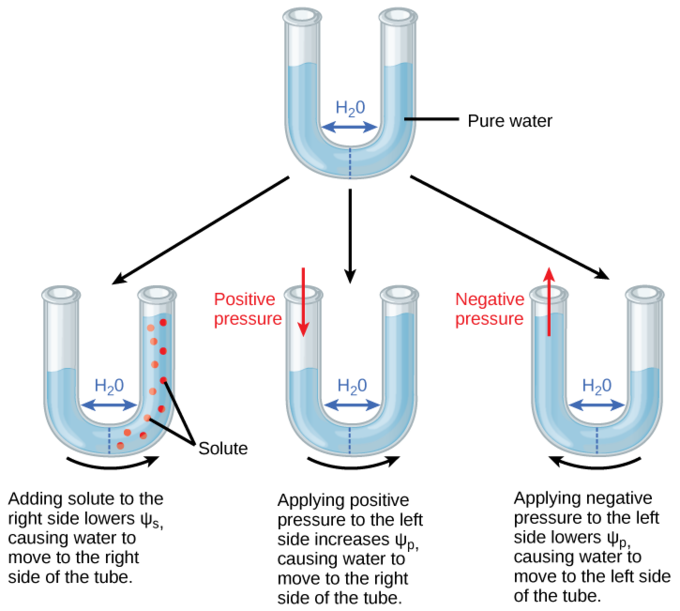
• Water uptake/loss must be balanced • Water moves by osmosis • Cell walls add physical pressure which affects osmosis • Water potential (Ψ) takes both solute and physical pressure • Formula: Ψ = Ψs + Ψp
Adding solute does what to the water potential?
Adding solute lowers water potential because there is less free water molecules (less capacity to do work) -the Ψs is negative
Facilitated Diffusion (5)
Only matter that is soluble in lipids can pass through the lipid bilayer by simple diffusion • water soluble particles use the protein channels to move across the membrane by diffusion • small molecules & ions pass through the pores created by the channel proteins • big molecules are helped across the membrane by the transport proteins • molecules are moving down the concentration gradient, therefore no extra energy is needed
Membrane Technologies (6)
• industrial use of synthesis to mimic actions of membrane • study of receptor proteins that bind with specific molecules to bring them into the cell by endocytosis • useful in the study of HIV & cancer • focus on recognition of receptor proteins to prevent virus from getting in • develop drugs that target the unique proteins of cancer • development of drugs that stimulate the immune system to detect & destroy cancer cells
Synthetic Membrane Technologies (3)
• liposomes are fluid-filled sacs surrounded by a phospholipid bilayer identical to the membrane in human cells • used to deliver drugs to infected tissues in a controlled delivery system • inside holds water-soluble medicine while the bilayer holds fat-soluble medicine
Advantages to Synthetic Membrane Technologies
• Liposomes stay in blood for longer than medication on it’s own • Delivers treatment to target cells only (no harm to other cells) • Used in gene therapy to inject DNA into cancer cells to kill them