AQA A Level Chemistry - Chemical Equilibria
No description yet. This curated deck is ready for daily study.
Card preview (20)
What is a reversible reaction?
• In a reversible reaction, the REACTANTS turn into PRODUCTS and the PRODUCTS can then be turned back into the REACTANTS
How is Equilibrium established?
• When an equilibrium reaction starts there are only reactants present • The reactants are used up as time goes by because the forward reaction occurs • The rate of the forward reaction decreases as time passes due to the reactants being used up • When the reaction starts, there are no products but the products are made as time goes by • The rate of the backward reaction increases as time passes due to the increase in the amount of products • After a certain amount of time, the forward reaction rate will equal the backward reaction rate • This means that as the reactants are being used up and turned into products, the products are being used up and being turned into reactants
Model Answer: How is a dynamic equilibrium reached?
• At the rate of the reaction the forward reaction is fast and the backward reaction is slow • After the start, the reverse reaction speeds up as the forward reaction slows down • The rate of the forward reaction becomes the same as the rate of the backward reaction
What does Dynamic Equilibrium mean?
• The forward and backward reactions proceed at equal rates • The concentration of the reactants and products are constant
When can Dynamic Equilibrium occur?
• Dynamic Equilibrium can only occur if the reversible reaction is carried out in a sealed container, so that no products can escape • This is known as a closed system
Model Answer: State Le Chatelier’s principle
• The position of equilibrium will shift to oppose a change made to it
What will happen if the concentration of CO is increased?

• The equilibrium will shift to the right • To oppose the addition of CO (reactant) • So yield of CO2 and H2 increases
What will happen if the concentration of CO is reduced?

• The equilibrium will shift to the left • To oppose the reduction of CO • So yield of CO and H2O increases
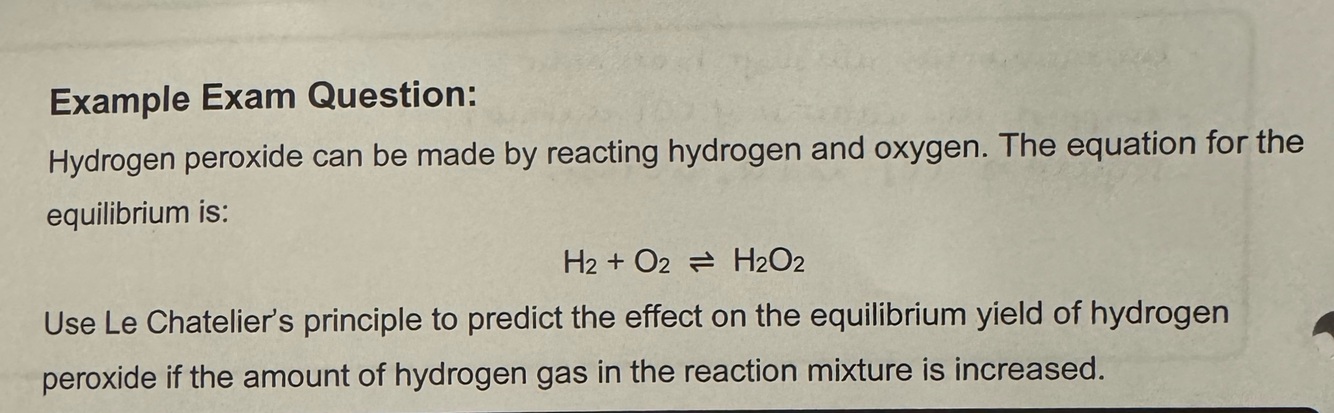
• The equilibrium shifts to the right to oppose the addition of hydrogen • So yield of H2O2 increases
Changes in pressure
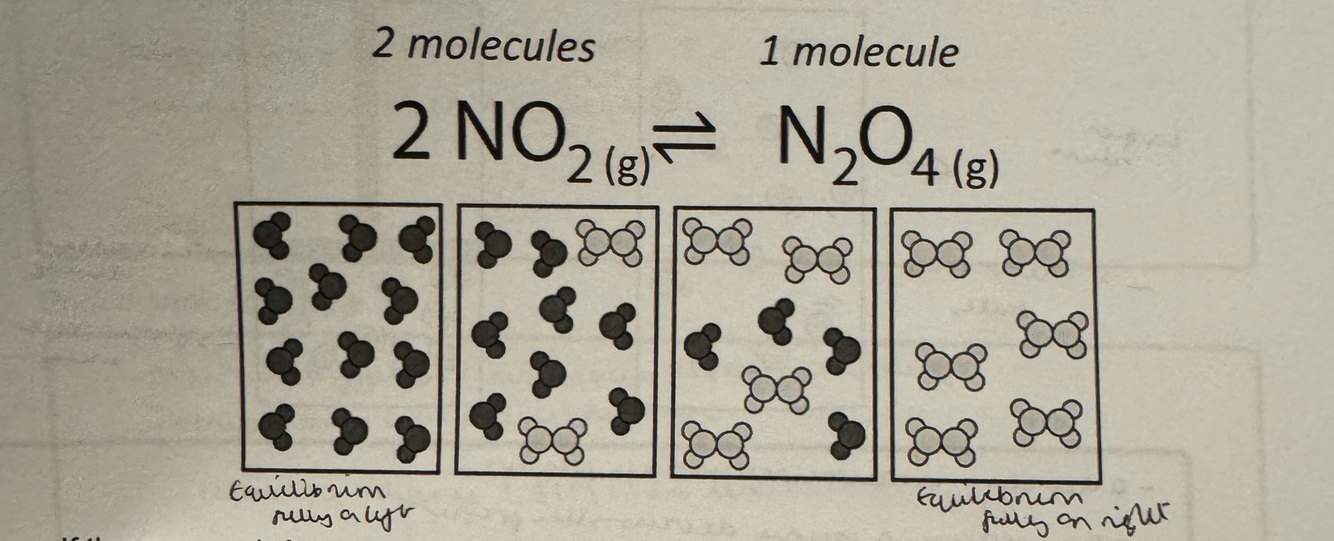
• Pressure changes will only affect reactions that involve gases • If the pressure of one of the substances at dynamic equilibrium is changed, the equilibrium will shift to oppose that change. The more molecules (or moles) the greater the pressure. The fewer the molecules the smaller the pressure. For example: • If the pressure is increased: • There are fewer moles/molecules on the right • The equilibrium shifts to the right to oppose the increase in pressure • So yield of N2O4 increases • If the pressure is decreased: • There are more moles/molecules on the left • The equilibrium shifts to the left to oppose the decrease in pressure • So yield of N2O2 increases • If there were equal number of moles of product and reactant, then changing the pressure would not affect the position of equilibrium
The effect of volume on pressure
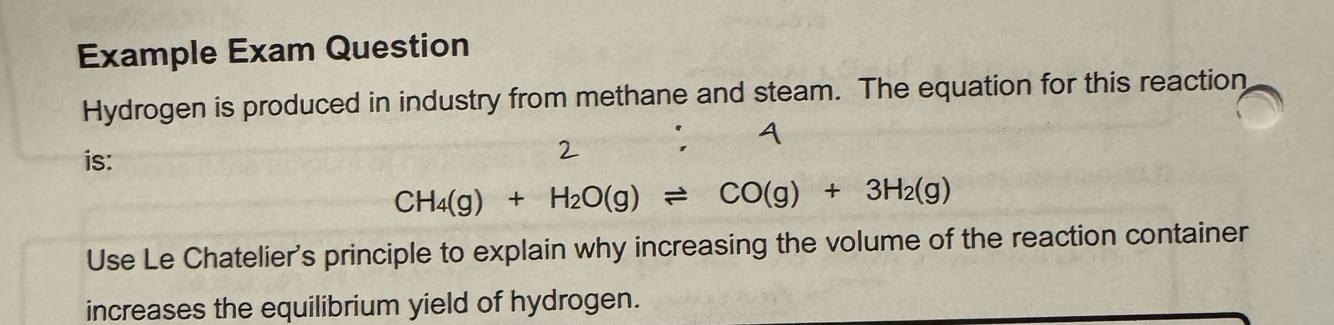
• Changes in volumes also affect the pressure • A decrease in volume increases the pressure • An increase in volume decreases the pressure Example answer: - Increasing the volume decreases the pressure - There are more moles/molecules on the right therefore equilibrium shifts to the right to oppose the decrease in pressure - So yield of hydrogen increases
Changes in temperature
• Exothermic reactions: • Release heat energy • Temperature of the surroundings increases • Enthalpy change (△H) is negative • Endothermic reactions: • Absorb heat energy/energy taken in from surroundings • Temperature of surroundings decreases • Enthalpy change (△H) is positive • Example: • The △H value tells us that the forward reaction is exothermic which means the temperature of the surroundings increases if more of the forward reactionhappens than the backwards reaction • The enthalpy change for the backwards reaction will always be the opposite, so the backward reaction is endothermic which means the temperature of the surroundings increases if more of the backwards reaction happens than the forward reaction

Changes in temperature
• If the temperature of the equilibrium system is changed, the equilibrium will shift to oppose that change. It helps to label the reactants and products as HOT or COLD when answering questions like this • If the temperature of the reaction is decreased: • Forward reaction is exothermic • The equilibrium shifts to the right to oppose the decrease in temperature • Yield of CO2 and H2 increases • If the temperature of the reaction is increased: • Backward reaction is endothermic • The equilibrium shifts to the left to oppose the increase in temperature • Yield of H2O and CH4 increases

Explanation of effect on temperature on equilibrium
• If we increase temperature, equilibrium will move in the direction that decreases the temperature • Endothermic reactions decrease the temperature of the surroundings, so an increase in temperature will shift the equilibrium to the side that is endothermic which means
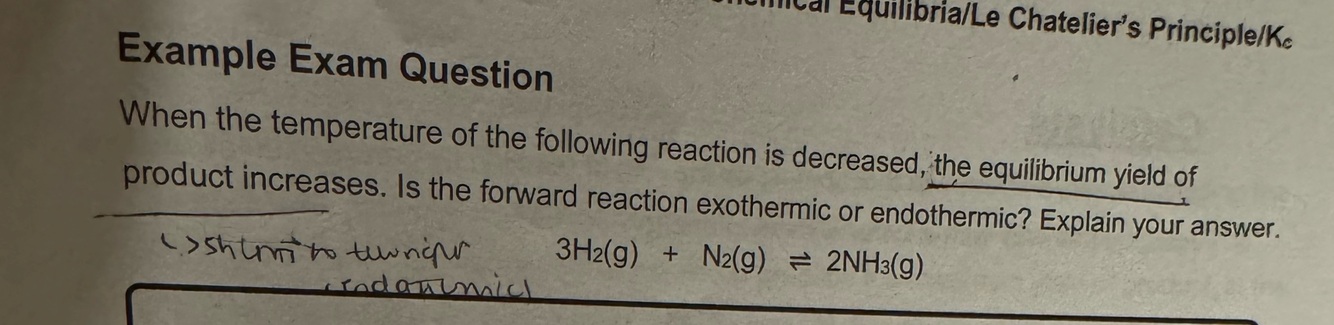
• Equilibrium has shifted to the right to oppose the decrease in temperature • So forward reaction is exothermic
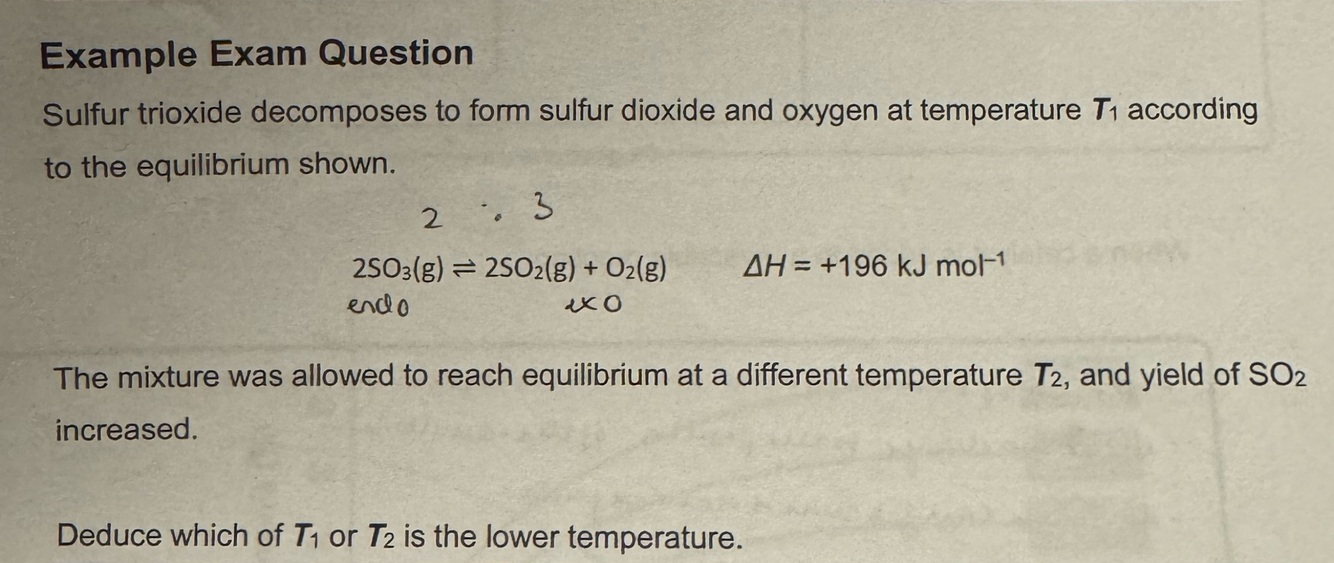
• Forward reaction is endothermic • Equilibrium has shifted to the right to oppose an increase in temperature • T1 is lower/T2 is higher
What is a catalyst and what is its effect when added to a reversible reaction?
• A catalyst is a substance that speeds up the rate of reaction by providing an alternative reaction pathway with a lower activation energy • When a catalyst is added to a reversible reaction: • The rate of both the forward and reverse reactions increases equally • There is no change to the position of the equilibrium • Dynamic equilibrium is reached faster
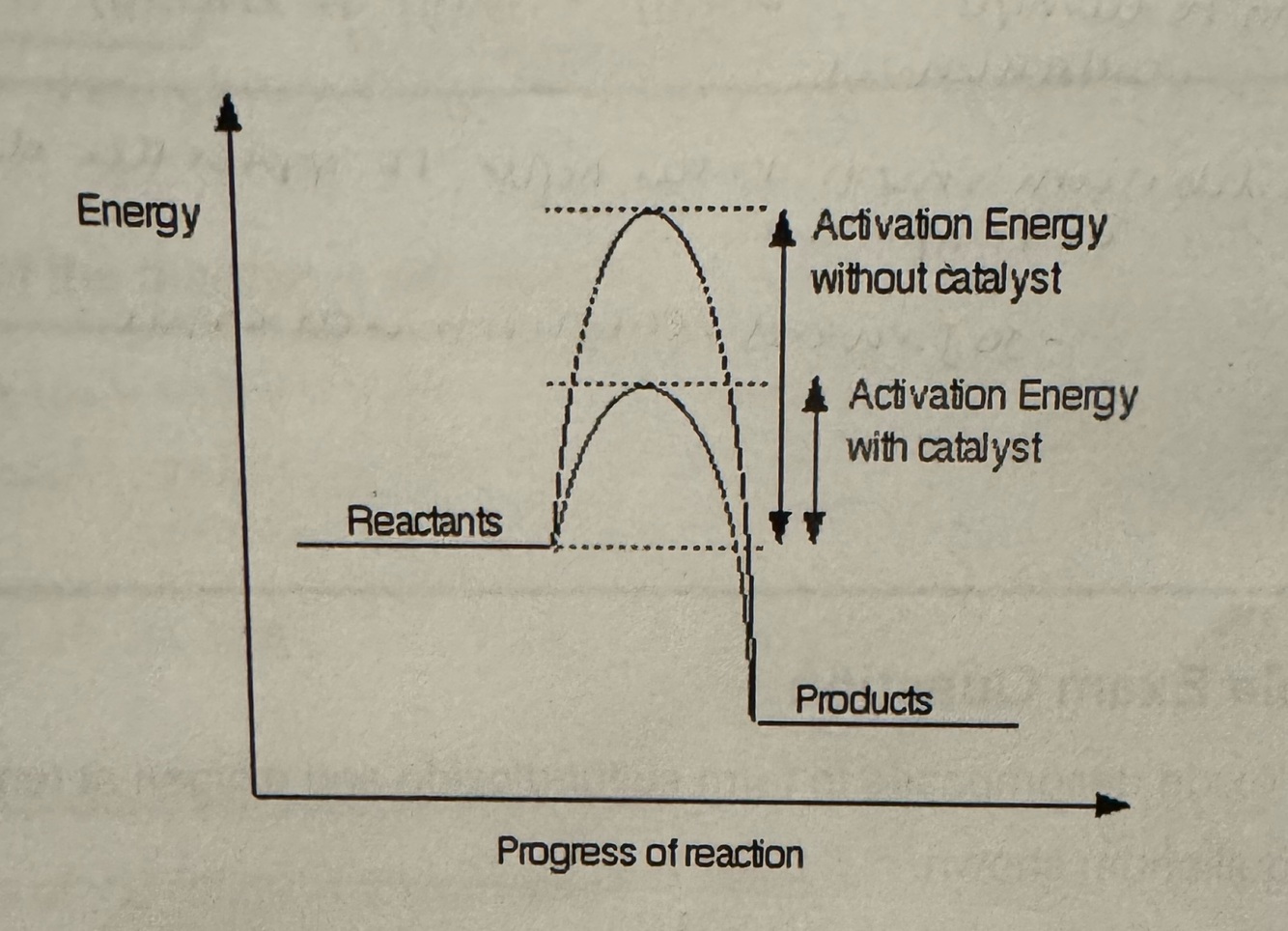
The Haber process is a reversible reaction that is used to produce ammonia. Why are catalysts added to the Haber process?
• To reduce the time taken to reach dynamic equilibrium
What are Compromise Conditions?
• Many of the chemical processes used in industry involve equilibrium reactions, including the Haber process (used to make ammonia) and methanol production. The companies using these reactions try to choose conditions which produce the maximum yield of product, in the shortest amount of time, for the least cost. As you will see, this is not always easy with equilibrium reactions. Example: The Haber Process: for maximum ammonia, 350 degrees c and 400-450 atmospheres • Most ammonia production plants run at a pressure of around 200 atmospheres and a temperature of around 450 degrees C. This is a lower pressure and a higher temperature than would give the maximum conversion, which are called compromise conditions
Why are Compromise Conditions necessary?
• Compromise conditions are necessary because: • Higher pressure would be too expensive • 450 degrees C gives a good yield in a fast time • A catalyst is used in the Haber process. The catalyst does not affect the position of equilibrium but reduces the cost of the reaction, as less fossil fuel is burned to generate heat energy