Electrolysis
No description yet. This curated deck is ready for daily study.
Card preview (24)
What are electrolytes?
• Electrolytes are ionic. The charge moves through the molten liquid by the movement of ions. • If the electrolyte solidifies then the ions are in fixed positions and cannot move and the current cannot flow.
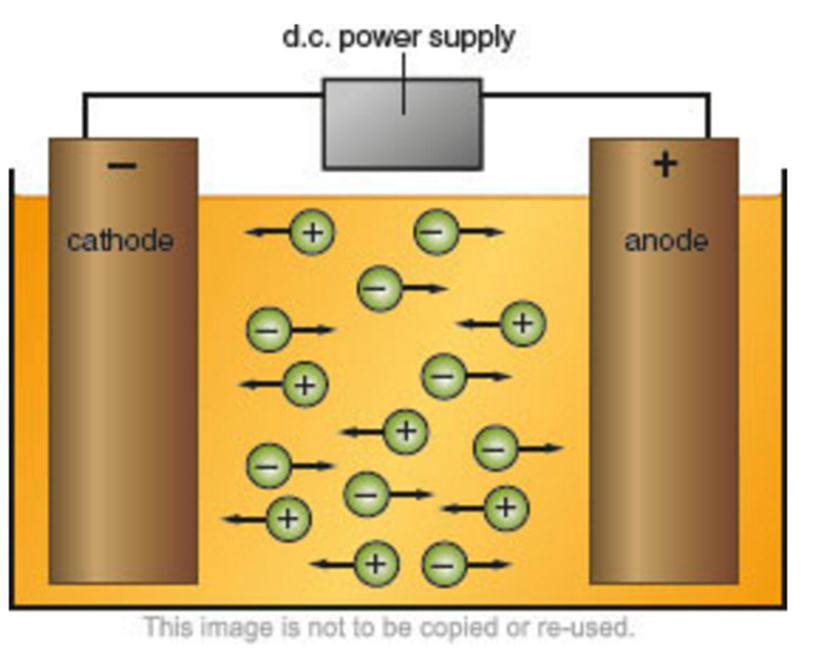
What is electrolysis?
Electrolysis is the flow of charge by moving ions. These moving ions discharge at electrodes.
What happens to the ions and electrons in electrolyte?
• Positive ions move towards the cathode. • Negative ions move towards the anode. • Ions reach the electrodes and are discharged; they turn into atoms or molecules.
Sodium Ion
Na+
Chlorine Ion
Cl-
Potassium Ion
K+
Lead Ion
Pb2+
Aluminium Ion
Al3+
Hydroxide Ion
OH-
Copper Ion
Cu2+
Hydrogen Ion
H+
Bromine Ion
Br-
Oxygen Ion
O2-
Potassium Chloride Symbol
KCl
Lead(II) Bromide Symbol
PbBr2
Aluminium Trioxide Symbol
Al2O3
The reaction of sodium chloride at the cathode can be written as:
• Na+ + e- → Na • The sodium chloride splits into ions, so the ions are free to move. • The positive Na+ ions migrate towards the negative cathode. • Each Na+ Ion gains one extra electron from the cathode.
The reaction of sodium chloride at the anode can be written as:
• 2Cl- - 2e- → Cl2 • The negative Cl- ions migrate to the positive anode. • The Cl- ions are discharged as chlorine gas. • Two Cl- ions each gain one electron and combine to form a chlorine molecule.
Half equation of potassium chloride at the anode and cathode.
• Cathode: 2K+ + 2e- → 2K • Anode: 2Cl- - 2e- → Cl2
Half equation of lead(II) bromide at the anode and cathode.
• Cathode: Pb2+ + 2e- → Pb • Anode: 2Br- _ 2e- → Br2
Half equation of aluminium trioxide at the anode and cathode.
• Cathode: 2Al3+ + 6e- → 2Al • Anode: 6O2- - 12e- → 3O2
What are the products of different electrolytes?
• If sodium hydroxide (NaOH) or sulfuric acid H2SO4 solution is electrolysed, hydrogen is formed at the cathode and oxygen is formed at the anode. • If copper(II) sulfate, CuSO4, solution is electrolysed with carbon electrodes, copper is formed at the cathode and oxygen is formed at the anode.
What affects the amount of substance during electrolysis?
• The amount of substance formed during electrolysis varies with time and current - it increases with increasing time and current. • The substances produced at the electrodes are discharged ions. • The only thing that affects the number of ions discharged is the amount of charge transferred.
The electrode reactions in the electrolysis of NaOH(aq) or H2SO4(aq) are:
• At the cathode: 2H+ + 2e- ⇒ H2 • At the anode: 4OH - 4e- ⇒ 2H2O + O2