Greenhouse gases
No description yet. This curated deck is ready for daily study.
Card preview (24)
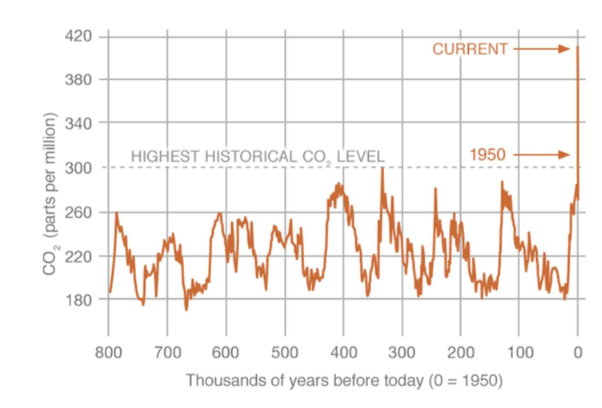
How does data from ice cores show atmospheric CO₂ changes since 1950
Before 1950 around 300ppm Now around 400ppm
Which are the top 3 sectors contributing to global GHG emissions
• Fossil fuels and industrial processes (65%) • Argiculture (16%) • Forestry and other land use (11%)
Why does increasing CO₂ levels lead to increasing global temperatures
• GHGs like CO₂ absorb infrared radiation which traps heat • This is due to their molecular bonds altering energy levels when hit by infrared radiation of certain wavelengths
Solar radiation hits the earth as …….. radiation And leaves the earth’s surfaces as …….. radiation
Shortwave (UV) Longwave (IR)
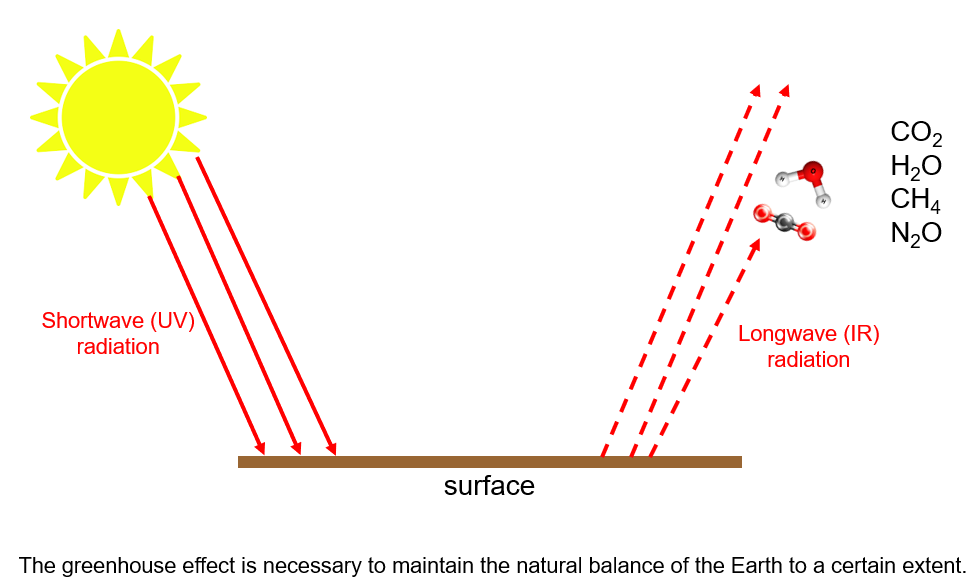
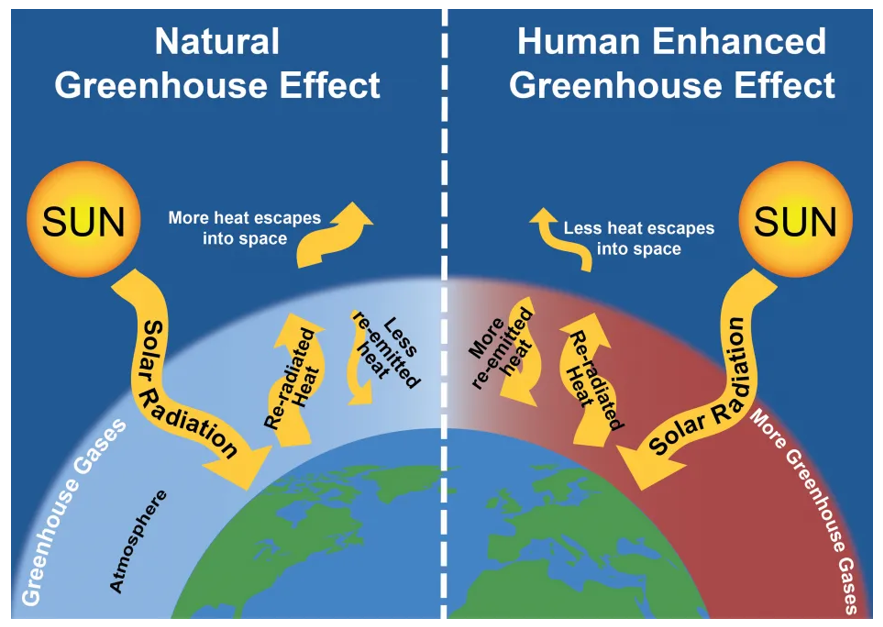
Increasing levels of GHGs results in…
a reduced amount of energy the Earth’s surface radiates to space, thus warming the planet
The shorter the wavelenght (λ) of a wave
The higher energy it is
True of false Electromagnetic waves don’t need molecules like sound to travel
true
The earths ozone prevents what type of waves from entering the troposphere
High energy waves: gamma, x-rays and UV The atmosphere absorbs this energy
Which energy wavelengths does penetrate the atmosphere
Energy in the visible part of the spectrum
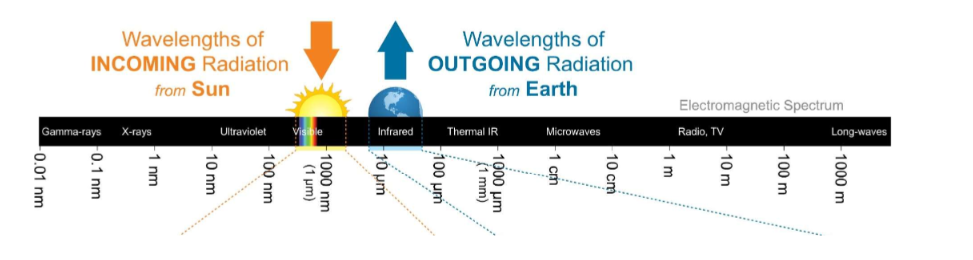
Energy absorbed by the atmosphere is inversely correlated to
energy intensity (i.e. the wavelength)
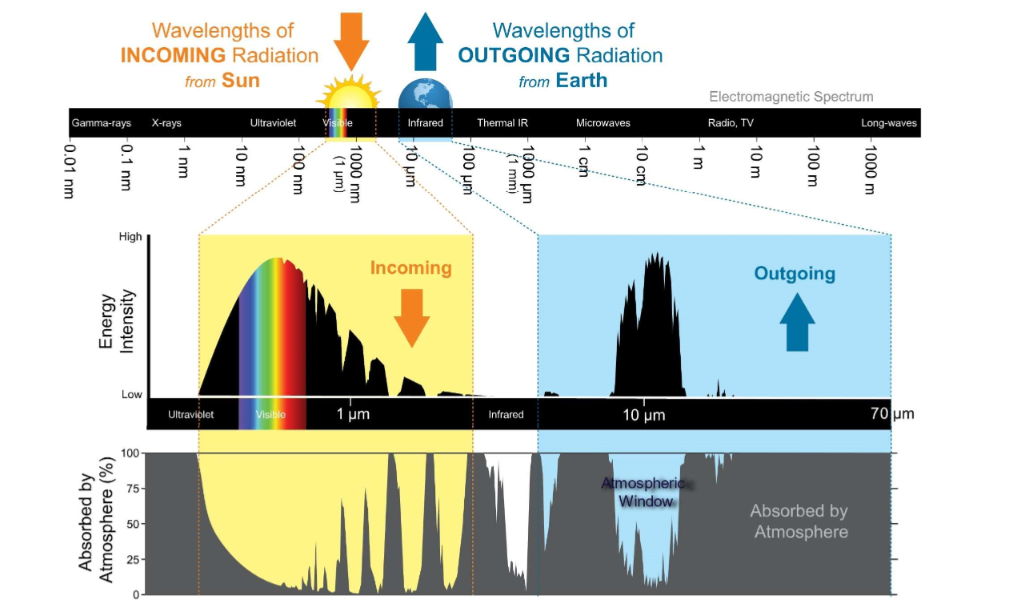
What is the atmospheric window
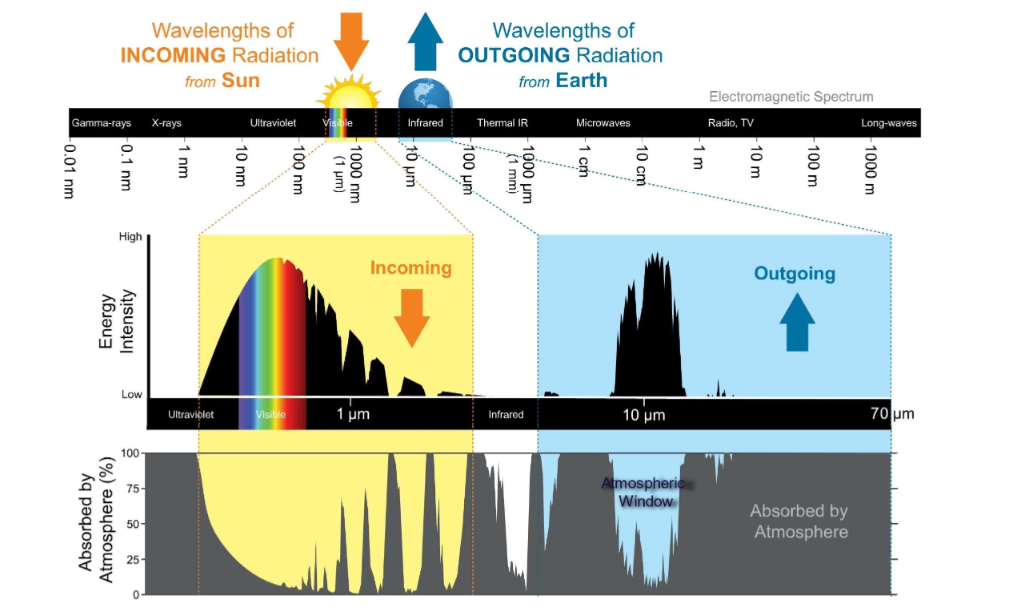
it is a band of IR radiation which can freely pass through to the Earth’s surface - important to avoid the atmosphere being to warm (this is opposite to an absorption band which is the portion of the electromagnetic spectrum that is blocked)
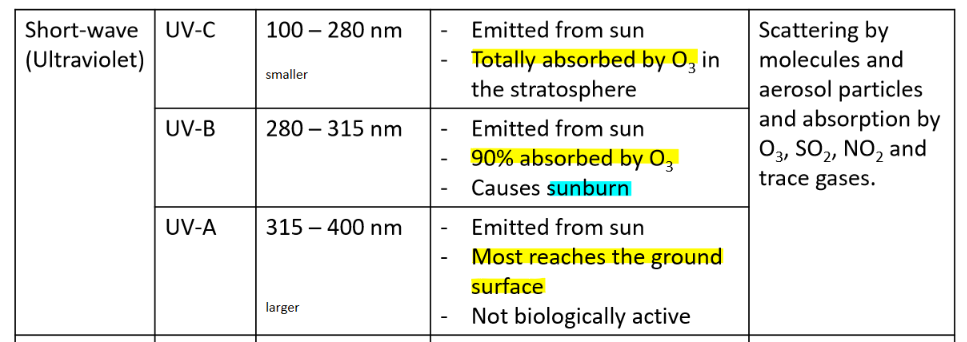
What is the difference between UV-A, B and C
• wavelength decreases in size from UV-A to UV-C • UV-C is totally absorbed by ozone in the atmosphere • UV-B is 90% absorbed by ozone (this is what causes sunburn
What is the radiation balance of the earth assumed to be?
Amount of heat absorbed = heat radiation emitted (climate change is a difference in this balance)
What is a Radiative forcing (W m‾²)
• The influence a given climatic factor has on the amount of downward-directed radiant energy impingging upon Earth’s surface (strongest for water vapour) • Imbalance on the steady state
What is Radiative efficiency (aₓ)
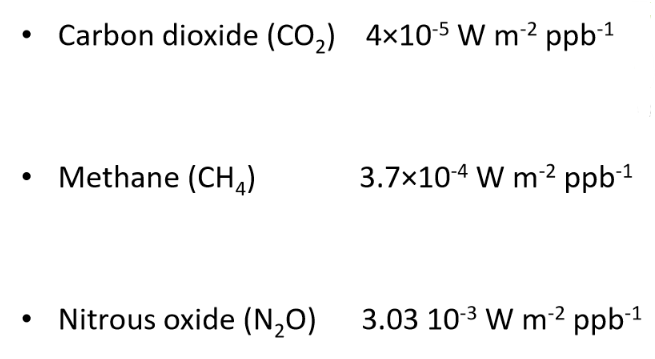
The efficiency is determined by the capacity of each molecule (e.g. CO₂, CH₄) to absorb long IR radiation
What is GWP
Global warming potential (no units)
Which of the following molecules has the highest radoative efficiency? CO₂, CH₄, NO₂
NO₂
Molecular vibrations can derermine the radiative efficiency of molecule? What are molecular vibrations?
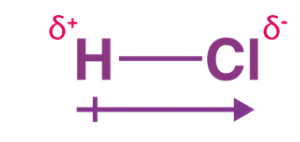
• to absorb IR the electrical dipole moment of the molecule must change when electrons are displaced
What is a dipole moment?
Tension between a positive and negetive pole within the molecule This can only occcur in molecules which are heteronuclear diatomic - unsymmetrical distribution of change
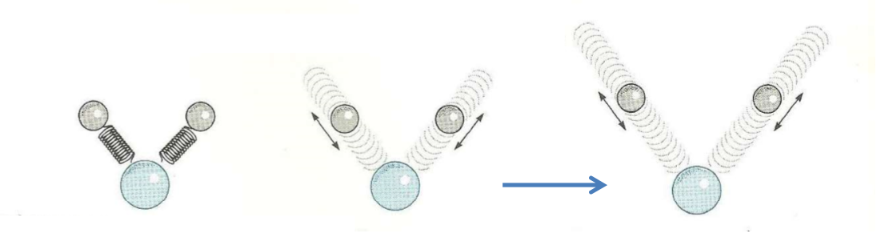
If a vibrating molecules absorbs radiation of a matching frequency ….
… it becomes more ‘energetic’ amplitude of vibration increases
A molecule can lose vibrational energy by ….
… re-emitting radiation (energy) and return to the original state (this repeats and this is what allows the atmosphere to heat up)
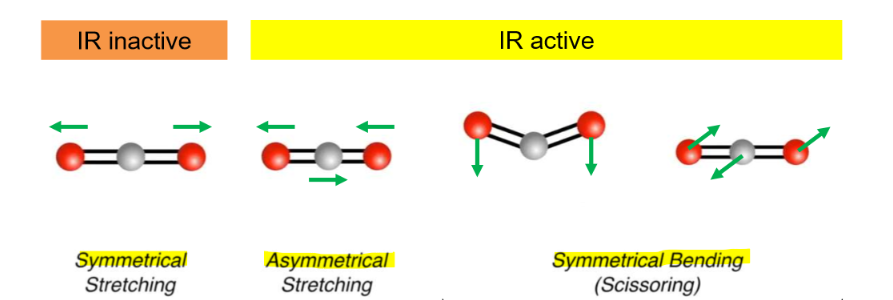
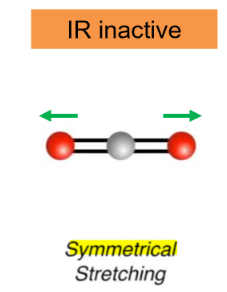
CO₂ is a linear triatomic molecule Which vibration modes are IR active?
Asymmetrical stretching (v3) Symmetrical bending (v2)
Why is the symmetrical stretching (v1) mode of CO₂ IR inactive
Due to there being no change in the dipole moment
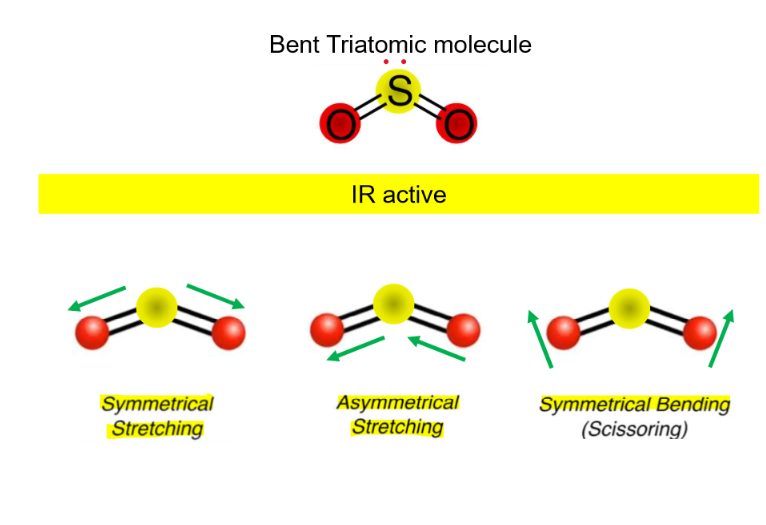
SO₂ is a bent triatomic molecule Which vibrational modes are IR active?
• Symmetrical stretching (v1) • Symmetrical bending (v2) • Asymmetrical stretching (v3)