Ch 25
暂无描述。系统推荐的高质量记忆内容,适合每天坚持背诵学习。
卡片预览 (24 张)
Define Metabolism
the sum of all body chemical reactions
Define Catabolism
is breaking down larger molecules into smaller molecules. Catabolic reactions provide more energy than they consume; they are exergonic – they liberate heat
Define Anabolism
is building up smaller molecules into larger molecules. Anabolic reactions consume more energy than they produce; they are endergonic – they consume heat
Metabolism and Nutrition
• Metabolism is an energy-balancing act • ATP (adenosine triphosphate), is the energy currency unit that participates most often in living cells which couples energy-releasing catabolic reactions to energy-requiring anabolic reactions. • The exact reactions that occur depend on which enzymes are active in a particular cell at a particular time
Define nutrient
is a “food or liquid that supplies the body’s metabolic needs. Nutrients include: A necessary chemical (such as Na+ and other minerals) A substance that provides energy (such as lipids or carbohydrates like glucose) Something that helps in growth of new body components (such as vitamins) A substance that repairs or maintains body functions (such as proteins, or amino acids to make proteins)
ATP
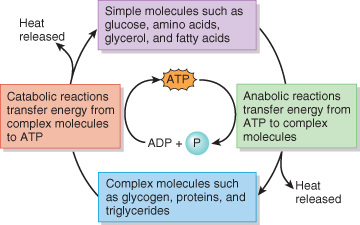
ATP temporarily stores and transfers energy given off in catabolic reactions and transfers it to anabolic reactions that require energy.
How Do We Get Energy From ATP?
By breaking the high- energy bonds between the last two phosphates in ATP
Define Oxidation-reduction or redox reactions
• Oxidation – removal of electrons • Decrease in potential energy • Dehydrogenation – removal of hydrogens • Liberated hydrogen transferred by coenzymes • Nicotinamide adenine dinucleotide (NAD) • Flavin adenine dinucleotide (FAD) • Glucose is oxidized • Reduction – addition of electrons • Increase in potential energy
REDOX Reactions
• Chemical reactions in which a pair of electrons are exchanged as a means of transferring energy • Oxidation is the removal of electrons • Reduction is the addition of electrons
Oxidation Reduction Chemisty: Redox Chemistry
• Oxidation and Reduction reactions always take place simultaneously. • Loss of electrons – oxidation • Gain of electrons - reduction
Carbohydrate Metabolism
• Glucose (C6H12O6) is not just an example we happen to choose – it is indeed the body’s preferred source of fuel. • During digestion, polysaccharides and disaccharides are hydrolyzed into the monosaccharides glucose (80%), fructose, and galactose • These are absorbed into the villi of the small intestine and carried to the liver
Summary of Cellular Respiration
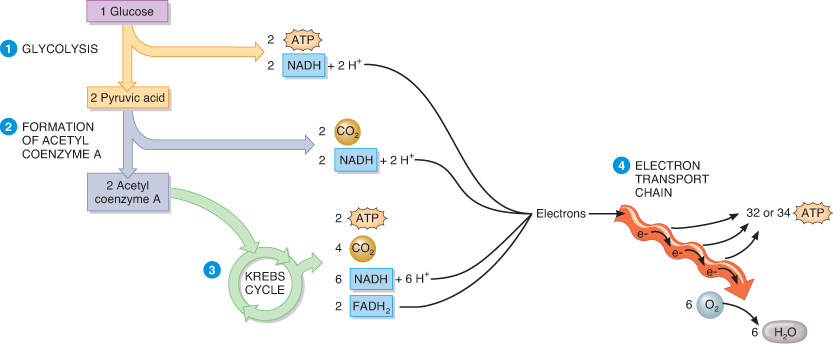
• In the total oxidation of 1 molecule of glucose, 36-38 molecules of ATPs are generated, depending on the tissue. • Only 4 ATP are generated by substrate level phosphorylation (directly transferring a high energy phosphate from one organic molecule to another) in glycolysis and the Krebs cycle • Most of the ATP (either 32 or 34) is made by oxidative phosphorylation using the cytochromes of the electron transport chain and O2 as the final electron acceptor
Summary of Cellular Respiration
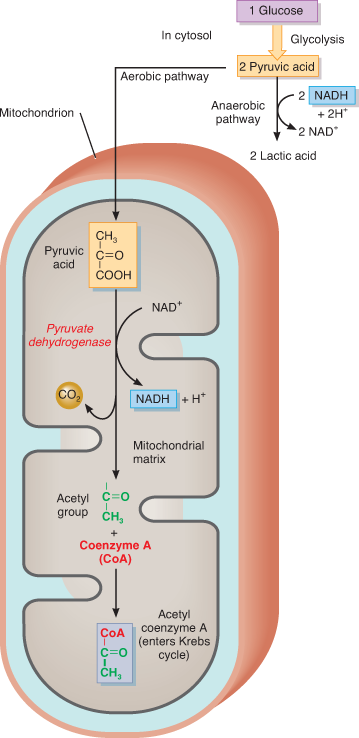
• The location of events of cellular respiration are summarized in this graphic • Glycolysis is occurring in the cytoplasm • The Krebs cycle takes place in the mitochondrial matrix • The cytochrome proteins of the electron transport chain are embedded into the inner mitochondrial membrane
Cellular Respiration
Glucose Anabolism
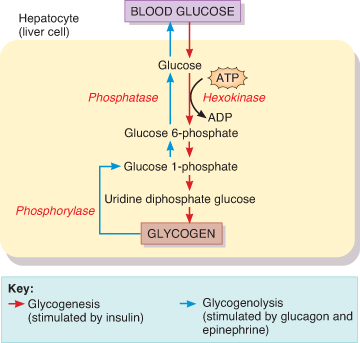
• GLYCOGENESIS - Glucose synthesized to GLYCOGEN • GLUCONEOGENESIS is the process of forming “new” glucose or its metabolites from fat or protein breakdown • GLYCOGENOLYSIS is break down of glycogen
Glucose storage - GLYCOGENESIS
• Glucose stored as glycogen: glycogenesis • Polysaccharide that is the only stored carbohydrate in humans • Insulin stimulates hepatocytes and skeletal muscle cells to synthesize glycogen • 75% stored in skeletal muscle, 25% in liver • Glucose → G6P → G1P → Uridine diphosphate glucose →glycogen • and release into blood
Glucose release - GLYCOGENOLYSIS
• Glucose release: glycogenolysis • Glycogen stored in hepatocytes broken down into glucose and release into blood • HEPATOCYTES: GLYCOGEN → G1P → G6P → GLUCOSE • MUSCLE: GLYCOGEN → G1P
Glycogenesis and glycogenolysis
Glucose formation - GLUCONEOGENESIS
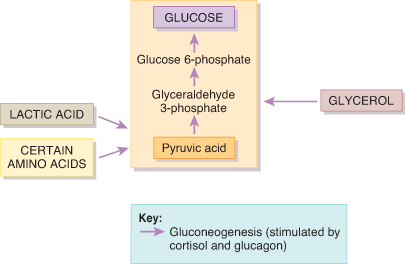
• No food, low glycogen stores in liver, EAT! OR • Triglycerides and Protein catabolism • Lactic acid, glycerol, amino acids converted to Pyruvic acid → glucose formation or Krebs cycle
Making Glucose
• Gluconeogenesis is the process of forming “new” glucose or its metabolites from fat or protein (from non-carbohydrate sources). Gluconeogenesis is always taking place, but it occurs on a large scale during fasting, starving, or eating a low carbohydrate diet • Lactic acid, amino acids, and the glycerol portion of triglycerides are used to form glucose molecules or pyruvic acid to enter the Krebs cycle
Lipids
• Although the word “fat” is commonly used to mean lipids, fats are, in fact, just one subgroup of lipids called triglycerides • Other lipids include waxes, sterols (steroid hormones), fat-soluble vitamins (such as vitamins A, D, E and K), monoglycerides, diglycerides, phospholipids, and others • For metabolic purposes, triglycerides are a condensed form of useable energy
Lipids
• All triglycerides are composed of a glycerol backbone combined with 3 fatty acids • Fatty acids are anywhere from 4 to 24 carbons long,and they may have all single carbon-carbon bonds (saturated), or some double or triple bonds (making them unsaturated)
Triglycerides
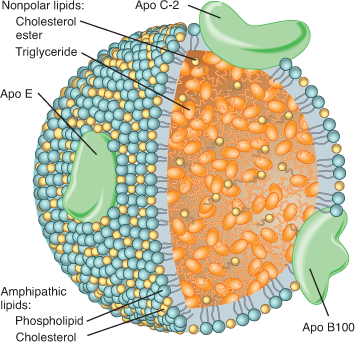
• are nonpolar, and therefore very hydrophobic molecules • To be transported in watery blood, they must first be made more water-soluble by combining them with carrier molecules called lipoproteins (produced in the liver) • Lipoproteins vary in their size, density, and the amount of cholesterol and protein in their make-up
Lipoproteins
• In general, however, all lipoproteins have: • An outer shell that is made hydrophilic due to polar proteins (plus amphipathic phospholipid and cholesterol) • An inner core that is hydrophobic - a place where the triglycerides are transported