Chapter 5
No description yet. This curated deck is ready for daily study.
Card preview (24)
Chirality
• Chirality is the property of molecules that allows a compound to exist in 2 non-superimposable mirror image forms
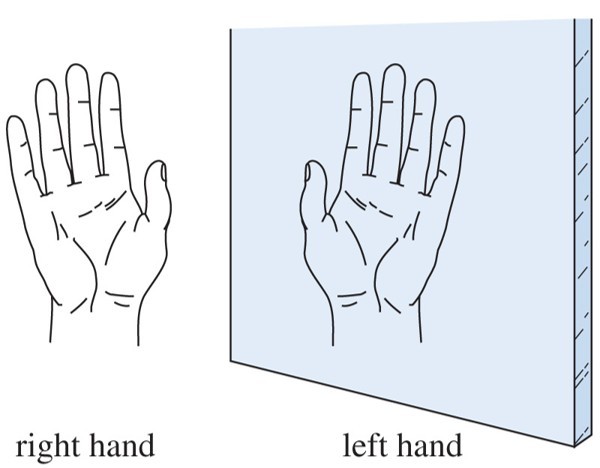
Enantiomers
Nonsuperimposable mirror images, different molecules with different properties
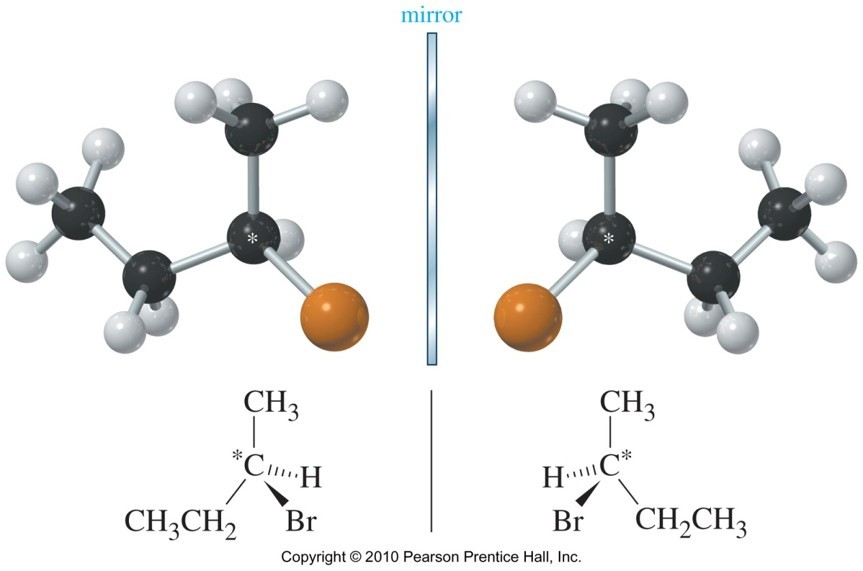
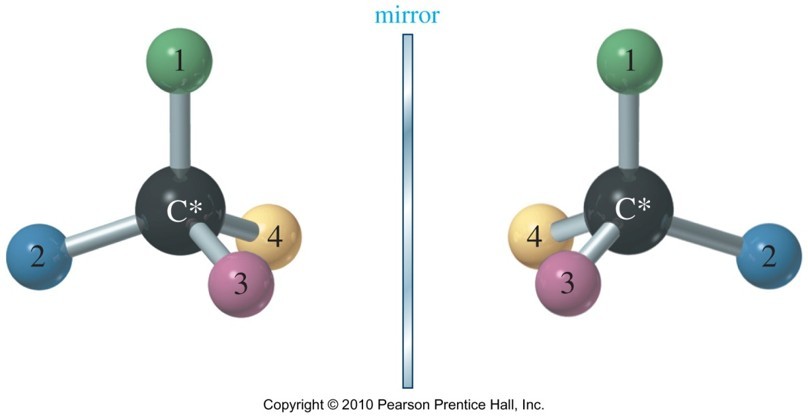
Asymmetric Carbons
• Carbons with four different groups attached are chiral • It’s mirror image will be a different compound (enantiomer)
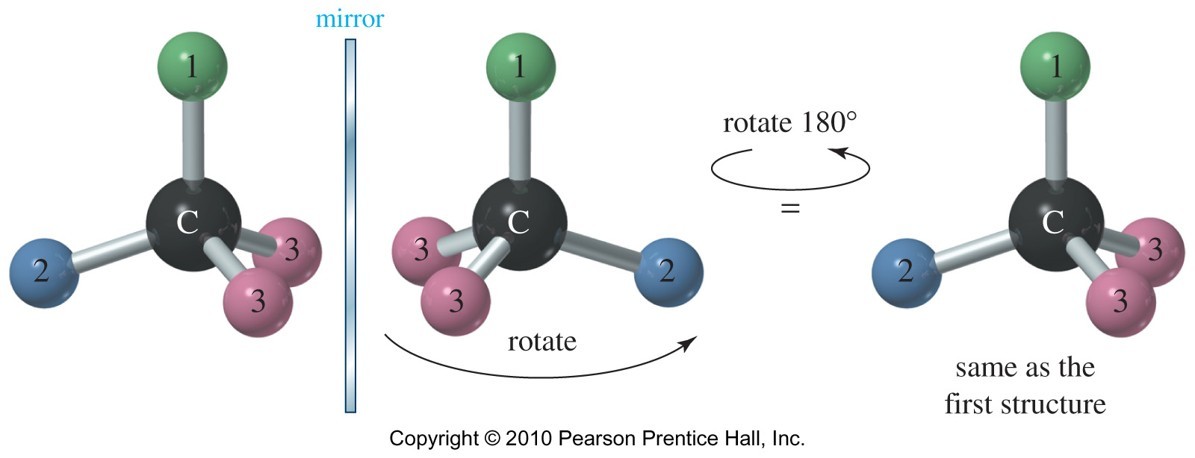
Achiral Compounds
When the images can be superposed the compound is achiral
Determining a Plane of Symmetry
• Notice the plane can bisect atoms.
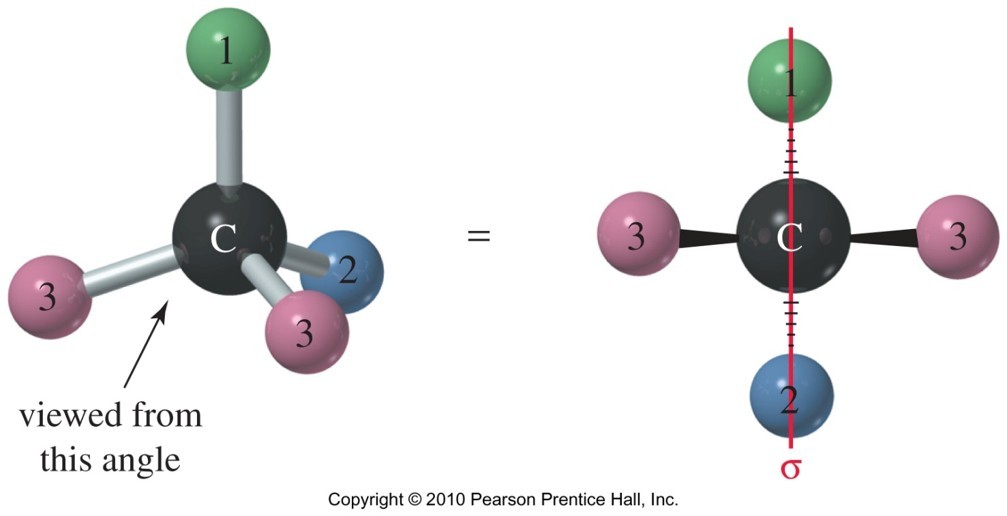
What does it mean when a molecule has a plane of symmetry?
A molecule that has a plane of symmetry is achiral.
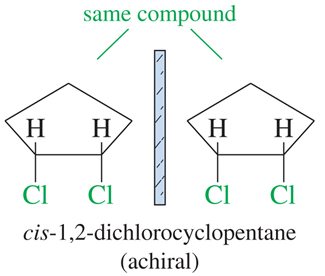
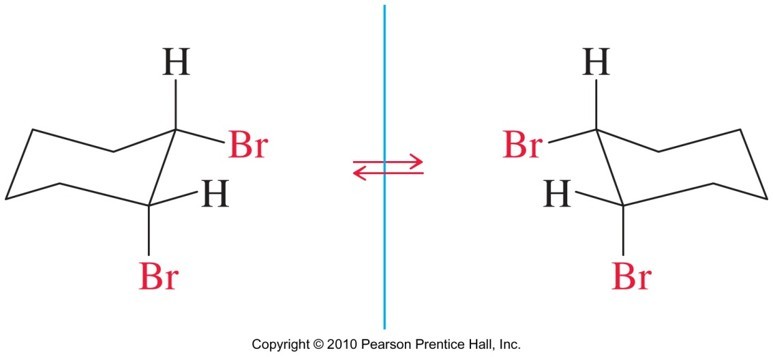
Cis Cyclic Compounds (chiral or achiral?)
Cis-1,2-dichlorocyclohexane is achiral because the molecule has an internal plane of symmetry. Both structures above can be superimposed.
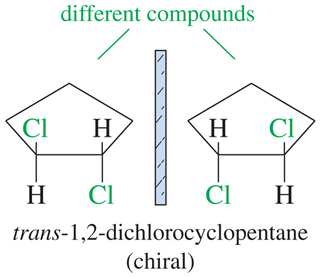
Trans Cyclic Compounds (chiral or achiral?)
Trans-1,2-dichlorocyclohexane does not have a plane of symmetry so the images are nonsuperimposable and the molecule will have two enantiomers.
absolute configuration
(R) or (S) assignment
relative configuration
assigned with respect to a reference sample or another stereocenter in the same molecule • relative configuration is easier to deduce from experimental data than absolute configuration
assigning absolute configuration
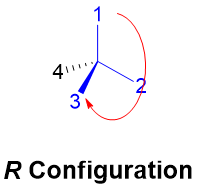
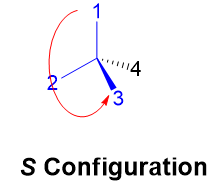
1) assign priorities to the groups on the asymmetric (chiral) center 2) orient the molecule with the lowest priority group pointing away from you 3) trace a path from group 1 to group 2 to group 3
R configuration
clockwise path is the R configuration
S configuration
counterclockwise is the S configuration
Sequence Rules for Priorities
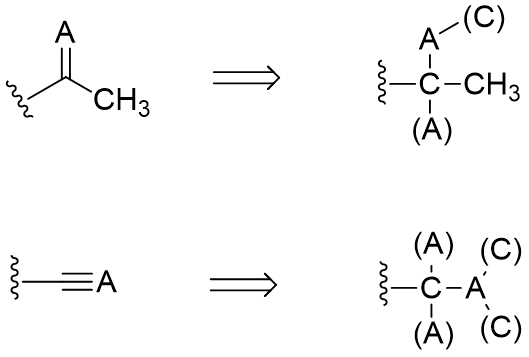
1) If the atoms attached to the asymmetric center are all different, priority depends on atomic number 2) When relative priority cannot be decided by Rule 1, compare the next set of atoms in the groups working outward from the stereogenic center (ignore H when atoms within a rank are compared) 3) A double-bonded atom is treated as if there were two such single bonds (triple-bonded atom treated as three such single bonds)
Expanded Notation
• For multiply bonded atoms, expand the bonding by putting the appropriate number of atoms in parentheses • Real atoms take priority over parenthetical atoms
Incorporating Configuration in Nomenclature
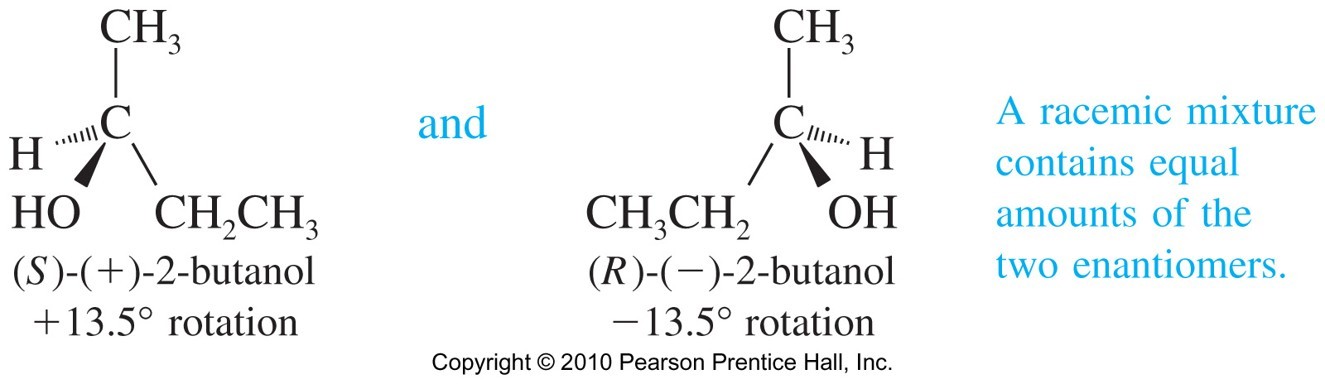
• R or S configuration goes in front of the name in parentheses, followed by sign of rotation (if known) • For molecules with more than one stereocenter, the position number of the stereocenter is added to the R or S

Properties of Enantiomers
Enantiomers have identical physical properties except: –The way they interact with plane polarized light (equal magnitude/opposite direction) –The way they interact with other chiral molecules
Optically active
compounds rotate the plane of polarized light
Optically inactive
compounds do not rotate polarized light
Measuring optical rotation
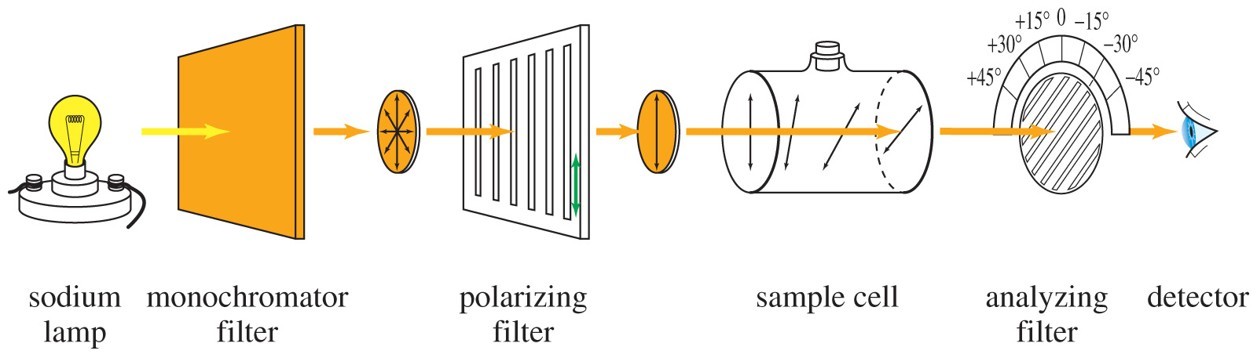
• Optical rotation measured by a polarimeter – 1) monochromatic light passed through a polarizer 2) the plane-polarized light is passed through a sample 3) the analyzer (another polarizing filter) is adjusted to allow the maximum light through, and the angle is noted Clockwise rotation is (+) dextrorotatory-d Counter-clockwise rotation is (-) levorotatory-l
Racemic Mixtures
• Equal quantities of d- and l- enantiomers. • Notation: (d,l) or (±) • No optical activity. • The mixture may have different boiling point (b. p.) and melting point (m. p.) from the enantiomers!
Optical Purity
• optical purity (enantiomeric excess or ee) measures how much more of one enantiomer is present than the other • optical purity = observed rotation / known rotation (x 100%) • optical purity = % major enant – % minor enant
Chilarity and Equilibriums
• If equilibrium exists between two chiral conformers, the molecule is not chiral. • Judge chirality by looking at the most symmetrical conformer. • Cyclohexane can be considered to be planar, on average.
Diastereomers
Have more than one stereocenter • Diastereomers are non-mirror image stereoisomers • Diastereomers differ in configuration in at least one, but not all, stereogenic centers • Diastereomers have: different physical properties and can be separated by ordinary physical methods • Diastereomers have same formula, connectivity, but different 3D arrangement and are not enantiomers