Chapter 4: Mental Imagery
No description yet. This curated deck is ready for daily study.
Card preview (10)
Allocentric representation
Book definition: “A representation of the environment according to a fixed coordinate system. Contrast with egocentric representation. (p. 92)”
Cognitive map
Book definition: “A mental representation of the locations of objects and places in the environment. See also route map; survey map. (p. 89)”
Egocentric representation
Book definition: “A representation of the environment as it appears in a current view. Contrast with allocentric representation. (p. 91)”
Epiphenomenon
Book definition: “A secondary mental event that has no functional role in the information processing. (p. 78)”
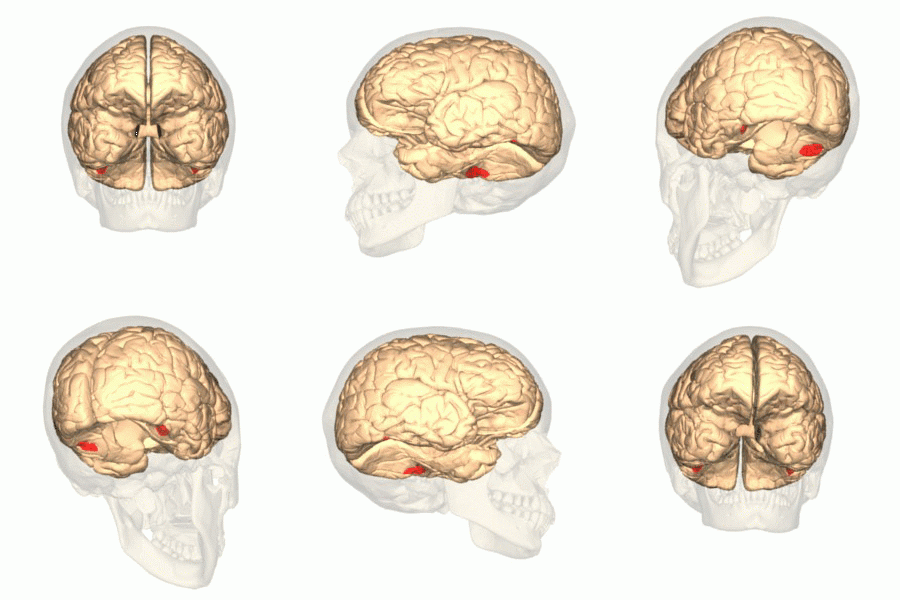
Fusiform face area (FFA)
Book definition: “A part of the temporal cortex that is especially involved in fine discriminations, particularly of faces. (p. 87)”
Mental imagery
Book definition: “The processing of perceptual-like information in the absence of an external source for the perceptual information. (p. 79)”
Mental rotation
Book definition: “The process of continuously transforming the orientation of a mental image. (p. 82)”
Parahippocampal place area (PPA)
Book definition: “A region adjacent to the hippocampus that is active when people are perceiving places. (p. 87)”
Route map
Book definition: “A representation of the environment consisting of the paths between locations. Contrast with survey map. (p. 89)”
Survey map
Book definition: “A representation of the environment consisting of the position of locations in space. Contrast with route map. (p. 89)”