3.4 Alkenes
No description yet. This curated deck is ready for daily study.
Card preview (24)
What is an alkene?
Unsaturated hydrocarbons with a C=C double bond
What is the general formula of an alkene?
Cn H2n
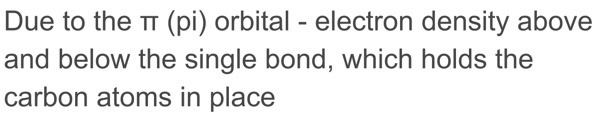
Why is there no rotation about the C=C double bond?
Are they more or less reactive than alkanes? why?
More reactive, due to high electron density of double bond and the fact the pi-bond is slightly easier to break
What intermolecular forces of attraction do they have?
Only van der Waals due to non-polar bonds
Are they soluble in water? why?
No, non-polar bonds (van der Waals’ < hydrogen bonding)
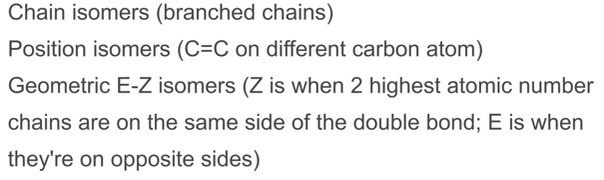
Name and describe the three kinds of isomers alkenes can have
Write an equation for the complete combustion of pent-2-ene

What is an electrophile?
Electron deficient atoms/ions which accept a pair of electrons
What is the most stable kind of carbonation intermediate? why?
Alkyl groups have positive inductive effect, so the most stable carbocation is the one bonded to the most other carbon atoms i.e A tertiary carbocation
Major products will be formed from which kinds of carbocations?
Tertiary (or the most stable available)
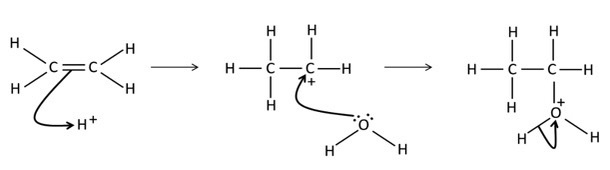
What conditions are needed for the electrophilic addition of H2O to an alkene?
Acid catalyst, usually phosphoric acid
What are the products of the reaction of H2O and an alkene
An alcohol
Draw a mechanism for the addition of water to ethene
What conditions are needed for the electrophilic addition of a hydrogen halide to an alkene?
Room temp
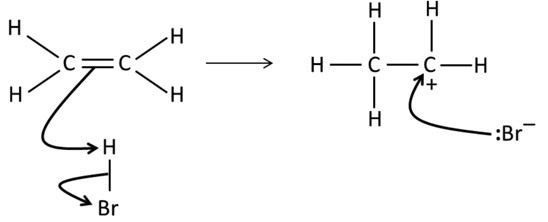
Draw a mechanism for the reaction of HBr and ethene
What conditions are needed for the electrophilic addition of a halogen molecule to an alkene?
Room temperature and organic solvent
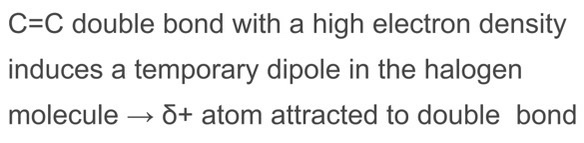
How does a molecule with a non-polar bond react as if it is an electrophile?
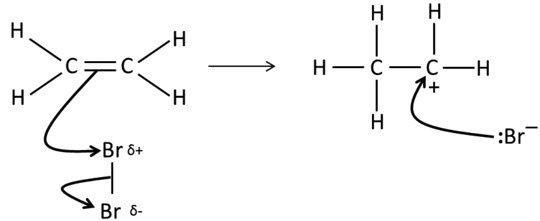
Draw a mechanism for the reaction between bromine and ethene.
Draw a mechanism for the reaction of sulfuric acid with ethene.
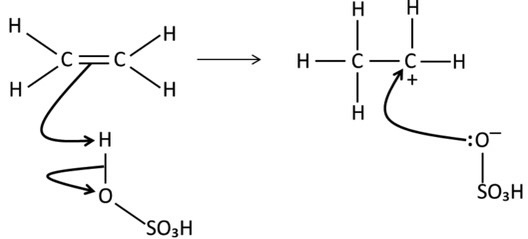
How would you turn the product into an alcohol and how does show that sulfuric acid catalyses the addition of water to an alkene?
Add water H2SO4 reforms, showing it catalyses the hydration of alkenes
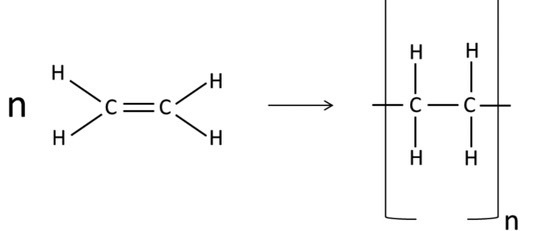
What is an addition polymer?
Many monomers bonded together via rearrangement of bonds without the loss of any atom or molecule
What are monomers? What form do they usually take?
Molecules which combine to form a polymer usually have a C=C bond which breaks to leave a repeating pattern
Draw how you would represent the polymerisation of ethene.