6.4 Designing a training plan
No description yet. This curated deck is ready for daily study.
Card preview (12)
what is a training program
a plan to improve a component/components of fitness for an individual that are broken down into different durations
the different durations of a training program
Macroscale - 8 month - Big goal - Ex. be better at basketball Mesoscale - 2 month - Ex. improve endurance/vert jump Microscale - 1 week - Small goal - Ex. improve jumping technique
parts of a training program (7)
• Warm up –> Increase blood flow/get muscles ready • Stretching activities • Dynamic = warm up • Static = cool down • Endurance training • focus on VO2/aerobic system • Longer duration • Cool down - return body to rest in controlled way • Flexibility training - increase ROM of a joint • Resistance training - strength training • The incorporation of recreational activities and sports - Ex. Walk, run - Decrease boredom - Functional
key principles of a program design -6
• progression • overload • specificity • reversibility • variety • periodization
what is progression (4)
• Gradually increasing the demands of a training program over time to continue making progress • Increasing the frequency, intensity, or duration of the exercises • Endurance before speed • Need to slowly build to your target
what is overload (4)
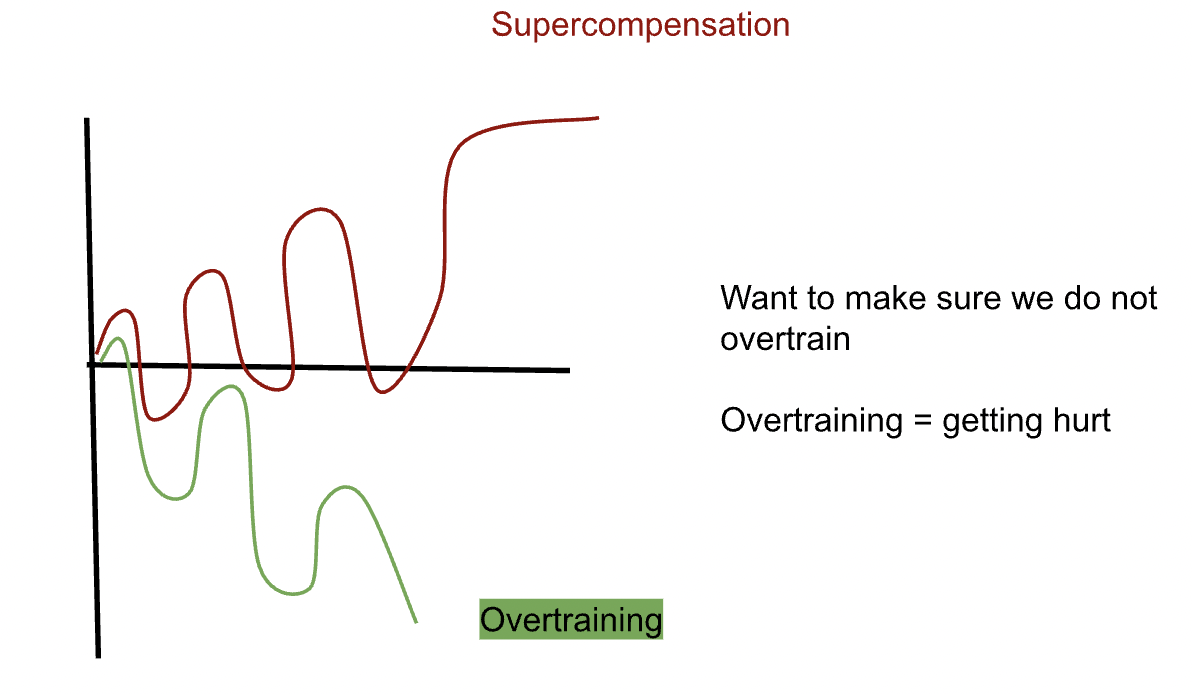
• Gradually increasing the demands placed on the body during exercise to stimulate adaptation and improvement • Must overload the muscles to see change • This can be achieved by manipulating the frequency (how often), intensity (how hard) and duration (how long) of the exercise • Overtraining vs supercompensation: want to make sure we do not overtrain, overtraining = get hurt
what is specificity
Specific to the desired outcome. Means that the exercises and training methods used should be tailored to the specific goals of the individual Ex. improving strength/flexibility
what is reversibility (3)
Refers to the principle that gains made through training can be lost if training is discontinued * Few weeks-months to lose level * Able to get back to level faster than a novice trainer
what is variety (4)
• Different exercises and training methods into a program to prevent boredom and stimulate adaptation • Can be achieved by introducing new exercises or training methods Ex. • Different lift for muscle group • Cycle endurance focus
what is periodization (4)
• the systematic planning of a training program over a period of time to optimize performance and prevent injury Has three periods: • Preseason • Competition • Offseason
difference of building strength for a beginner (2) or advanced (2)
For beginner: * Identify the 7-10 RM (maximum repetition) range and perform 1-2 sets of 6-12 exercises 2x/wk * Continue with each exercise varying sets among light (12–15 RM), medium (7–10 RM), and heavy (3–5 RM) intensity, performing 2-3 sets of each exercise. Increase to 3-5 sessions per week. For advanced: * Perform 3 sets of each exercise (usually 8–10 separate exercises) varying during both workouts and days among light (12–15 RM), medium (7–10 RM), and heavy (3–5 RM) intensities. * Exercise at least 3 sessions per week, but increase the frequency according to the person’s objectives.
difference of building endurance for a begginer (2) or advanced (1)
For beginner: * Begin with large muscle exercise (cycling, walking, jogging, rowing, etc.) at an intensity (heart rates of 115 to 130 bpm) for 15 to 25 minutes * The minimum frequency of sessions is 2 per week. During succeeding weeks, gradually increase the intensity, duration, and/or frequency of sessions. For advanced: * Engage in large muscle exercise 3 to 5 times per week for periods of 30 to 50 minutes. Vary the intensity and duration of exercise on different days. Include Fartlek techniques