Thermodynamica
No description yet. This curated deck is ready for daily study.
Card preview (24)
• What are the three factors which determine whether a chemical reaction is feasible?
• Temperature • Enthalpy - most reactions which are feasible are exothermic because the reactants want to release energy to the environment. This means the products will be lower in energy and more stable • Entropy
• What is entropy?
• This is a measure of the degree of disorder within a system • Entropy is given the symbol ‘S’ and is always a positive number • Entropy change is therefore ΔS and can be positive or negative • Units of entropy are usually given as Jk-1mol-1 though sometimes they have to be converted to kJ-1mol-1 by dividing by 1000
• What are the orders of entropy in relation to states?
• Solids have lower entropies than liquids, which are lower than gases • When a solid increases in temperature its entropy increases as the particles vibrate more • There is a bigger jump in entropy with boiling than that with melting • Gases have large entropies as they are much more disordered
• How to calculate the change in entropy of a system?

• What determines the feasibility of a reaction?
• The balance between entropy and enthalpy determines the feasibility of a reaction • This is given by the relationship: Δ G = Δ H - T Δ S Where: Δ G = Gibbs Free Energy measured in kJ mol-1 Δ H = Enthalpy Change measured in kJ mol-1 T = Temperature measured in Kelvin Δ S = Entropy Change measured in kJK-1 mol-1
• When is a reaction feasible?
• A reaction is feasible if Δ G ≤ 0
• How to calculate the temperature at which a reaction becomes feasible?
• For a reaction to be feasible Δ G must ≤ 0 • The point at which a reaction becomes feasible is when Δ G = 0 0 = Δ H - T Δ S so T Δ S = Δ H so T = Δ H / Δ S Units: T - Kelvin, Δ H , kJ mol-1, Δ S, kJ k-1 mol-1
What is the definition for the standard enthalpy of formation? ΔfH
• The enthalpy change when one mole of a substance is formed from its elements under standard conditions, with all reactants and products being in their standard states Examples:
• What is the definition for the standard enthalpy of combustion? ΔHc°.
• The enthalpy change when one mole of a substance is completely burnt in excess oxygen under standard conditions, all reactants and products being in their standard states • Substances that cannot be combusted like water, carbon dioxide and most other oxides, have zero enthalpy of combustion
• What is the definition for mean bond enthalpy ΔHbe?
• The enthalpy change when one mole of gaseous molecules each break a covalent bond to form two free radicals, averaged over a range of compounds
• What is the definition for First Ionisation Enthalpy? 1st ΔHie
• The standard enthalpy change when one mole of electrons is removed from one mole of gaseous atoms to give one mole of gaseous ions each with a single positive charge
• What is the definition for Second Ionisation Enthalpy? 2nd ΔHie
• The standard enthalpy change when one mole of electrons is removed from one mole of gaseous 1+ ions to give one mole of gaseous ions each with a 2+ charge
• What is the definition for the Standard Enthalpy of Atomisation? ΔHat
• The enthalpy change when one mole of gaseous atoms is formed from an element in its standard state
• What is the definition for First Electron Affinity? 1st ΔHea
• The standard enthalpy change when one mole of gaseous atoms is converted into a mole of gaseous ions, each with a single negative charge under standard conditions
• What is the definition for Second Electron Affinity? 2nd ΔHea
• The standard enthalpy change when one mole of electrons is added to a mole of gaseous ions each with a single negative charge, to form a mole of ions each with a two negative charge
• What is the definition for lattice formation enthalpy?
• The standard enthalpy change when one mole of solid ionic compound is formed from its gaseous ions
• What is the definition for Lattice Dissocation Enthalpy?
• The standard enthalpy change when one mole of solid ionic compound dissociates into its gaseous ions
• How can you compare lattice enthalpies for different compounds?
• Charge - compare the charge of the ions • Radius - compare the radius of the ions • Attraction - compare the attraction between the pairs of ions • More - state which ionic compound has the more exothermic/endothermic lattice enthalpy
• What does the strength of an enthalpy of lattice formation depend on?
• The sizes of the ions - the larger the ions, the less negative the enthalpies of lattice formation (i.e a weaker lattice). As the ions are larger, the charges become further apart and so have a weaker attractive force between them • The charges on the ion - The bigger the charge of the ion, the greater the attraction between the ions so the stronger the lattice enthalpy (more negative values)
• What does the Perfect Ionic model assume?
• Theoretical lattice enthalpies assume a perfect ionic model where the ions are 100% ionic and spherical and the attractions are purely electrostatic • The ions are perfect spheres (point charged) and the negative ions can’t be polarised (distorted)
• Why is the lattice enthalpy, if any different, always greater using the Born-Haber cycle?
• The Born-Haber lattice enthalpy is the real experimental value as it takes into account covalent character
• What is covalent character?
• Many ionic substances have bonding which is partly covalent • This happens when the positive ion polarises (distorts) the negative ion by attracting some of its electron density, resulting in a partial sharing of electrons • As covalent bonds are the strongest type of chemical bond, the presence of covalent character increases the strength of an ionic bond
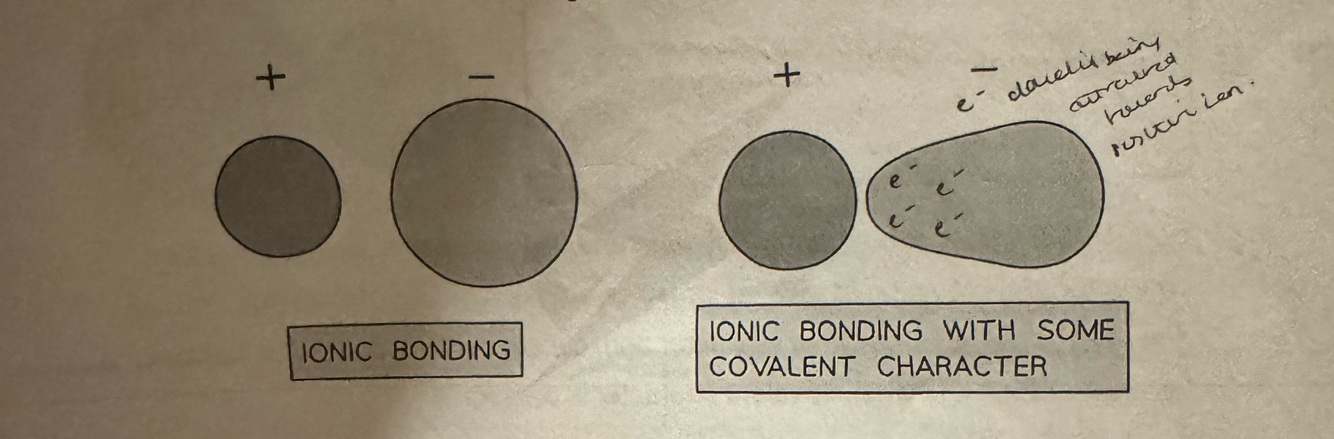
• Which ionic compounds does covalent character occur in?
• Ionic compounds with the following features: • Positive ion - small with a high charge (more polarising) • Negative ion - large with a high charge (more polarisable)
• What type of ionic compound will have very similar values for its lattice enthalpy when calculated using both the perfect ionic model and a Born-Haber cycle?
• Ionic compound where bonding is mostly purely ionic (little to not covalent character) eg FrF (small negative ion, big positive ion)