Aldehydes and Ketones I: Electrophilicity and Oxidation-Reduction
No description yet. This curated deck is ready for daily study.
Card preview (13)
carbonyl characteristic dictated by polarity of double bond; carbon has a partial positive charge making it electrophilic
reactivity of carbonyl
water adds to a carbonyl, forming a geminal diol
hydration reaction
hydration reaction

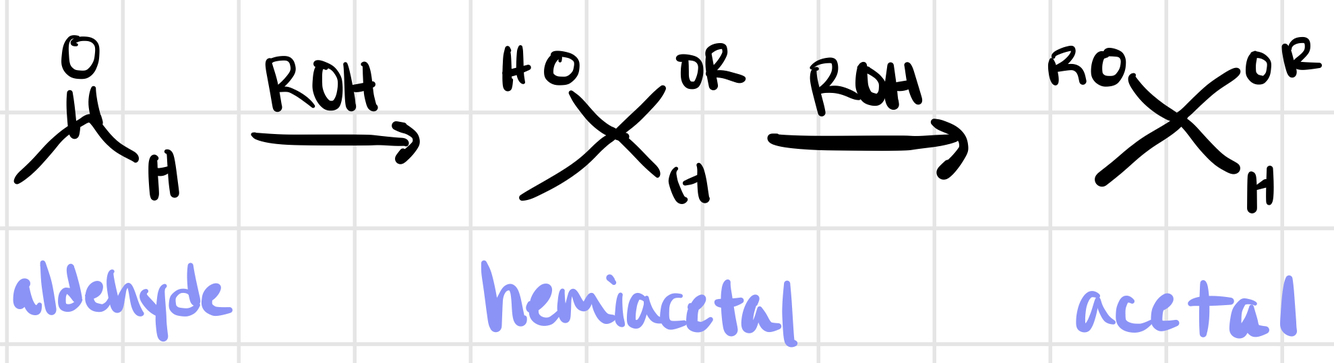
formed when one equivalent of alcohol reacts with an aldehyde/ketone, via nucleophilic addition
hemiacetal/hemiketal
hemiacetal/hemiketal formation

formed when two equivalents of alcohol react with an aldehyde/ketone, via nucleophilic substitution
acetal/ketal
acetal/ketal formation
can form when nitrogen and nitrogen derivatives react with carbonyls
imines
imine formation

can form when hydrogen cyanide reacts with carbonyls
cyanohydrins
cyanohydrin formation

_____ (aldehydes and/or ketones) can be oxidized by KMNO4, CrO3, Ag2O, or H2O2
aldehydes
____ (aldehydes and/or ketones) can be reduced by LiAlH4 or NaBH4
aldehydes and ketones