6.3 Analysis
No description yet. This curated deck is ready for daily study.
Card preview (24)
What is an Rf value?
-a comparison between how far a component has moved compared to the solvent in thin layer chromatography
Define retention time ?
-the time taken for a component to travel from the inlet to the detector in a gas chromatograph
What is the stationary phase in chromatography?
-it is fixed in place -it can be a liquid (e.g. in some gas chromatography systems where the mixture components have different attractions to each phase ) -it can also be a solid (e.g. in thin layer chromatography where the components of the mixture are absorbed by different amounts)
What is the mobile phase in chromatography ?
-moves in a definite direction -e.g. an inert gas in gas chromatography (GC) or a liquid solvent in thin layer chromatography (TLC)
How does separation occur in chromatography?
-by each chemical in a mixture having a different attraction to each phase -e.g. a chemical that is very attracted to the mobile phase but not the stationary phase will travel a long way up, but a chemical that is very attracted to the stationary phase will not travel far
What is thin layer chromatography used for ?
-to analyse organic compounds E.g. to check the purity of a sample or to determine the extent of a chemical reaction
What is the stationary phase in TLC (thin layer chromatography )?
-a thin piece of inert material -e.g. glass covered with an absorbent chemical such as aluminium oxide
What is the mobile phase in TLC (thin layer chromatography)?
-usually an organic solvent -the solvent will move in one direction vertically up the plate and develop the chromatogram
Why is a lid sometimes used in TLC?
-as the lid reduces the rate at which the solvent is absorbed and allows for a better separation
What is the equation for an Rf value?
Rf value= distance moved by component ——————————————————- distance moved by solvent
What do the number of spots on the plate in TLC tell you?
-how many chemicals make up the mixture
How can you use Rf values to identify substances in a sample when doing thin layer chromatography ?
By either: -using data tables that list Rf values for a wide variety of chemicals -or control spots can be run on the same TLC plate and a direct comparison can be made
When doing thin layer chromatography what should you be careful of when using data tables to identify a substance?
-the Rf values are different if the phases are changed (e.g if a different solvent is used) so it is important to use the correct table for the mobile and stationary phases in your experiment.
In TLC what will similar compounds have ?
-similar Rf values
What is a limitation of TLC (thin layer chromatography)?
-chemicals that a very attracted to the mobile phase may not be separated using this method
What is GC (gas chromatography ) used for?
-to separate volatile components in a mixture
Why is a gas chromatograph often connected to a mass spectrometer?
-so that the separate parts of the mixture can undergo further analysis
What is the stationary phase in gas chromatography?
-a solid or liquid coating on a coiled tube -this coating is normally a hydrocarbon with a high boiling point
What is the mobile phase in gas chromatography ?
-an unreactive carrier gas such as helium or nitrogen
What will a GC produce?
-a chart of absorption against time -where the x-axis is retention time
What can the retention time of a chemical tell you?
-this value can be compared to known values to identify the component as each component will take a different amount of time to travel through the column and reach the detector -be careful as retention times for the same chemical will be different when different phases are used so use the correct data table
What do the different parts of a GC charts show?
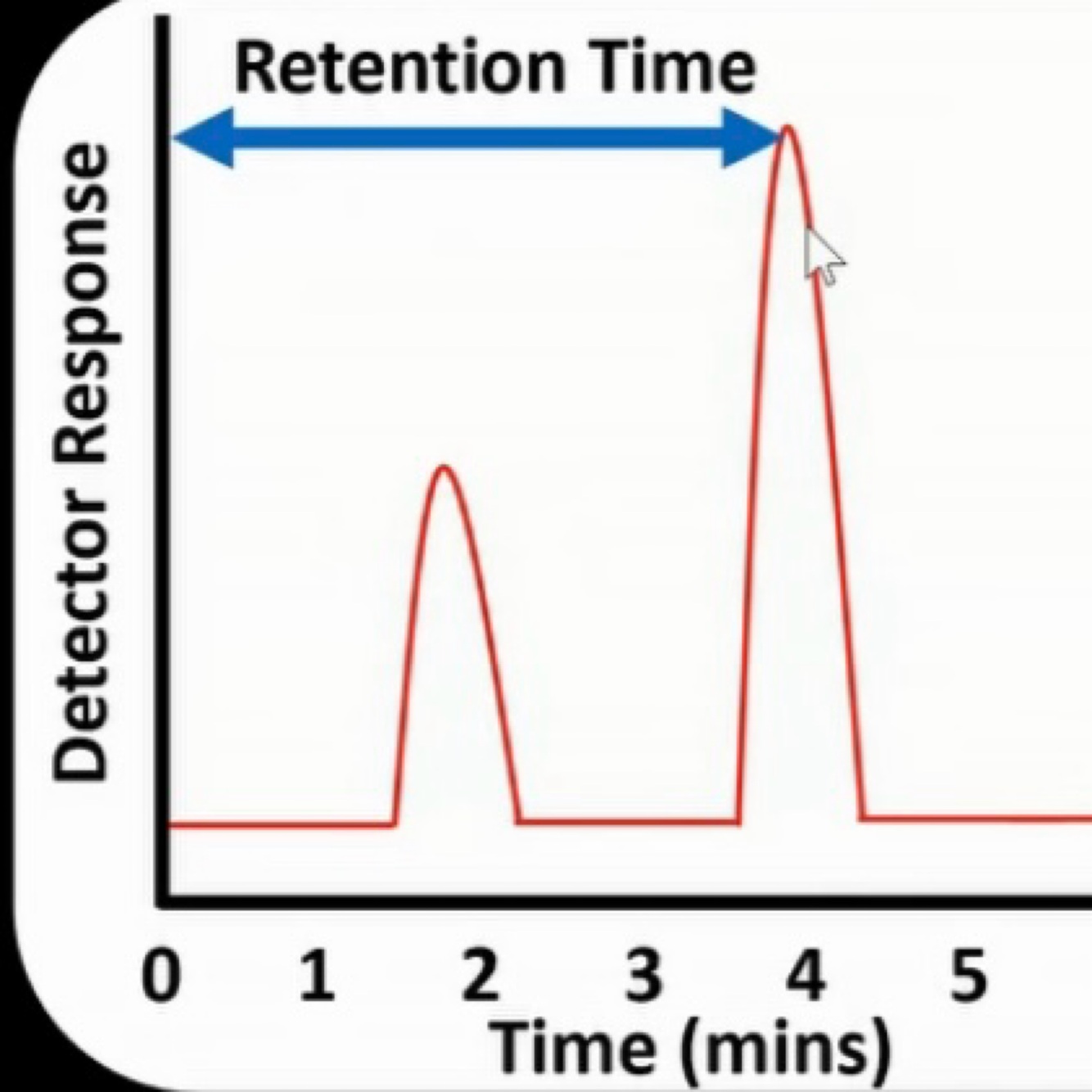
-retention time-can be compared to known values to identify the component -each peak represents a different substance each substance has a different retention time -the area under the absorption peak tells us the amount of each substance or percentage of a component in a mixture, the larger the area the more substance .
i) Which compound is present in the greatest quantity? ii) Which compounds were present in equal amounts? iii) Which compound had the strongest interaction with the stationary phase?
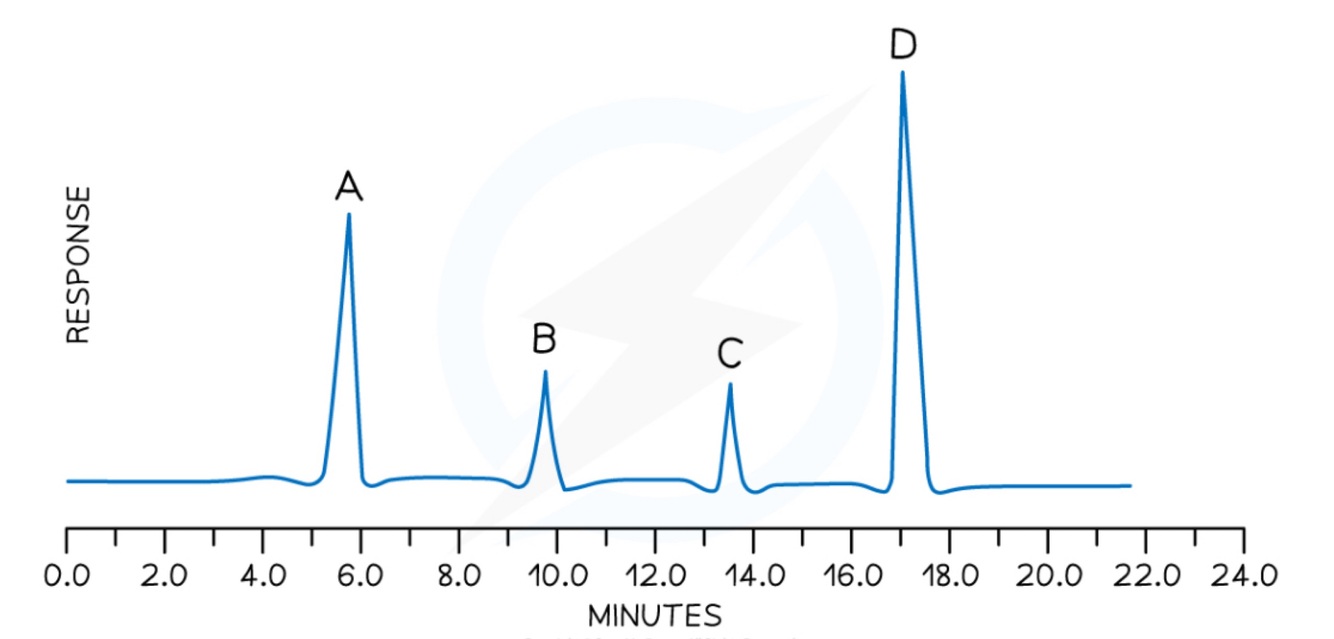
i) D (the larger the relative size of the peak, the greater the quantity of that substance present) ii) B and C (the peak sizes are equal) iii) D (the larger the retention time, the greater the interaction of that component with the stationary phase)
i) Which compound is present in the greatest quantity? ii) Which compounds were present in equal amounts? iii) Which compound had the strongest interaction with the stationary phase?
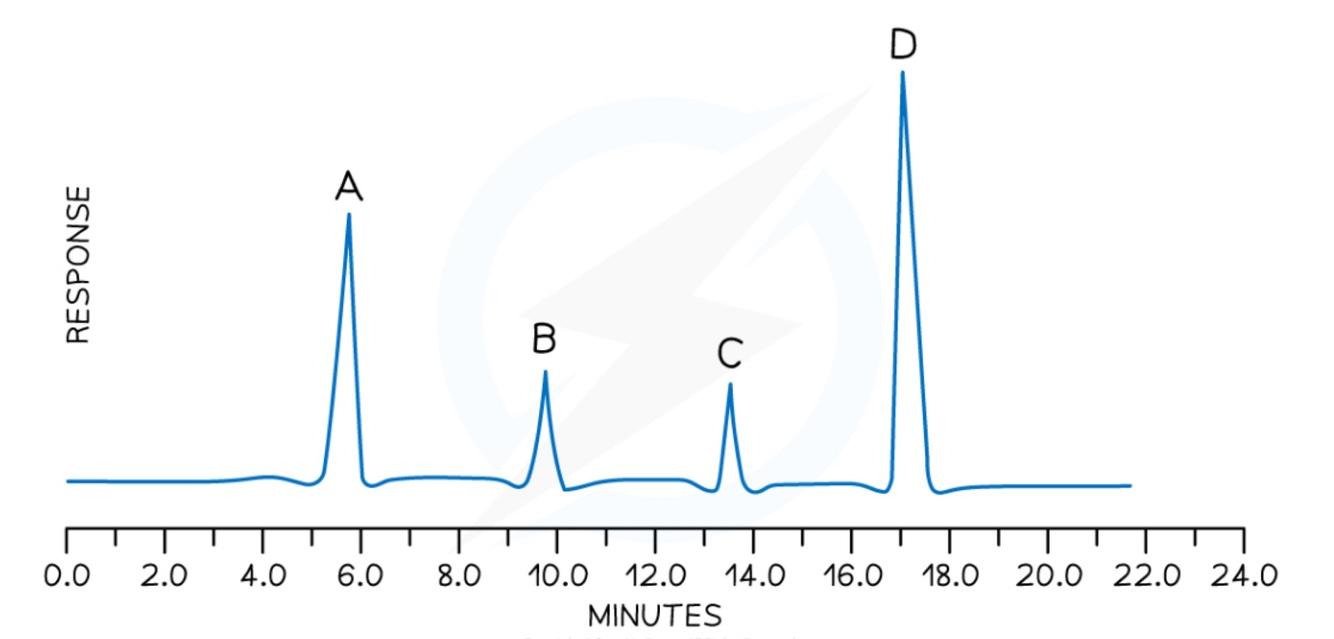
i) D (the larger the relative size of the peak, the greater the quantity of that substance present) ii) B and C (the peak sizes are equal) iii) D (the larger the retention time, the greater the interaction of that component with the stationary phase)